Table of Contents
ToggleIntroduction
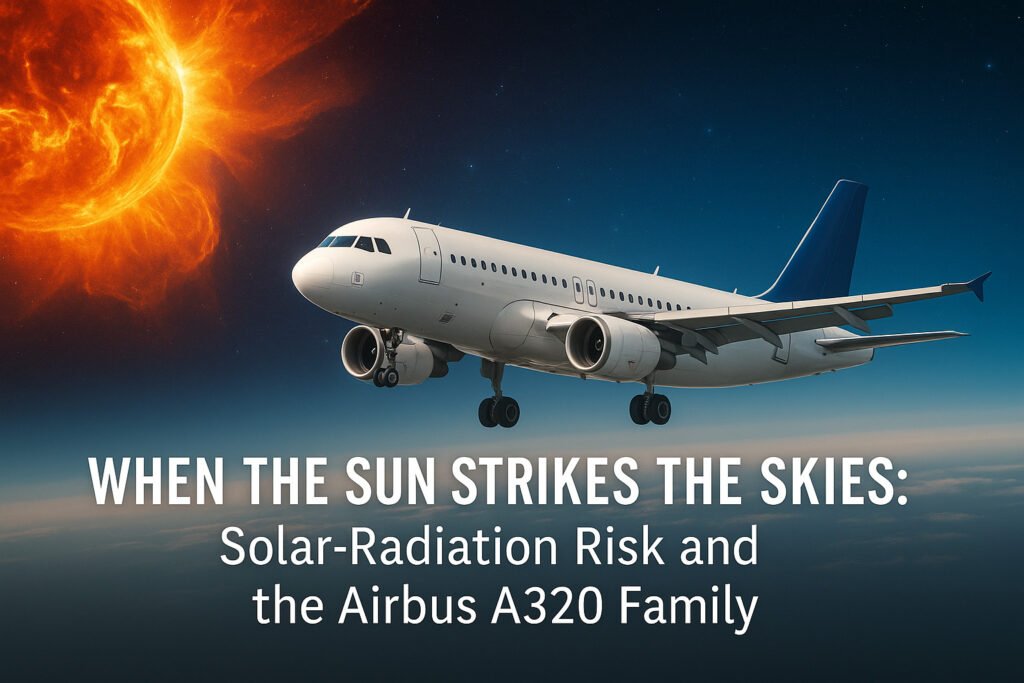
When the Sun becomes unusually active, the effects are felt far beyond satellites and power grids — they reach the commercial aircraft we fly every day. In early 2025, a solar event forced Airbus to issue an advisory for operators of the A320 family, drawing global attention to an invisible but real risk: high-energy radiation affecting onboard electronics.
This post unpacks the incident, the science, the scale of the problem, and what it means for pilots, engineers, and passengers. More importantly, it explains how this episode fits into the larger story of aviation technology evolving to face new environmental challenges.
The 2025 A320 Incident: What Triggered the Warning
In January 2025, several airlines reported unusual behaviour in the flight-control computers of A320-family aircraft. Although no accidents occurred, the anomalies were serious enough to prompt investigation.
Preliminary analysis pointed to solar radiation interacting with critical electronic components, causing momentary data errors. Airbus responded swiftly, issuing a global advisory urging operators to review specific systems, apply software patches, and follow enhanced monitoring protocols.
The incident served as a wake-up call: even highly reliable aircraft can experience disruptions when solar activity surges.
How Solar Radiation Disrupts Flight Computers
At high altitudes, aircraft fly through regions exposed to cosmic rays and solar particles. Most of the time, shielding and system redundancy keep operations safe.
However, when solar activity intensifies, charged particles can penetrate electronic hardware and trigger what engineers call single-event upsets (SEUs). These may:
- flip a “0” to a “1” in computer memory (bit-flip)
- momentarily corrupt stored data
- cause a system to reboot or switch to backup mode
- trigger false alerts or unusual instrument behaviour
Modern aircraft are designed to tolerate such events, but a cluster of them — or a hit on a vulnerable component — can require pilot intervention or system resets.
According to NASA’s studies on solar radiation and space weather, high-energy particles can disrupt electronic systems even at high altitudes. For details, please reach out to NASA Space Weather web site as under.
https://science.nasa.gov/heliophysics/space-weather/
The Scale of the Problem: How Many A320s Are Exposed?
The A320 family is the world’s largest narrow-body fleet, with more than 10,000 aircraft delivered globally. This means a significant number of jets operate daily in regions where solar exposure varies — Europe, North America, the Middle East, and Asia.
India alone operates around 700–750 A320-family aircraft, making it one of the largest A320 markets.
Not every aircraft experiences anomalies during solar events, but the sheer size of the fleet means even rare disruptions can affect multiple operators.
Where the Radiation Hits: Vulnerable Zones of the A320
High-energy particles do not affect the aircraft uniformly. The components most susceptible are those in exposed or lightly shielded areas, typically:
- flight-control computers and associated modules
- avionics bays located below the cockpit
- power-supply units and electronic boards close to the fuselage skin
- systems with older chips that lack advanced radiation-hardening
Radiation doesn’t damage the aircraft structure — it destabilises sensitive electronics that rely on microprocessors and high-density memory.
When Systems Glitch: What Happens to an Aircraft in Flight
An aircraft affected by solar radiation usually remains fully controllable. The more common outcomes are:
- temporary loss or flickering of data on cockpit displays
- autopilot disconnections
- switching of systems to alternate or direct modes
- unexpected alarms prompting a manual cross-check
- need for the crew to follow checklist procedures or reset a module
Modern redundancy ensures safety. Pilots are trained for these events, and aircraft can operate safely even with degraded modes — but the experience is disruptive and operationally significant.
The FAA has documented how radiation-induced upsets can impact avionics behaviour during flight. Please access the FAA site as under:
https://www.faa.gov/guidance
Why the A320 Is More Affected Than Other Aircraft
Other aircraft are not immune, but the A320 family uses specific generations of integrated circuits and flight-control architecture that appear more sensitive to radiation-triggered bit-flips.
Newer aircraft, such as the A350 or Boeing 787, use electronics designed with enhanced shielding, advanced chipsets, and more robust fault-tolerance against space-weather effects.
The A320neo variants are better protected than earlier models, but the legacy architecture of the platform still plays a role in vulnerability.
After the Advisory: Fixes, Updates, and Ongoing Actions
Following the 2025 advisory, Airbus and regulators took several steps:
- software patches were released for affected flight-control modules
- operators were instructed to review maintenance logs for anomalies
- new monitoring tools were deployed to detect upset events earlier
- long-term mitigation strategies, including chip upgrades, were assessed
- global aviation authorities initiated joint reviews of radiation exposure trends
The key message was clear: the aircraft remains safe, but proactive action reduces risk even further.
Airbus regularly publishes technical updates and safety enhancements that address such operational issues. Kindly go through the manual as provided in the official site of Airbus given below:
Is the A320 Safe Now? What Passengers Should Know
Yes. The A320 remains one of the safest and most reliable aircraft ever built.
The radiation-related effects do not compromise structural or mechanical safety. They are rare, momentary electronic upsets, and crews are fully trained to manage them.
Passengers should understand three points:
- Aircraft are designed with multiple layers of redundancy.
- Airbus and regulators act quickly whenever anomalies appear.
- No incident linked to radiation has ever resulted in a catastrophic outcome on the A320.
Flying remains as safe as it has ever been.
NOAA’s Space Weather Prediction Centre provides real-time alerts that airlines use to plan routes safely.
Bigger Picture: Aviation Electronics, Radiation, and Future Design
The 2025 episode highlights a broader challenge for aviation: as electronics become smaller and more powerful, they also become more sensitive to radiation.
Future aircraft may require:
- radiation-tolerant chips
- smarter redundancy management
- enhanced shielding in avionics bays
- continuous monitoring of space-weather patterns
- design philosophies that treat radiation risk as a core engineering requirement
The lesson is simple: the skies of tomorrow will demand technology that can withstand not just turbulence and weather, but the Sun itself.
ESA’s aviation space-weather programme highlights growing risks for electronic systems as solar activity increases. Please read the following:
Conclusion: Flying into a Safer Tomorrow
The Sun may strike the skies, but the aviation industry is better prepared today than ever before. The 2025 A320 advisory is not a story of danger, but of responsiveness, engineering discipline, and the constant evolution of safety.
As technology advances and solar activity becomes more unpredictable, aircraft design will keep adapting — ensuring that passengers continue to fly with confidence, no matter what the cosmos sends our way.
🔙Return to the World of Ideas: Wolverine Speaks : Discover more stories, insights, and perspectives across science, art, culture, and human experience — all under one voice.
FAQs
Solar radiation is a stream of charged particles and electromagnetic energy emitted by the Sun. At high altitudes, aircraft fly above much of the Earth’s protective atmosphere, making flyers and crew slightly more exposed. While the risk on any single flight is low, it becomes more relevant for frequent fliers and aviation professionals.
Yes. Modern aviation safety systems allow pilots and airlines to receive alerts from space-weather agencies during solar storms. These warnings help in making real-time decisions—such as adjusting flight paths or altitude—particularly on polar or high-latitude routes.
No aircraft is uniquely “vulnerable”, but the A320 family—being one of the most widely used short- to medium-haul fleets—often flies at altitudes where exposure is naturally higher. The focus of safety protocols is not vulnerability, but awareness and management of cumulative exposure.
Extreme solar events, though rare, can disturb satellite signals and high-frequency communications. The A320 is designed with multiple redundancies, shielding, and alternate navigation options to ensure safe operations even during heightened solar activity.
Not at all. Aviation regulators, airlines, and scientific agencies monitor space weather round the clock. When necessary, flights may reroute or adjust altitude—steps usually invisible to travellers. The risk to individual passengers remains extremely low.
There is a small increase in cumulative exposure for those who fly regularly as part of their job. Aviation authorities recognise this and classify aircrew exposure as an occupational hazard. Airlines monitor crew rosters accordingly. For occasional travellers, the risk is negligible.
Accordion Content
Solar radiation comes from the Sun, while cosmic radiation originates from deep space—including exploding stars and distant galaxies. Both contribute to the radiation levels encountered at cruising altitude, and both are monitored by aviation safety bodies.
It’s rare, but not impossible. Severe geomagnetic storms may lead to temporary suspension of polar flights or route adjustments. For aircraft like the A320, which typically operates on low- to mid-latitude routes, cancellations are unusual.
As aircraft rely increasingly on satellite navigation, data links, and digital systems, understanding the behaviour of the Sun becomes essential. Space weather is now considered an operational parameter—just like wind, temperature, or turbulence.
The A320’s engineering includes structural shielding, multiple layers of avionics protection, and operational procedures that account for solar activity. Airlines also manage flying hours for crew to ensure that cumulative exposure remains within safe, regulated limits.