
Introduction: Beyond Headlines Lies the Real Story
Every day, markets move. Headlines flash—indices surge, inflation cools, GDP expands. But beneath this constant noise lies a deeper, more meaningful narrative: the interplay between markets and the broader economy.
Understanding this relationship is not just for economists. It is essential for students seeking clarity, investors searching for opportunity, and policymakers shaping the future. Markets are not random—they are signals. And when read correctly, they reveal where the economy is headed.
The Economy: The Foundation of All Market Activity
At its core, the economy reflects the production, consumption, and distribution of goods and services. Its health is measured through key indicators such as:
- GDP Growth – the pace at which the economy expands
- Inflation – the stability of prices
- Employment Data – the strength of the labour market
- Interest Rates – the cost of money
For students, these are foundational concepts. For investors, they are decision-making tools. For policymakers, they are levers of control.
A rising GDP with moderate inflation typically signals a healthy, expanding economy—often translating into stronger corporate earnings and buoyant markets.
“…driven largely by the impact of policy decisions and regulatory changes…”
Markets: The Forward-Looking Barometer
Financial markets—especially equity markets—do not wait for confirmation. They anticipate.
Markets are often described as “forward-looking discounting mechanisms.” This means they price in future expectations well before they materialise in economic data.
For instance:
- Markets may rally even when current economic data looks weak—if recovery is expected.
- Conversely, markets may fall during strong economic phases—if slowdown risks emerge.
This divergence often confuses new learners but creates opportunities for informed investors.
“…requiring disciplined investment strategies in changing markets…”
Economic Cycles: The Rhythm of Growth and Slowdown


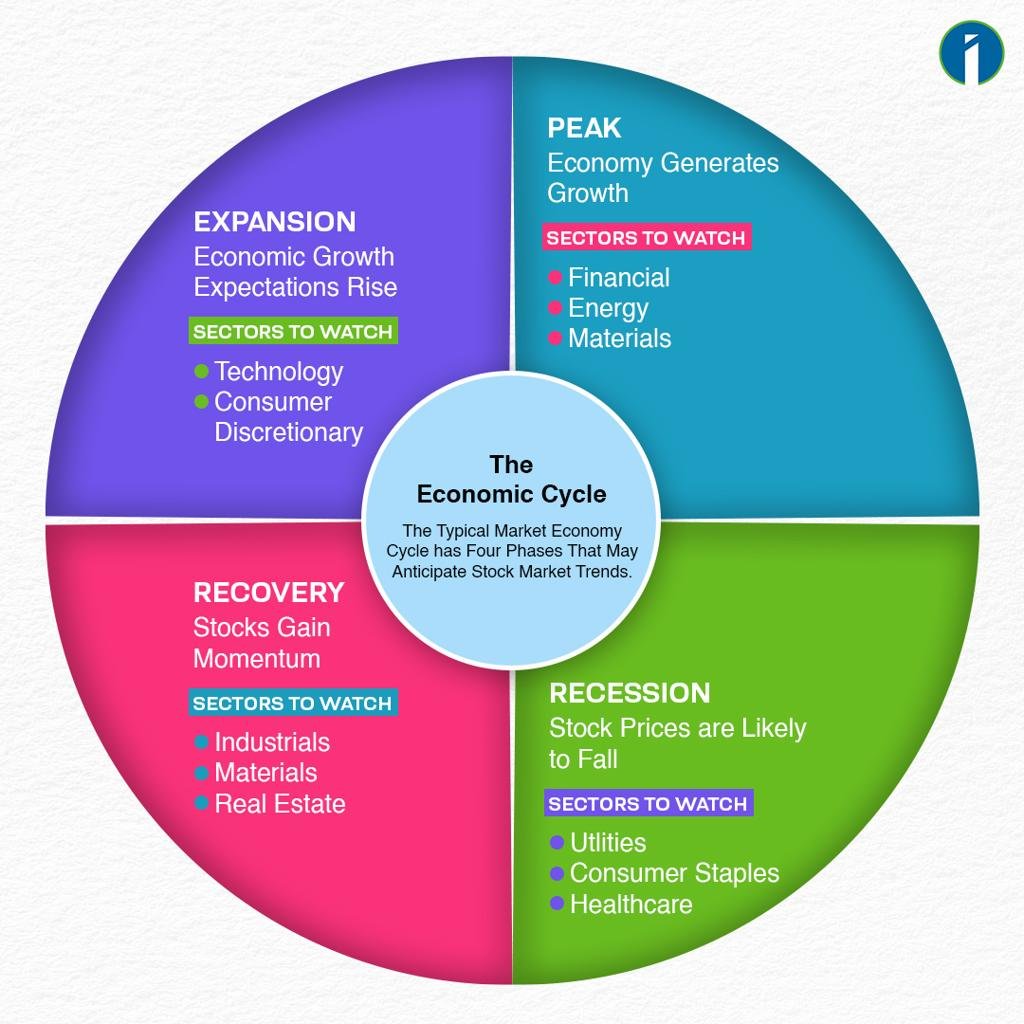
Economies move in cycles—predictable in pattern, uncertain in timing. The four broad phases are:
- Expansion – Growth accelerates, jobs increase, markets rise
- Peak – Growth stabilises, inflation pressures build
- Slowdown/Recession – Demand weakens, markets correct
- Recovery – Activity revives, confidence returns
For students, this is theory. For investors, this is timing. For policymakers, this is responsibility.
Recognising where we are in the cycle can help:
- Investors adjust asset allocation
- Businesses plan expansion or caution
- Governments calibrate fiscal and monetary policy.
“…reflected in corporate performance and strategic decisions…”
Key Signals Every Stakeholder Must Track


To “read” the economy effectively, one must track a combination of signals:
1. Interest Rates & Central Bank Policy
Interest rates influence borrowing, spending, and investment.
Lower rates stimulate growth; higher rates control inflation but may slow the economy.
2. Inflation Trends
Moderate inflation indicates demand strength.
High inflation erodes purchasing power and triggers policy tightening.
3. Corporate Earnings
Markets ultimately follow earnings. Strong, sustained earnings growth supports long-term market expansion.
4. Liquidity & Global Flows
Capital flows across borders impact emerging markets like India.
Global liquidity conditions often drive market rallies or corrections.
5. Geopolitical Developments
Events such as conflicts, trade tensions, or elections can reshape economic expectations overnight.
India’s Growth Story: Opportunity Amid Complexity
India stands at a unique intersection of demographics, digital transformation, and policy reform.
Key structural drivers include:
- A young and aspirational population
- Rapid digital adoption (fintech, UPI ecosystem)
- Infrastructure push and manufacturing incentives
- Expanding middle class and consumption base
For investors, India represents a long-term growth story, though not without volatility.
For policymakers, the challenge lies in balancing growth with stability and inclusiveness.
“…fueled by the rise of startups and innovation-led growth…”
Investor Perspective: Turning Signals into Strategy
Understanding markets and the economy is not about predicting exact outcomes—it is about probability and preparedness.
Smart investors:
- Avoid reacting to short-term noise
- Focus on long-term trends and cycles
- Diversify across asset classes
- Align investments with economic phases
Periods of uncertainty often create the best opportunities, as valuations become attractive and future growth gets underpriced.
“…adapting to cycles through well-planned investment strategies…”
For Students: Building Economic Literacy
For students, this subject is more than academic—it is practical knowledge for life.
Grasping how markets and economies interact helps in:
- Career choices in finance, policy, and business
- Personal financial planning
- Developing analytical thinking
The earlier one learns to interpret these signals, the better prepared one is for an increasingly complex world.
For Policymakers: Balancing Growth with Stability
Policymakers operate in a delicate space.
Too much stimulus can fuel inflation; too little can stall growth.
The goal is to:
- Sustain economic expansion
- Maintain price stability
- Encourage investment and employment
- Build resilience against global shocks
Effective policy decisions often determine whether an economy merely grows—or truly prospers.
Conclusion: Learning to Read the Signals
Markets and the economy are deeply interconnected—each influencing and reflecting the other.
To the untrained eye, movements may seem random. But to those who study the signals, patterns emerge.
- Students gain understanding
- Investors find opportunity
- Policymakers shape outcomes
In a world driven by uncertainty, the ability to read these signals is not just an advantage—it is a necessity.
“…making it essential to understand the broader economic and policy environment…”