
Table of Contents
ToggleIntroduction
High jump is one of athletics’ most fascinating events, where success depends on a unique combination of speed, timing, technique and courage. Unlike many sports where physical strength alone determines success, high jump requires athletes to convert momentum into height through precision and body control.
Over the years, the sport has witnessed different techniques and styles. However, few athletes have changed the course of a sport as dramatically as Dick Fosbury. Through an unconventional idea and the courage to challenge established methods, he transformed high jumping forever.
Explore Sporting Legends – Stories of Excellence and Inspiration
Traditional Styles of High Jump
Before Dick Fosbury appeared on the world stage, athletes generally relied on techniques that had evolved gradually over decades.
Some of the commonly used styles included:
Scissors Technique
Athletes crossed the bar in a sitting motion with legs passing one after another.
Western Roll
Jumpers approached at an angle and crossed the bar sideways.
Straddle Technique
This became the dominant style before Fosbury. Athletes crossed the bar face down with the body parallel to the bar.
For many years, the straddle technique was considered the most efficient method available.
About Dick Fosbury
Dick Fosbury was born in 1947 in Portland, Oregon, United States. As a young athlete, he struggled with traditional high-jump techniques and found it difficult to compete effectively. Rather than giving up, he began experimenting with an entirely different approach.
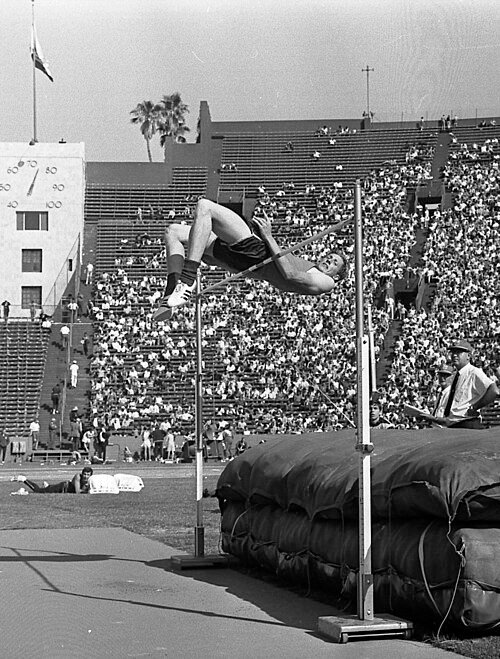
Instead of crossing the bar face down, he attempted something unusual — approaching the bar diagonally, turning his body and crossing it backwards with his head and shoulders leading the movement.
Initially, coaches and observers considered his technique strange and unconventional.
How the Fosbury Flop Changed High Jump
The new technique later became famous as the Fosbury Flop. The method involved:
– a curved approach run
– explosive take-off
– back-first clearance over the bar
– landing on the shoulders and back
The introduction of softer landing mats during that period also made the technique safer and practical. The Fosbury Flop offered important advantages:
– lower centre of gravity during clearance
– improved efficiency in converting speed into height
– greater potential for higher jumps
Within a few years, athletes worldwide began adopting this technique. Today, nearly all elite high jumpers use some variation of the Fosbury Flop.
Achievements and Records
Dick Fosbury’s most famous achievement came at the 1968 Summer Olympics. He:
– won the Olympic gold medal
– cleared 2.24 metres
– set an Olympic record at that time
– captured global attention for his revolutionary technique
More importantly, his influence extended far beyond medals.
Current High Jump Records
The sport continued evolving after Fosbury’s innovation.
Current men’s world record: Javier Sotomayor 2.45 metres (1993)
The current men’s world high jump record of 2.45 metres is held by Cuban athlete Javier Sotomayor. He achieved this remarkable feat in Salamanca, Spain, in 1993.
Current women’s world record: Stefka Kostadinova : 2.09 metres (1987)
The women’s high jump record of 2.09 metres was achieved by Bulgarian athlete Stefka Kostadinova during the 1987 World Championships in Rome, a remarkable performance that remained unbeaten for nearly 37 years.
Even today, athletes attempting these heights continue using variations of the Fosbury Flop.
Conclusion
Sport occasionally changes because someone dares to question accepted wisdom. Dick Fosbury did not simply win medals; he transformed an entire athletic discipline.
His story reminds us that innovation often begins with individuals willing to think differently and persist despite scepticism.
More than five decades later, the Fosbury Flop remains one of the most remarkable examples of how one idea can permanently alter the future of sport.
Useful Resources
Frequently Asked Questions(FAQs)
Dick Fosbury was an American high jumper who introduced the revolutionary Fosbury Flop technique.
The Fosbury Flop transformed high jumping and remains the dominant technique used by athletes today.
No. High jump existed long before Fosbury, but he changed the way athletes performed it
Athletes commonly used techniques such as the scissors, western roll and straddle style.
The 1968 Mexico Olympics brought worldwide attention to Dick Fosbury and his innovative technique.
The men’s world record is 2.45 metres, set by Javier Sotomayor.
India’s men’s high jump national record is held by Tejaswin Shankar, from National Capital Territory of Delhi, with a jump of 2.29 metres, a mark that established him as one of India’s leading athletes in the event.
For women, the Indian national record is held by Sahana Kumari, from Karnataka, who cleared 1.92 metres. Her achievement remains an important milestone in Indian women’s athletics.
India has witnessed steady progress in athletics over the years, and newer generations of high jumpers continue striving to raise these benchmarks further.