
Table of Contents
ToggleIntroduction
Few places in the world possess a spiritual aura quite like the Himalayas. Towering peaks, snow-fed rivers and ancient forests have inspired countless myths, religious traditions and cultural practices for thousands of years. To millions, these mountains are not merely a geographical feature but the abode of the divine.
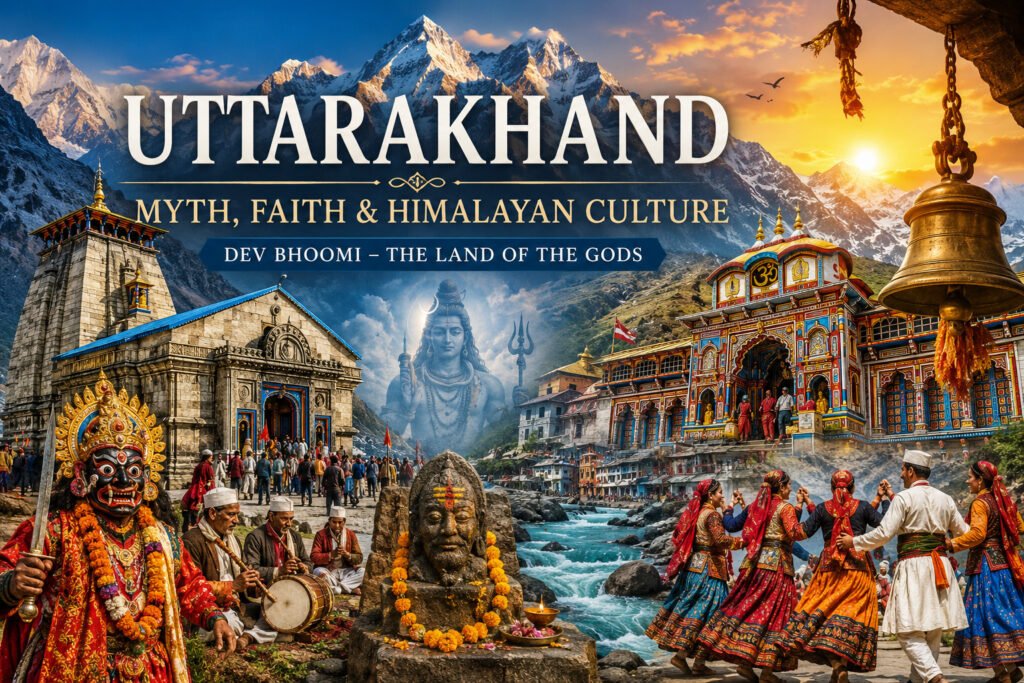
At the heart of this sacred landscape lies Uttarakhand, affectionately known as Dev Bhoomi—the Land of the Gods. It is here that mythology, history and everyday life merge seamlessly. The rivers Ganga and Yamuna begin their earthly journey from these mountains. The Char Dham pilgrimage attracts devotees from across the globe. Ancient temples stand alongside modest village shrines, while local deities continue to command as much reverence as those described in the Puranas.
Yet Uttarakhand’s true richness lies beyond its religious significance. Its people have preserved an extraordinary cultural heritage that reflects resilience, simplicity and harmony with nature. Folk songs celebrate changing seasons, traditional dances narrate heroic legends, village festivals strengthen community bonds, and age-old customs continue to shape daily life.
For me, this is not merely a subject of research. It is deeply personal. My ancestral roots lie in the hills of Kumaon, and throughout my life I have remained connected to the traditions, values and spiritual ethos that define this remarkable land. This section therefore combines historical research, cultural exploration and personal reflection—offering readers an opportunity to discover Uttarakhand from both the head and the heart.
Whether you are a traveller planning your first visit, a student of Indian civilisation, someone tracing family roots, or simply curious about Himalayan culture, these articles aim to provide a meaningful journey into one of India’s most fascinating regions.
The Cultural Heritage of Uttarakhand
The culture of Uttarakhand is the product of centuries of interaction between geography, spirituality and human resilience. Life in the Himalayas has never been easy. Steep mountains, harsh winters and remote villages demanded cooperation, self-reliance and respect for nature. These conditions gradually shaped a society whose traditions continue to thrive despite rapid modernisation.
The cultural identity of Uttarakhand has been shaped by three distinctive Himalayan regions—Kumaon, Garhwal and Jaunsar-Bawar. While Kumaon and Garhwal together constitute the state’s two historic administrative divisions, Jaunsar-Bawar, situated in the western Himalayas, represents a unique cultural region with its own traditions, dialects, folklore and social customs. Together, these regions preserve an extraordinary mosaic of beliefs, festivals, music, architecture and ways of life that have evolved over centuries while remaining deeply connected to nature and spirituality.
Generations have preserved their heritage through oral storytelling, folk music, temple rituals and seasonal festivals.
Music remains central to Himalayan life. Traditional forms such as Jhora, Chanchari, Chhapeli and Pandav Nritya are performed during festivals, weddings and community gatherings. They are more than entertainment—they are living records of history, mythology and collective memory.
The region is equally renowned for its craftsmanship. Intricate wood carving, temple architecture, woollen weaving, copper utensils and handcrafted artefacts reflect the creativity and resourcefulness of mountain communities.
Food too mirrors the environment. Nutritious dishes prepared from locally grown grains, pulses and herbs demonstrate how generations adapted to life at high altitudes while preserving remarkable culinary traditions.
Above all, Uttarakhand nurtures an intimate relationship with nature. Mountains, forests, rivers and even ancient trees are treated with reverence. Environmental conservation here is often rooted not in legislation but in faith and tradition.
Faith Beyond Religion
One of Uttarakhand’s most remarkable characteristics is that spirituality extends far beyond organised religion.
Every village possesses its own guardian deity. Families maintain sacred rituals that have continued for generations. Local fairs are both religious observances and social gatherings. Seasonal agricultural cycles begin with prayers. Homes celebrate festivals with customs unique to each region.
This living spirituality fosters an enduring sense of belonging. It reminds people that faith is not confined to temples but exists in gratitude towards nature, respect for ancestors and compassion for fellow human beings.
Many traditions also demonstrate remarkable inclusiveness. Local folklore often blends mythology with historical events, allowing successive generations to preserve both memory and identity.
The Living Himalayas
Visitors often arrive in Uttarakhand seeking famous pilgrimage destinations such as Kedarnath, Badrinath, Gangotri and Yamunotri. While these sacred sites deserve their worldwide reputation, they represent only one dimension of the Himalayan experience.
The true spirit of Uttarakhand is found equally in its villages.
It lives in morning prayers echoing through mountain valleys.
It lives in elderly storytellers recounting legends beside winter fires.
It lives in women singing traditional songs while working in terraced fields.
It lives in village temples where festivals unite entire communities regardless of social status.
It lives in the hospitality extended to every traveller who enters a mountain home.
This is a culture that continues to evolve while remaining firmly rooted in its traditions.
What You Will Discover in This Series
This collection brings together articles exploring different dimensions of Uttarakhand’s civilisation.
The Cultural Tapestry of Uttarakhand :An introduction to the traditions, customs, languages, music, dance, cuisine, festivals and artistic heritage that collectively define the state’s cultural identity.
My Connection with Dev Bhoomi: A personal narrative describing how family roots in Kumaon shaped my lifelong relationship with Uttarakhand and influenced my understanding of faith, heritage and belonging.
Why is Uttarakhand Called Dev Bhoomi?: An exploration of the myths, scriptures, pilgrimage traditions and historical events that earned Uttarakhand its revered title as the Land of the Gods.
The Birth of Uttarakhand: A Journey to Statehood : The inspiring story of the peaceful people’s movement that culminated in the formation of India’s twenty-seventh state in November 2000, preserving both regional identity and Himalayan aspirations.
The Deep Roots of Worship in Everyday Life: A closer look at how spirituality permeates every aspect of daily life—from household rituals and harvest festivals to reverence for rivers, forests and ancestral traditions.
Pilgrimage Traditions of the Himalayas: A comprehensive exploration of the Char Dham, Panch Kedar, Panch Badri, Hemkund Sahib, sacred rivers and lesser-known pilgrimage routes that continue to attract millions.
Culture Beyond Temples: The Living Heritage of Uttarakhand: Discover village life, folk music, dances, traditional attire, cuisine, fairs, architecture and customs that preserve the soul of Himalayan civilisation.
Bhairav Devta: The Fierce Guardian of the Himalayas: An exploration of one of Uttarakhand’s most revered guardian deities, whose worship symbolises courage, justice, protection and unwavering devotion.
Joshis of Danya: A Kumaoni Legacy Rooted in the Hills: A deeply personal account tracing the history, traditions and contributions of the Joshi family from Danya in Kumaon, illustrating how individual family histories enrich the broader story of Uttarakhand’s cultural heritage.
Why This Series Matters
The pace of modern life has transformed even the remotest Himalayan villages. Roads, technology and migration have brought unprecedented opportunities, but they have also accelerated the disappearance of oral traditions, dialects, folk customs and ancestral knowledge.
Documenting these traditions is therefore more than an academic exercise—it is an act of cultural preservation.
Every forgotten folk song, abandoned temple, disappearing dialect or neglected family history represents a fragment of civilisation that deserves to be remembered.
Through this series, WolverineSpeaks hopes to contribute, in a small but meaningful way, to preserving the stories that have shaped generations of Himalayan communities.
Conclusion
Uttarakhand is not simply a destination on a map; it is a civilisation shaped by mountains, rivers, faith and the enduring spirit of its people. Here, mythology is remembered not only in ancient scriptures but also in everyday conversations. Festivals celebrate both divine grace and community life. Nature is revered as a sacred companion rather than a resource to be exploited.
This series is an invitation to journey beyond the familiar pilgrimage routes and discover the living culture of the Himalayas—its legends, traditions, people and enduring values.
At WolverineSpeaks, we believe that understanding a region begins with understanding its stories. The articles in this collection seek to preserve those stories, celebrate the resilience of Himalayan communities and inspire future generations to cherish one of India’s richest cultural legacies.
Because the Himalayas are not merely mountains—they are a living archive of faith, history, culture and human resilience.
Continue Exploring
👉 Explore the wider world of Indian arts, traditions and cultural heritage. 👉 Discover the rich cultural tapestry of Uttarakhand through its traditions, festivals, music, language and way of life. (The Cultural Tapestry of Uttarakhand)
👉 Personal journeys and ancestral memories often deepen our connection with the Himalayas. (My Connection with Dev Bhoomi)
👉 Discover why Uttarakhand is revered as Dev Bhoomi—the Land of the Gods. (Why is Uttarakhand Called Dev Bhoomi?)
👉 Understand how Uttarakhand’s long struggle culminated in the creation of India’s 27th state. (The Birth of Uttarakhand: A Journey to Statehood)
👉 Explore how faith shapes everyday life across the villages and valleys of the Himalayas. (The Deep Roots of Worship in Everyday Life)
👉 Follow the sacred pilgrimage traditions that have inspired devotees for centuries. (Pilgrimage Traditions of the Himalayas)
👉 Discover the living heritage of Uttarakhand beyond its famous temples. (Culture Beyond Temples: The Living Heritage of Uttarakhand)
👉 Meet Bhairav Devta—the fearless guardian worshipped across the Himalayan region. (Bhairav Devta: The Fierce Guardian of the Himalayas)
👉 Trace the history of the Joshis of Danya and one family’s enduring Kumaoni legacy. (Joshis of Danya: A Kumaoni Legacy Rooted in the Hills)
Frequently Asked Questions(FAQs)
Uttarakhand is known as Dev Bhoomi, or the Land of the Gods, because of its sacred temples, the origins of the Ganga and Yamuna, ancient pilgrimage routes, revered sages and enduring spiritual traditions. Its unique blend of mythology, faith and Himalayan culture has made it one of India’s holiest regions for centuries.
The major cultural regions are Kumaon, Garhwal, and Jaunsar-Bawar, each with distinct traditions, languages, folklore, and spiritual practices.
The Char Dham Yatra is one of Hinduism’s most sacred pilgrimages, covering the holy shrines of Badrinath, Kedarnath, Gangotri, and Yamunotri in Uttarakhand.
Bhairav Devta is revered as a powerful guardian deity and fierce manifestation of Lord Shiva, worshipped across Uttarakhand for protection and spiritual balance.
Uttarakhand’s spirituality is deeply integrated into daily life through village deities, local rituals, sacred geography, folk traditions, and reverence for nature.
Festivals, Jagars, folk dances, and local fairs preserve cultural identity, spiritual traditions, oral history, and community bonds across generations.
Uttarakhand became the 27th state of India on 9 November 2000 after being carved out of Uttar Pradesh.
Uttarakhand is home to the Char Dham, Panch Kedar, Panch Badri, the sources of the Ganga and Yamuna, and hundreds of ancient temples. Its sacred geography and deep-rooted traditions have made it one of India’s foremost centres of pilgrimage.
Himalayan culture reflects a close relationship between people, nature and spirituality. It combines mythology, local traditions, folk music, festivals, village customs and environmental stewardship into a way of life that has endured for centuries.
Hindi is the official language of Uttarakhand, while Kumaoni, Garhwali and Jaunsari are widely recognised as the state’s principal regional languages, though they are often classified as dialects of Hindi in official records.
Apart from the Char Dham shrines of Badrinath, Kedarnath, Gangotri and Yamunotri, Uttarakhand is home to Hemkund Sahib, Jageshwar, Baijnath, Neelkanth Mahadev, Purnagiri and numerous ancient temples dedicated to local deities.
In Uttarakhand, mountains, rivers, forests and even ancient trees are regarded as sacred. This deep respect for nature has shaped local customs, religious practices and environmental conservation for generations.
Local deities are central to village life across Uttarakhand. They are believed to protect communities, guide important decisions and preserve customs through festivals, rituals and oral traditions that have been passed down over generations.
Jaunsar-Bawar is one of Uttarakhand’s most distinctive cultural regions, known for its unique customs, Jaunsari language, traditional architecture and the worship of Mahasu Devta. Its heritage enriches the cultural diversity of the state.
Jagar is a traditional ritual involving devotional singing and music to invoke local deities and ancestral spirits. It is one of Uttarakhand’s most distinctive forms of living spiritual and cultural heritage.
Beyond its famous pilgrimage sites, Uttarakhand offers traditional villages, folk festivals, local cuisine, ancient temples, wildlife, trekking routes and living cultural traditions that reveal the true spirit of the Himalayas.
Jim Corbett National Park, established in 1936 as Hailey National Park, is India’s oldest national park. Located in Uttarakhand, it is renowned for its Bengal tigers, Asian elephants, diverse birdlife and rich biodiversity. It also played a pioneering role in Project Tiger, launched in 1973.
Uttarakhand shares international borders with Nepal to the east and the Tibet Autonomous Region of China to the north. These frontiers have historically influenced trade, pilgrimage, culture and strategic importance in the Himalayan region.
The Himalayas shape every aspect of life in Uttarakhand—from its rivers, forests and wildlife to its mythology, pilgrimage traditions and village customs. They are revered not only as mountains but also as sacred landscapes central to India’s spiritual heritage.
Uttarakhand is the source of many of northern India’s most sacred rivers, including the Ganga and Yamuna. The Ganga begins with the Bhagirathi at Gaumukh, while the Yamuna originates from the Yamunotri glacier. These rivers are central to India’s spiritual and cultural identity.
Fed by Himalayan glaciers, Uttarakhand is the birthplace of several perennial rivers that sustain millions of people across northern India. These rivers are revered in Hindu tradition and have shaped the state’s history, agriculture and pilgrimage routes.
Beyond its sacred sites, Uttarakhand is known for its remarkable biodiversity. The state is home to Bengal tigers, Asian elephants, leopards, musk deer, Himalayan black bears, snow leopards in higher altitudes and over 600 species of birds, protected within its national parks and wildlife sanctuaries.
Situated in the central Himalayas, Uttarakhand shares international borders with Nepal and China. Its mountain passes, border districts and strategic infrastructure make it important not only for India’s security but also for pilgrimage, tourism and trans-Himalayan heritage.