
Table of Contents
ToggleExploring the Human Questions Behind Scientific Progress
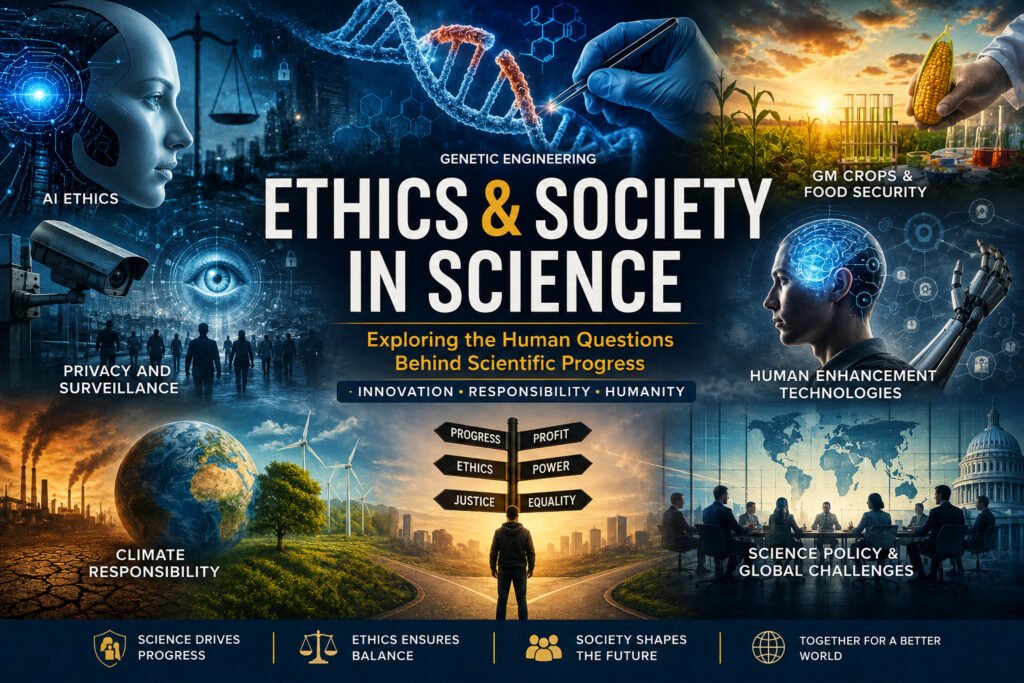
Science and technology have transformed human civilization in extraordinary ways. From artificial intelligence and genetic engineering to biotechnology, climate science, and advanced surveillance systems, modern innovation continues to reshape how humanity lives, works, communicates, and survives.
Yet every scientific breakthrough also raises deeper questions:
- What should humanity do — not merely what it can do?
- How do we balance innovation with ethics?
- Can technology advance faster than society’s ability to regulate it responsibly?
- Who decides the limits of scientific intervention in human life and nature?
Ethics & Society in Science explores these critical questions at the intersection of science, technology, policy, morality, and human responsibility.
This section examines how scientific progress influences society, privacy, healthcare, food systems, environmental sustainability, governance, and the future of humanity itself. The goal is not simply to celebrate innovation, but to thoughtfully explore its consequences, responsibilities, and long-term impact on civilization.
👉 Explore the larger world of science, discovery, and curiosity.
This section explores:
AI Ethics
Artificial intelligence is rapidly transforming industries, economies, healthcare, warfare, education, and daily life. Yet the rise of intelligent systems also raises serious ethical concerns.
This section explores:
- AI decision-making,
- algorithmic bias,
- automation and employment,
- AI in warfare,
- misinformation,
- machine autonomy,
- and the future relationship between humans and intelligent machines.
As AI grows more powerful, society must confront difficult questions about accountability, fairness, transparency, and human control.
👉 Future technologies are rapidly reshaping society, work, and human civilization.
Genetic Engineering
Modern biotechnology now allows scientists to alter genes, edit DNA, and potentially reshape life itself.
This section examines:
- CRISPR gene editing,
- designer genetics,
- inherited diseases,
- ethical boundaries in human modification,
- and the social implications of altering biological systems.
The ability to rewrite genetic code may become one of humanity’s most powerful — and controversial — scientific capabilities.
👉 Modern medical science is increasingly transforming human health, survival, and longevity.
GM Crops & Food Security
As global populations rise and climate pressures intensify, genetically modified crops are increasingly viewed as tools for food security and agricultural resilience.
This section explores:
- genetically modified organisms (GMOs),
- sustainable agriculture,
- food production challenges,
- environmental concerns,
- and the debates surrounding biotechnology in farming.
Balancing innovation, public trust, environmental protection, and global nutrition remains a major global challenge.
Privacy and Surveillance
Digital technologies now collect enormous amounts of personal data through smartphones, cameras, online platforms, AI systems, and connected devices.
This section examines:
- digital privacy,
- mass surveillance,
- facial recognition,
- cybersecurity,
- data ownership,
- and the growing tension between security, convenience, and personal freedom.
As technology becomes more deeply integrated into society, protecting human privacy may become one of the defining ethical issues of the modern era.
Human Enhancement Technologies
Science is increasingly moving beyond healing the human body toward enhancing human capabilities themselves.
This section explores:
- brain-computer interfaces,
- cognitive enhancement,
- cybernetic integration,
- artificial organs,
- longevity technologies,
- and the future possibility of technologically enhanced humans.
These developments challenge traditional ideas about identity, equality, and what it means to remain human.
👉 Some technological possibilities once considered speculative are rapidly becoming reality.
Climate Responsibility
Climate change represents not only an environmental challenge, but also an ethical and societal one.
This section examines:
- climate responsibility,
- sustainability,
- renewable energy transitions,
- environmental policy,
- climate justice,
- and humanity’s role in protecting planetary systems.
Scientific understanding alone may not solve climate challenges without global cooperation, responsible governance, and long-term thinking.
👉 Nature’s interconnected systems continue reminding humanity of its environmental responsibilities.
Science Policy & Global Challenges
Scientific advancement increasingly influences geopolitics, economics, healthcare, defense, public policy, and global stability.
This section explores:
- science governance,
- international cooperation,
- regulation of emerging technologies,
- biosecurity,
- public trust in science,
- and the policy decisions shaping humanity’s future.
In an interconnected world, scientific progress can no longer be separated from societal responsibility and global consequences.
Conclusion
At its core, Ethics & Society in Science is about understanding that scientific progress is never purely technical — it is deeply human.
The future of science will not only depend on what humanity discovers, but also on the wisdom, responsibility, and ethical choices guiding those discoveries.
Frequently Asked Questions(FAQs)
Ethics in science refers to the moral principles and responsibilities guiding scientific research, technological development, and their impact on society.
AI ethics is important because artificial intelligence can influence privacy, employment, decision-making, security, misinformation, and human rights.
Genetic engineering raises questions about safety, inherited changes, designer genetics, ethical boundaries, and long-term societal impact.
Modern technologies collect and process vast amounts of personal data, increasing concerns about surveillance, data ownership, and digital freedom.
These are technologies designed to improve human physical or cognitive abilities through biotechnology, AI, cybernetics, or medical innovation.
Climate change affects future generations, ecosystems, global inequality, and sustainability, making environmental responsibility a major ethical challenge.
Science policy involves the laws, regulations, and governance systems guiding scientific research, innovation, public safety, and technological development.