Table of Contents
ToggleIntroduction – The Invisible Universe Around Us
Almost everything we see in the night sky — stars, planets, galaxies and glowing clouds of gas — is made of ordinary matter. Yet modern cosmology suggests that this visible material accounts for only a small part of the universe.
A much larger share appears to consist of an unseen substance known as dark matter. It does not emit or reflect light, but scientists infer its presence from the way galaxies rotate, how galaxy clusters behave, how light bends through space and how cosmic structures have formed.
Despite decades of research, dark matter has never been conclusively detected as a particle in a laboratory.
That leaves us with three fundamental questions:
What is dark matter, why do scientists believe it exists, and what would it mean if we finally discovered what it is?
This article explores the evidence, the leading theories, the experiments searching for answers, and why dark matter remains one of the greatest unsolved mysteries in modern science.
2. What Is Dark Matter?
Dark matter is the name scientists give to a form of matter that cannot be seen directly because it does not appear to emit, reflect or absorb light in the way ordinary matter does.
That does not mean scientists think it is imaginary. They believe it exists because of the gravitational effects it seems to have on stars, galaxies and galaxy clusters.
In simple terms, dark matter behaves like an invisible source of gravity.
For example, when astronomers study the way stars move around the outer regions of galaxies, they often find that the stars are travelling much faster than expected. If only the visible stars and gas were providing the gravity, some of those galaxies should not remain held together as they do.
The simplest explanation is that there is additional, unseen mass surrounding and passing through those galaxies.
Scientists therefore use the term dark matter for this hidden mass.
It is important to distinguish dark matter from ordinary matter. Ordinary matter is made of atoms and includes everything familiar to us — people, planets, stars, rocks, air and water. Dark matter, by contrast, appears to interact very weakly with ordinary matter and light, which is why detecting it directly has proved so difficult.
Dark matter is also different from dark energy, another mysterious component of the universe. Dark matter is associated mainly with gravity and the formation of cosmic structures, while dark energy is used to describe whatever is causing the expansion of the universe to accelerate.
Although scientists have strong evidence that something like dark matter is present, they still do not know exactly what it is made of. That unanswered question lies at the heart of modern dark-matter research.
3. How Do Scientists Know Dark Matter Exists?
Dark matter has never been seen directly, but scientists have found several strong clues suggesting that large amounts of invisible mass are present throughout the universe.
One of the earliest clues came from the way galaxies rotate. Stars near the outer edges of galaxies move much faster than expected. Based only on the visible stars and gas, those outer stars should move more slowly or even escape into space. The fact that galaxies remain held together suggests that additional unseen mass is providing extra gravity.
Another important clue comes from galaxy clusters. These enormous groups of galaxies also appear to contain much more mass than can be accounted for by the visible material alone. Their movements indicate the presence of a large amount of hidden matter.
Scientists also study gravitational lensing. According to Einstein’s theory of gravity, massive objects bend the path of light travelling past them. By measuring how light from distant galaxies is distorted, astronomers can estimate how much mass lies in between. In many cases, the amount of mass inferred from this bending is far greater than what can actually be seen.
A famous example is the Bullet Cluster, where observations show that most of the mass appears to be located separately from the hot, visible gas. This has been widely regarded as some of the strongest evidence that unseen matter exists independently of ordinary matter.
Dark matter also helps explain how the large-scale structure of the universe formed. Galaxies are arranged in enormous filaments and clusters across space. Computer models suggest that this structure could not have developed in the way we observe today unless additional invisible matter provided extra gravitational pull during the early evolution of the universe.
Taken together, these observations form a compelling pattern. Scientists may not yet know what dark matter is made of, but its gravitational influence appears repeatedly across the cosmos.
That is why dark matter is considered one of the strongest scientific explanations for the missing mass that seems to shape galaxies, clusters and the universe itself.
4. Dark Matter and Dark Energy: What Is the Difference?
The terms dark matter and dark energy sound similar, but they describe two very different mysteries.
Dark matter is thought to provide additional gravity. It appears to help hold galaxies and galaxy clusters together and plays an important role in the formation of large-scale structures across the universe.
Dark energy, on the other hand, is associated with the accelerating expansion of the universe. Instead of pulling matter together, it appears to be linked with space itself expanding at an ever-increasing rate.
A simple way to think about the difference is this:
- Dark matter pulls
- Dark energy pushes the universe apart
This is only a simplified description, but it captures their very different roles.
Dark matter is believed to make up roughly a quarter of the universe, while dark energy accounts for most of the rest. Ordinary matter — everything from stars and planets to people and dust — makes up only a small fraction.
Neither dark matter nor dark energy has been directly identified in the way ordinary matter has. Scientists infer their existence from the effects they appear to produce.
Dark matter helps explain why galaxies behave as though they contain more mass than we can see.
Dark energy helps explain why distant galaxies are moving away from one another faster and faster.
Both remain among the biggest unanswered questions in modern cosmology, but they should not be confused with one another. Dark matter is mainly connected with gravity and structure, while dark energy is connected with cosmic expansion.
Lorem ipsum dolor sit amet, consectetur adipiscing elit. Ut elit tellus, luctus nec ullamcorper mattis, pulvinar dapibus leo.
5. What Could Dark Matter Be Made Of?
Scientists are confident that dark matter appears to exert gravity, but they still do not know what it is actually made of. Several possibilities have been proposed, and each would require physics beyond the particles that make up ordinary matter.
One of the best-known candidates is the WIMP, or Weakly Interacting Massive Particle. WIMPs are hypothetical particles that would have mass but would interact only very weakly with ordinary matter. Because of this, enormous underground detectors are used in an attempt to catch the extremely rare occasions when a WIMP might collide with an atomic nucleus.
Another important candidate is the axion. Axions are also hypothetical particles, but they would be much lighter than WIMPs. Special experiments are being designed to search for the faint signals that axions might produce under carefully controlled conditions.
Scientists have also considered sterile neutrinos, which would be related to the familiar neutrinos already known to exist but would interact even more weakly with ordinary matter.
Other ideas are more exotic. Some theories suggest that dark matter could involve entirely new families of particles or hidden sectors of physics that have not yet been observed.
There is also ongoing debate over whether all of the evidence attributed to dark matter must necessarily come from an undiscovered particle. A minority of researchers investigate alternative theories in which our understanding of gravity itself may need modification on very large scales.
So far, none of the proposed candidates has been confirmed.
That is precisely what makes the search so important. Identifying dark matter would not merely solve an astronomical puzzle; it could reveal an entirely new part of physics that is presently invisible to us.
6. How Scientists Search for Dark Matter
Because dark matter does not emit light and appears to interact only very weakly with ordinary matter, finding it directly is extremely difficult. Scientists therefore use several different methods in the hope that one of them will reveal what dark matter is made of.
One approach is direct detection. Highly sensitive detectors are placed deep underground, where layers of rock help shield them from cosmic rays and other background radiation. These experiments look for the tiny amount of energy that might be produced if a dark-matter particle were to collide with an atomic nucleus inside the detector.
Another approach uses particle accelerators such as the Large Hadron Collider. Scientists smash ordinary particles together at very high energies and search for signs that an unknown particle has been created. If energy appears to be “missing” from a collision, it may indicate that an invisible particle has escaped detection.
A third method is known as indirect detection. Some theories suggest that dark-matter particles could occasionally collide with one another and produce ordinary particles or radiation. Telescopes in space and on Earth search for unusual gamma rays, neutrinos or other signals that might point to such events.
Astronomers also continue to study the gravitational effects of dark matter across galaxies and galaxy clusters. These observations do not identify the particle itself, but they help scientists map where dark matter appears to be concentrated and test whether different theories match what is seen in the universe.
The challenge is that every possible signal must be distinguished from ordinary background effects. A tiny flash of light inside a detector, for example, could come from natural radioactivity rather than dark matter.
For this reason, experiments are designed with extraordinary precision, and any promising result must be repeated and independently confirmed before scientists can claim a discovery.
The search is therefore a combination of particle physics, astronomy, engineering and patience — all directed towards one of the most elusive substances ever proposed.
7. The Latest LZ Signal – A Possible Hint of Dark Matter?
In September 2026, the LUX-ZEPLIN (LZ) experiment reported one of the most intriguing results yet in the search for dark matter.
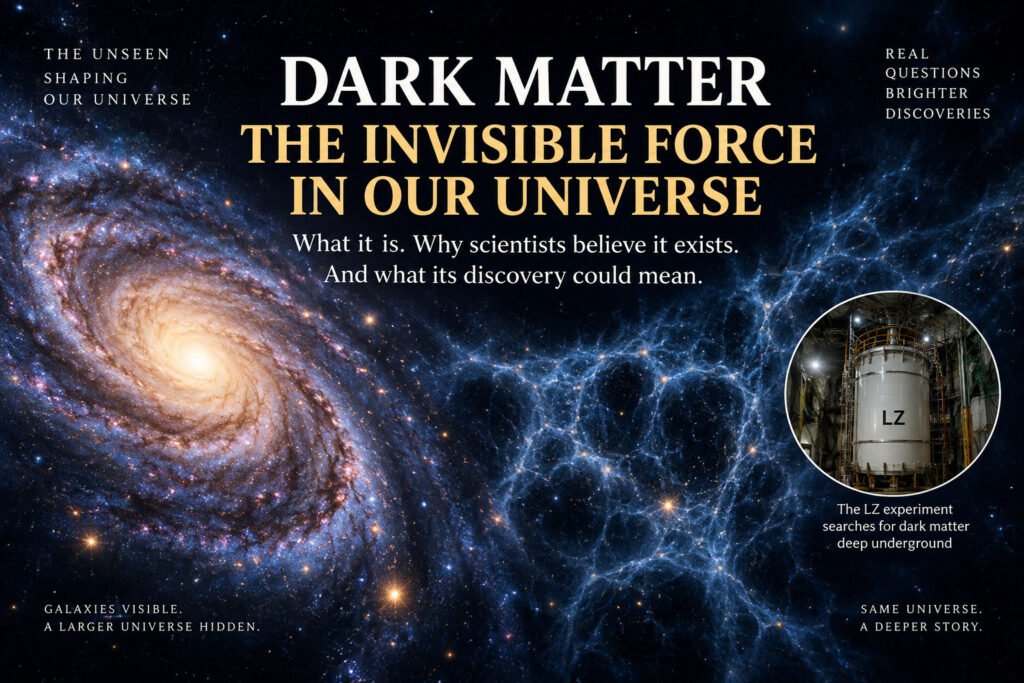
LZ is located nearly a mile underground at the Sanford Underground Research Facility in South Dakota, USA. Its detector uses tonnes of extremely pure liquid xenon and is designed to identify the faint signals that might occur if a dark-matter particle were to collide with an atomic nucleus.
Researchers reported a single unusual particle interaction that was difficult to explain using known background sources. The event produced characteristics consistent with a nuclear recoil — the sort of effect that could, in principle, be caused by a WIMP, one of the leading dark-matter candidates.
The result immediately attracted attention because the LZ team found only a very low expected background in the region where the event occurred. After accounting for statistical effects, however, the significance of the result was about 2.6 sigma, below the much stricter level normally required before physicists claim a discovery.
In simple terms, the event is interesting, but not proof.
Scientists now need more data. They must determine whether similar events appear again, whether another known physical process could explain the signal, and whether independent experiments can observe something comparable.
If future observations confirm that the event was caused by a WIMP or another dark-matter particle, it would mark the first direct detection of a substance that scientists believe makes up around 85% of all matter in the universe.
For now, the LZ result is best described as a promising clue rather than a breakthrough discovery.
And that distinction is important. In science, extraordinary claims require repeated evidence, careful statistical analysis and independent confirmation.
8. Why Is Dark Matter So Difficult to Detect?
Dark matter is difficult to detect because, if it is made of particles, those particles appear to interact only very weakly with ordinary matter.
Unlike ordinary matter, dark matter does not seem to produce light, reflect light or absorb it in a way that telescopes can easily observe. Scientists therefore cannot simply “see” dark matter. They have to search for the extremely small effects it may produce.
One major difficulty is background noise. Even detectors placed deep underground are constantly exposed to tiny signals from natural radioactivity, cosmic particles and other known physical processes. A possible dark-matter interaction may therefore look very similar to an ordinary event.
Another challenge is that dark-matter particles may pass through normal matter almost completely unnoticed. If billions of them move through a detector but only one interacts, scientists need extremely large detectors and very long observation periods to have any chance of recording a signal.
There is also uncertainty about what scientists should actually be looking for. If dark matter is made of WIMPs, one type of detector may be suitable. If it consists of axions or some other unknown particle, entirely different experiments may be required.
This means researchers are searching for something whose identity, mass and behaviour are still uncertain.
Even when an unusual event is recorded, one observation is not enough. Scientists need repeated signals, strong statistical evidence and ideally confirmation from independent experiments before they can be confident that dark matter has been detected.
In that sense, the search for dark matter is not only a technological challenge. It is also a scientific problem of separating an extraordinarily faint possible signal from everything else happening in the universe.
9. What Would the Discovery of Dark Matter Mean?
A confirmed discovery of dark matter would be one of the most important scientific breakthroughs of modern times.
At present, dark matter is known mainly through its gravitational effects. Scientists can observe how galaxies rotate, how clusters behave and how light bends around unseen mass, but they still do not know what dark matter is actually made of.
If researchers were able to identify a dark-matter particle directly, it would transform both astronomy and particle physics.
For astronomy, it would help explain what makes up much of the invisible mass that shapes galaxies and large-scale cosmic structures.
For particle physics, it could reveal a completely new type of particle beyond those already described by the Standard Model, the framework scientists currently use to explain known fundamental particles and forces.
Such a discovery could also answer questions about the early universe. Dark matter is believed to have played an important role in helping matter gather together after the Big Bang, eventually leading to the formation of galaxies and galaxy clusters.
The impact would therefore go far beyond simply identifying one mysterious substance. It could force scientists to revise or expand some of the most fundamental theories in physics.
There would also be many new questions.
How was dark matter created? Does it interact with itself? Are there several types of dark matter? Could it be linked in some way with other unresolved mysteries in cosmology?
In other words, discovering dark matter would not end the story.
It would open an entirely new chapter in our understanding of the universe.
10. India and the Search for Dark Matter
India is also contributing to the global effort to understand dark matter, mainly through research in particle physics, neutrino science, astrophysics and cosmology.
One important initiative is the India-based Neutrino Observatory (INO), a multi-institutional project designed around a large underground laboratory in Tamil Nadu. Its primary focus is neutrino physics, but Indian researchers associated with INO have also studied how such detectors could contribute indirectly to dark-matter searches.
For example, researchers have explored whether the proposed ICAL detector could detect neutrinos produced by the annihilation of dark-matter particles inside the Earth. Other studies have examined how atmospheric neutrinos might be used to probe certain kinds of dark matter.
Indian institutions are also active in the theoretical side of the subject. Researchers study possible dark-matter particles, alternative models of gravity, galaxy formation and the cosmological evidence for invisible matter. Seminars and research programmes at institutions such as TIFR and associated centres continue to examine how observations of galaxies, gravitational waves and the early universe may provide new clues.
The importance of this work lies in the fact that dark matter cannot be understood by one experiment or one branch of science alone. It requires collaboration between astronomers, particle physicists, cosmologists and detector specialists.
India’s contribution is therefore part of a much wider international effort — one in which the answer may eventually emerge from underground detectors, astronomical observations, particle experiments or an unexpected combination of all three.
11. The Future of Dark Matter Research
The search for dark matter is entering a new phase, driven by more sensitive detectors, larger astronomical surveys and increasingly sophisticated theoretical models.
Future underground experiments will try to detect even weaker interactions than current instruments can measure. Larger quantities of ultra-pure materials such as liquid xenon and argon will allow scientists to observe a greater volume of space for rare particle interactions while reducing background noise.
At the same time, new experiments are being developed to search for dark-matter candidates other than WIMPs. Axions, ultra-light particles and other hypothetical forms of dark matter require very different detection techniques, including specialised magnetic fields, resonant cavities and quantum sensors.
Astronomy will also remain central to the search. Powerful observatories will continue mapping the distribution of dark matter through gravitational lensing, galaxy motion and the large-scale structure of the universe. These observations may reveal whether dark matter behaves exactly as current theories predict or whether new physics is required.
Particle accelerators will provide another route. By creating extremely high-energy collisions, physicists hope to produce new particles that could help explain the missing matter of the universe.
An equally important development will be the comparison of results from many different approaches. A possible signal seen in an underground detector would become far more convincing if it could also be supported by astronomical observations or accelerator experiments.
The future of dark-matter research may therefore depend less on one dramatic experiment and more on the gradual convergence of evidence from several branches of science.
Whether the answer turns out to be a WIMP, an axion, an entirely unknown particle or even a revision of our understanding of gravity, the search itself is pushing science towards a deeper understanding of the universe.
And that is what makes dark matter such an extraordinary scientific challenge: we know that something appears to be there, yet we still do not know what it is.
12. Conclusion – The Mystery That Continues
Dark matter remains one of the greatest unanswered questions in modern science.
Scientists cannot see it directly, yet its gravitational effects appear throughout the universe — in the rotation of galaxies, the behaviour of galaxy clusters, gravitational lensing and the formation of cosmic structures.
So far, however, no experiment has conclusively identified what dark matter is made of.
That leaves us with the same three questions with which this article began:
What is dark matter?
It is the name given to the unseen matter believed to account for much of the universe’s mass.
Why do scientists believe it exists?
Because many astronomical observations are difficult to explain without the additional gravity that dark matter appears to provide.
What would it mean if we finally discovered what it is?
It could transform our understanding of both the universe and the fundamental laws of physics.
The search is therefore about far more than finding an invisible particle. It is about understanding how galaxies formed, how the universe evolved and whether there are forms of matter and physics still completely unknown to us.
For now, dark matter remains hidden.
But every new experiment, observation and unexpected signal brings science a little closer to answering one of the most profound questions of all:
What is the universe really made of?
Frequently Asked Questions (FAQs)
Dark matter is the name scientists give to an invisible form of matter that appears to exert gravity but does not emit, reflect or absorb light in the usual way.
- It is called dark because it cannot be seen directly with telescopes. Scientists infer its presence mainly from its gravitational effects.
They observe effects that visible matter alone cannot easily explain, such as the speed at which galaxies rotate, the behaviour of galaxy clusters and gravitational lensing.
No. Dark matter is associated mainly with gravity and the formation of cosmic structures, while dark energy is linked with the accelerating expansion of the universe.
Dark matter is believed to make up roughly a quarter of the total contents of the universe, while ordinary matter makes up only a small fraction.
Possible candidates include WIMPs, axions, sterile neutrinos and other hypothetical particles. None has yet been confirmed.
A WIMP, or Weakly Interacting Massive Particle, is a hypothetical particle that could have mass but interact only very weakly with ordinary matter.
They use underground detectors, particle accelerators, telescopes, gravitational observations and experiments designed to detect extremely faint or unusual signals.
Deep underground locations help shield sensitive detectors from cosmic rays and other background radiation that could mimic a dark-matter signal.
Not conclusively. Some experiments have recorded unusual events, but no signal has yet met the strict standards required for a confirmed discovery.
A confirmed discovery could reveal a new type of particle, improve our understanding of galaxy formation and possibly expand the fundamental laws of physics.
No one can say with certainty, but increasingly sensitive experiments and astronomical observations are giving scientists better tools to test the leading possibilities.