Table of Contents
ToggleIntroduction – A Football-Loving Country Still Searching for a Breakthrough
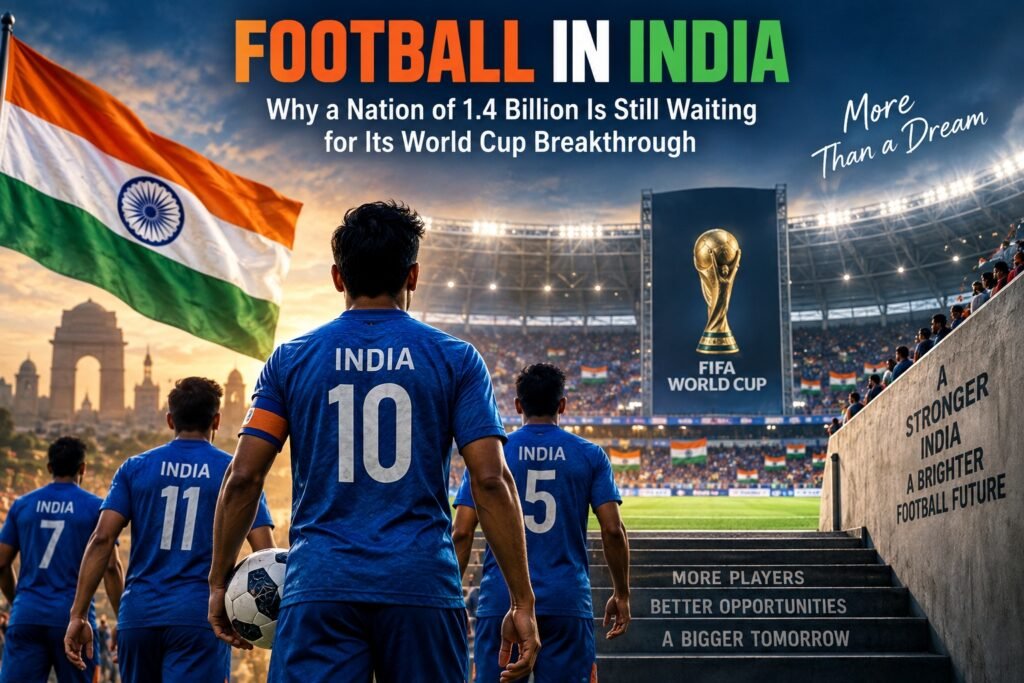
India has more than 1.4 billion people, millions of football followers and some of the most passionate football regions in Asia.
Yet India has never played a match at the FIFA World Cup.
That contrast is what makes the story of Indian football so intriguing.
India once enjoyed a golden period in Asian football, produced outstanding players and even came close to appearing at the 1950 World Cup. Today, professional leagues, academies and greater international exposure have brought fresh hope.
But the central question remains:
Why has a country of India’s size and sporting passion struggled for so long to reach football’s biggest stage?
The answer goes far beyond the familiar argument that cricket dominates Indian sport. It lies in the way football has been developed, managed and nurtured over several decades.
This article looks at where Indian football once stood, what went wrong, what is changing today and whether India can finally turn its enormous potential into a genuine World Cup breakthrough.
Explore the Wider World of Football
This story of Indian football forms part of a wider exploration of the game — its history, global appeal, great competitions, changing tactics and continuing evolution.
The Early History of Football in India
Football came to India during the nineteenth century through British soldiers, administrators and educational institutions. Kolkata soon became one of the earliest centres of the game.
Indian clubs began to emerge, and football gradually became more than a colonial pastime. It became part of local identity and public pride.
A defining moment came in 1911, when Mohun Bagan defeated the East Yorkshire Regiment to win the IFA Shield. The victory became important far beyond sport. At a time of British rule, it was seen as a powerful symbol of Indian confidence.
Football later developed strong roots in Bengal, Goa, Kerala and the North-East.
By the early twentieth century, India already had the foundations of a serious football culture.
That foundation would soon produce Indian football’s finest period.
India’s Golden Era – When Indian Football Commanded Respect
The 1950s and early 1960s were the high point of Indian football.
Under coach Syed Abdul Rahim, India became one of Asia’s strongest teams.
The country won football gold at the 1951 Asian Games, reached the semi-finals of the 1956 Melbourne Olympics, and won another Asian Games gold in 1962.
The 1956 Olympic campaign remains especially memorable. India defeated Australia 4–2, with Neville D’Souza scoring a hat-trick.
Then came the 1962 Asian Games triumph in Jakarta, where India defeated South Korea in the final under captain Chuni Goswami.
Players such as Chuni Goswami, P. K. Banerjee, Tulsidas Balaram, Jarnail Singh and Sailen Manna became national sporting figures.
This period matters because it proves something important:
India was once capable of competing with the best teams in Asia.
The real mystery is how that position was lost.
Why India Never Played in the FIFA World Cup
India came closest to the FIFA World Cup in 1950.
After other teams in its qualifying group withdrew, India had a place in the tournament in Brazil. Yet the team never travelled.
For years, the popular explanation was that India withdrew because its players were not allowed to play barefoot.
The truth appears more complicated.
Historical accounts also point to poor preparation, team-selection disagreements, travel difficulties and the fact that the World Cup was not yet treated in India with the importance it later acquired.
Whatever the exact reasons, the opportunity was lost.
That decision looks even more remarkable because India entered its strongest footballing period soon afterwards.
Had India gone to Brazil in 1950, the history of Indian football might have been very different.
Instead, India remained outside the World Cup and gradually lost ground as Asian football became more competitive.
The Decline – What Went Wrong?
Indian football did not collapse overnight.
It simply failed to modernise as quickly as the countries around it.
Grassroots development remained uneven. Coaching standards did not grow fast enough. Youth competitions were limited, professional structures developed slowly and talent identification remained fragmented.
Meanwhile, countries such as Japan and South Korea were investing in professional leagues, academies and modern coaching systems.
India also lacked a strong national league for many years. The National Football League began only in 1996.
Cricket’s rise certainly changed India’s sporting economy, but blaming cricket alone is too easy.
The deeper problem was structural.
Indian football stood still while Asian football moved forward.
That gap eventually became difficult to close.
The Indian Super League and the Revival of Club Football
The launch of the Indian Super League in 2014 brought new energy to domestic football.
For the first time in years, Indian club football received major television coverage, commercial investment and wider public attention.
Well-known international players and coaches gave the league visibility, while clubs improved presentation, training facilities and professional standards.
The ISL also helped football reach newer audiences outside traditional centres.
But there is an important distinction.
A successful league does not automatically produce a successful national team.
The ISL can strengthen the top of Indian football, but the real pipeline begins much earlier.
If India wants better international results, professional football must connect more closely with grassroots development, academies and youth competition.
That is where the real future begins.
Grassroots Football – Where the Real Future Begins
India’s World Cup dream will not begin with the national team.
It will begin with children.
The strongest footballing countries introduce young players to structured coaching and regular competition from an early age.
India certainly has talent, but talent must first be found.
Schools, local clubs, community programmes and district competitions can create that base.
The biggest challenge is scale.
Football remains strongest in places such as Bengal, Goa, Kerala and the North-East, but a country as large as India cannot depend on only a few regions.
Children across the country need more opportunities to play regularly.
The principle is simple:
The wider the base, the better the chance of producing elite players.
India does not lack potential.
It needs a better system for discovering it.
Coaching, Academies and Talent Identification
Finding a gifted young player is only the beginning.
The next step is development.
Modern football requires technique, tactical awareness, fitness, decision-making and mental strength. These qualities are built over years.
That makes good coaching essential.
India needs more qualified youth coaches, better academies and a clearer pathway from junior football to professional clubs.
Scouting also has to reach beyond established centres.
A talented child in a smaller town should have the same chance of being noticed as one in Kolkata, Goa or Bengaluru.
Academies must also avoid chasing only short-term results.
Youth football should be about producing better players, not merely winning junior tournaments.
The real goal is a national pathway in which talent can be found early, trained properly and given a genuine route to professional football.
Infrastructure and Professional Management
Football needs more than stadiums.
Players need good training grounds, academies, medical support, fitness facilities and regular access to quality pitches.
At the grassroots level, even something as basic as a safe playing field can make a difference.
India has improved its football infrastructure, but progress remains uneven.
Professional management matters just as much.
Clubs need stable finances, long-term planning, strong academies and consistent sporting philosophies.
Football associations also need continuity.
Too many changes in structure, leadership or direction make long-term development difficult.
India’s football system must work as one connected chain — from schools and local clubs to academies, professional teams and the national side.
Without that connection, talent can easily be lost.
What India Can Learn from Japan, South Korea and Other Asian Nations
India does not need to look only towards Europe for inspiration.
Japan and South Korea provide more relevant examples.
Both countries built strong domestic leagues, invested in coaching, strengthened youth development and created clear pathways for young players.
Their success did not come overnight.
It came through decades of consistent planning.
Japan’s J.League helped professionalise the game, while youth academies and school football continued to develop players.
South Korea combined structured development with strong competitive culture and international exposure.
Other smaller nations have also shown what organised football systems can achieve.
The lesson for India is clear:
Population is not enough. Structure matters more.
India needs its own model, but the principles remain universal — grassroots football, qualified coaches, good academies, regular competition and patience.
Women’s Football – An Important OpportunityAdd Your Heading Text Here
Women’s football deserves a much bigger place in India’s football plans.
The global women’s game is growing rapidly, and India has an opportunity to develop alongside that growth.
The most important step is to create more opportunities for girls to start playing early.
Schools, colleges and academies can play a major role.
A stronger domestic league would also give talented players a clearer professional pathway.
Women’s football should not be treated as an extension of the men’s game.
It deserves its own investment, coaching and long-term strategy.
For India, this is not only about equality.
It is also a genuine sporting opportunity.
A stronger women’s game would widen India’s football culture and bring many more families and young players into the sport.
Can India Realistically Reach a Future FIFA World Cup?
Yes — but only if India improves enough to compete consistently with Asia’s stronger teams.
The expanded World Cup gives Asian nations more opportunities, but qualification still has to be earned.
India needs deeper player quality, better youth development, stronger coaching and more competitive football.
There is also a useful perspective here.
Countries far smaller than India — including Uruguay, Croatia, Costa Rica, Iceland and Côte d’Ivoire — have reached the World Cup.
Some have achieved remarkable success.
That tells us that population is not the decisive factor.
A smaller country with a strong football system can outperform a much larger country without one.
India therefore should not ask only:
“When will we qualify for the World Cup?”
The more important question is:
“When will India become one of Asia’s consistently strong football nations?”
If that happens, World Cup qualification will become a realistic consequence.
Conclusion – From Potential to Performance
India’s football story is unusual.
It has history, passion, famous clubs and memories of a time when the national team was among Asia’s best.
Yet that early success was never converted into a lasting football system.
Today, the opportunity exists to change that.
Professional leagues are stronger, academies are growing and there is greater awareness of the importance of grassroots football and coaching.
But India must move beyond potential.
A population of 1.4 billion means little unless talented children are found and developed.
A professional league means little unless it strengthens the national pipeline.
And ambitious plans mean little without continuity.
The experience of successful football nations shows that there are no shortcuts.
World Cup qualification is usually the result of years of patient development.
India certainly has enough people who love football.
The challenge now is to build a system worthy of that passion.
Only then can potential become performance — and the World Cup dream become something more than a dream.
Frequently Asked Questions (FAQs)
No. India has never played a match in the FIFA World Cup finals.
India was due to participate in the 1950 World Cup in Brazil after other teams in its qualifying group withdrew, but the Indian team ultimately did not travel to the tournament.
That is the most popular explanation, but the real situation appears to have been more complicated. Historical accounts also point to preparation problems, team-selection disagreements and other practical difficulties.
The 1950s and early 1960s are generally regarded as Indian football’s golden era, when India was among the strongest footballing nations in Asia.
India won football gold at the Asian Games in 1951 and 1962, reached the semi-finals of the 1956 Melbourne Olympics and finished runners-up at the 1964 AFC Asian Cup.
The decline resulted from several factors, including weak grassroots development, limited coaching depth, insufficient infrastructure, fragmented talent identification and slower professionalisation compared with other Asian countries.
The ISL has improved visibility, investment, professional standards and commercial interest in domestic football. However, a stronger league alone cannot transform the national team without better grassroots and youth-development systems.
Grassroots football creates the broad player base from which future professionals and international players emerge. India needs more children playing regularly under qualified coaches and competing in organised youth leagues.
Both countries built long-term football systems based on professional leagues, coaching education, youth academies, regular competition and strong development pathways. Their progress shows that sustained systems matter more than short-term success.
Yes. Women’s football is growing rapidly worldwide, and India has an opportunity to develop stronger domestic competitions, school programmes and professional pathways for female players.
No. A large population increases the potential talent pool, but success depends on identifying, coaching and developing players through a structured system.
Yes, but qualification will require long-term improvement in grassroots football, coaching, academies, infrastructure, professional clubs, administration and international competitiveness.