Table of Contents
ToggleIntroduction
Every four years, the FIFA World Cup captures the imagination of billions of people across the globe. Streets come alive with celebrations, families gather around television screens, stadiums reverberate with the chants of passionate supporters, and entire nations unite behind their teams. For one month, football becomes more than a sport—it becomes a global celebration of talent, emotion, national pride, and cultural diversity.
What began as a modest tournament involving just 13 teams in Uruguay in 1930 has grown into the largest sporting spectacle on Earth. Today, the FIFA World Cup is watched by billions of viewers, generates billions of dollars in economic activity, and inspires generations of footballers across every continent.
But how did the tournament begin? Why is it played only once every four years? How are host countries selected? Why has India never qualified? What makes the 2026 World Cup different from all previous editions? And what does the future hold for football’s greatest tournament?
This article answers these and many other fascinating questions while tracing the remarkable journey of the FIFA World Cup—from its humble beginnings to its emergence as the world’s most celebrated sporting event.
The Birth of FIFA and International Football
Before there could be a World Cup, there had to be an organisation capable of governing the game internationally.
The Fédération Internationale de Football Association (FIFA) was founded on 21 May 1904 in Paris, France, by representatives from seven European nations:
- France
- Belgium
- Denmark
- Netherlands
- Spain (represented by Madrid FC)
- Sweden
- Switzerland
At the beginning of the twentieth century, football was rapidly gaining popularity, but each country followed slightly different rules and there was no international governing body to organise competitions or resolve disputes.
FIFA was therefore established with four principal objectives:
- To standardise the Laws of the Game internationally.
- To organise international football competitions.
- To promote football across the world.
- To encourage friendship and sporting cooperation among nations.
Initially, FIFA’s activities were largely confined to Europe. However, as football spread across South America, Asia, Africa, and later North America, FIFA gradually transformed into the world’s governing body for football. Today, it comprises 211 national member associations, making it one of the largest international sporting organisations.
Football Before the FIFA World Cup
Many readers assume that international football began with the FIFA World Cup. In reality, international matches had been played for decades before 1930.
The first officially recognised international football match took place in 1872 between England and Scotland.
Later, football became part of the Olympic Games, beginning in 1900 as a demonstration sport and officially from 1908 onwards. Although the Olympic football tournament attracted considerable attention, it had several limitations:
- Participation was largely restricted to amateur players.
- Professional footballers were excluded for many years.
- The tournament was organised by the International Olympic Committee (IOC), not FIFA.
- Football was only one of many sports at the Olympics and lacked its own dedicated global identity.
As football’s popularity continued to grow, FIFA believed the sport deserved an independent world championship where the best national teams could compete irrespective of amateur or professional status.
This vision eventually led to the creation of the FIFA World Cup.
The First FIFA World Cup – Uruguay 1930
The inaugural FIFA World Cup was held in Uruguay from 13 July to 30 July 1930.
Uruguay was chosen for several compelling reasons:
- It had won consecutive Olympic football gold medals in 1924 and 1928.
- The country was celebrating the centenary of its Constitution.
- The Uruguayan government agreed to finance much of the tournament and provide travel assistance to participating teams.
- It had developed one of the strongest football cultures in the world.
Only 13 nations participated:
- Seven from South America
- Four from Europe
- Two from North America
Travel to Uruguay was a major challenge in 1930. Many European teams undertook lengthy sea voyages lasting several weeks to reach South America.
The final was played at the iconic Estadio Centenario in Montevideo, where Uruguay defeated Argentina 4–2 to become the first FIFA World Cup champions.
No one could have imagined that this relatively small tournament would evolve into the greatest sporting event on Earth.
Why the FIFA World Cup Became Football’s Greatest Tournament
What began in Uruguay in 1930 as a modest 13-team competition has grown into the most celebrated tournament in world football. The FIFA World Cup became great because it combines sporting excellence, national pride, unforgettable drama and global participation in a way no other football event can match.
Unlike club football, the World Cup brings entire nations together behind one flag. A goal, a save or a penalty miss can become part of national memory. It has also been the stage where legends such as Pelé, Diego Maradona, Zinedine Zidane, Ronaldo, Lionel Messi and Cristiano Ronaldo created moments that defined generations.
Beyond football, the tournament is a global festival of culture, emotion and unity. It showcases host nations, inspires young players, drives economic activity and gives smaller footballing countries the chance to dream on the same stage as giants.
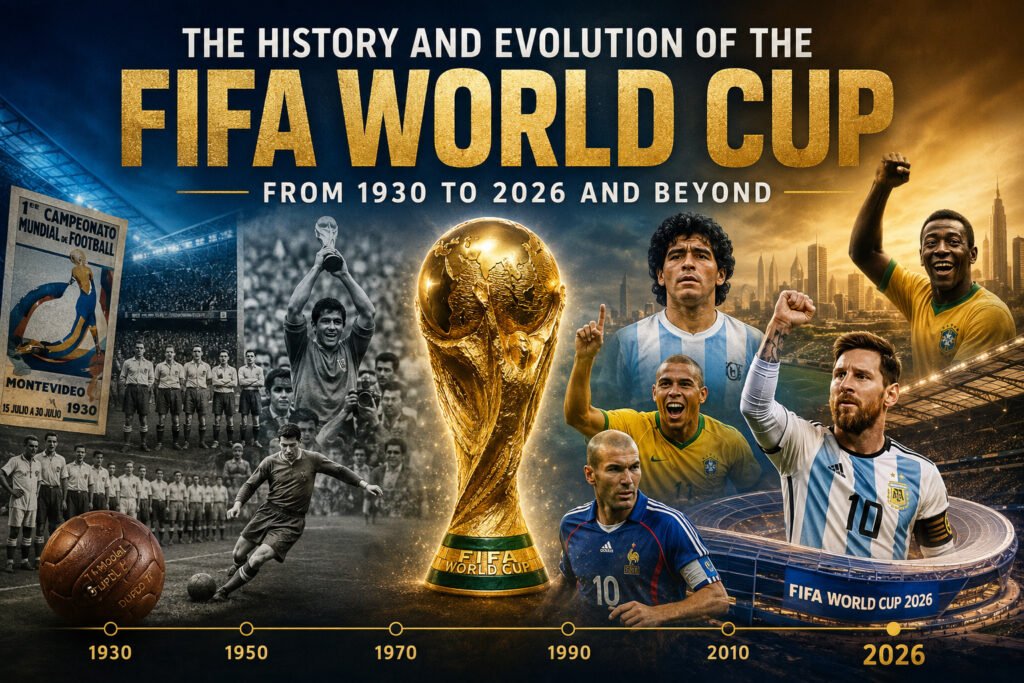
From Uruguay 1930 to the expanded 48-team edition in 2026, the World Cup has remained more than a tournament. It is football’s greatest celebration and one of humanity’s most powerful sporting spectacles
Conclusion
Football is far more than a sport. It is a cultural phenomenon, a source of national pride, a vehicle for social change, and a global language understood by billions.
As the game continues to evolve through innovation, technology, and expanding international participation, its ability to inspire passion and bring people together remains unchanged.
Whether you are a lifelong supporter or a newcomer to the sport, football offers stories, emotions, and moments that few other activities can match.
Explore Why the FIFA World Cup Became So Great
- The World’s Most Watched Sporting Event
Discover how the FIFA World Cup attracts billions of viewers across the globe. - Where Football Legends Are Born
From Pelé to Messi, explore how the World Cup creates football’s greatest icons. - The Cultural and Economic Impact of the FIFA World Cup
Understand how the tournament transforms host nations and shapes global culture. - How the World Cup Inspires Future Generations
See why millions of children dream of representing their country at the FIFA World Cup. - 100 Fascinating FIFA World Cup Facts Every Football Fan Should Know
From the fastest goals and biggest upsets to remarkable records and little-known trivia, discover the stories that make the FIFA World Cup the world’s greatest sporting spectacle. - FIFA World Cup Records and Statistics: The Greatest Players, Teams and Moments Ever
Frequently Asked Questions(FAQs)
Football is called the beautiful game because of its simplicity, creativity, skill, teamwork, and universal appeal. The phrase became widely associated with football legend Pelé.
Football is followed by more than four billion people, making it the most popular sport on the planet.
FIFA (Fédération Internationale de Football Association) is the governing body responsible for world football and the FIFA World Cup.
Major competitions include the FIFA World Cup, UEFA Champions League, Premier League, La Liga, Bundesliga, Serie A, Copa América, and UEFA European Championship.
Pelé, Diego Maradona, Johan Cruyff, Franz Beckenbauer, Lionel Messi, Cristiano Ronaldo, and Zinedine Zidane are among the greatest footballers in history.
Video Assistant Referee (VAR) is a technology system used to assist referees in reviewing important decisions during matches.
Yes. The growth of the Indian Super League, grassroots programmes, and international broadcasts has increased football’s popularity across India.
Its simplicity, accessibility, low equipment requirements, global competitions, passionate fan culture, and rich history make football the most widely followed sport.
There is no single standard size for a football stadium. FIFA recommends that an international football pitch should measure between 100–110 metres in length and 64–75 metres in width. Stadium capacities vary widely, from around 20,000 spectators to more than 100,000 in some of the world’s largest venues.
An official FIFA-approved football (Size 5) has a circumference of 68–70 centimetres and weighs between 410 and 450 grams at the start of a match. Size 5 balls are used in all major international competitions, including the FIFA World Cup.
Football is considered the de facto national sport in several countries, including Brazil, Argentina, England, Spain, Germany, and Italy, due to its immense popularity. However, many countries do not officially designate a national sport by law.
The official match balls for FIFA World Cups have traditionally been supplied by Adidas since 1970. Other leading football manufacturers include Nike, Puma, Mitre, Select, and Umbro, which supply balls for various domestic and international competitions.
The penalty spot is located 11 metres (12 yards) from the goal line. During a penalty kick, only the goalkeeper and the designated penalty taker are permitted inside the penalty area until the ball is kicked.
An international football goal measures 7.32 metres (24 feet) wide and 2.44 metres (8 feet) high.
A standard football match lasts 90 minutes, divided into two halves of 45 minutes each, with a half-time interval of up to 15 minutes. The referee also adds stoppage time at the end of each half to compensate for time lost due to substitutions, injuries, VAR reviews, goal celebrations and other interruptions. In exceptionally hot or humid conditions, two hydration (cooling) breaks, each lasting 90 seconds to 3 minutes, may be permitted—usually around the 30th and 75th minutes. The time taken for these breaks is added to stoppage time, so the match duration is extended accordingly.
A player is in an offside position if they are nearer to the opponent’s goal line than both the ball and the second-last defender when the ball is played to them, unless they are in their own half of the field. The rule is designed to prevent goal-hanging and promote fair play.