Football

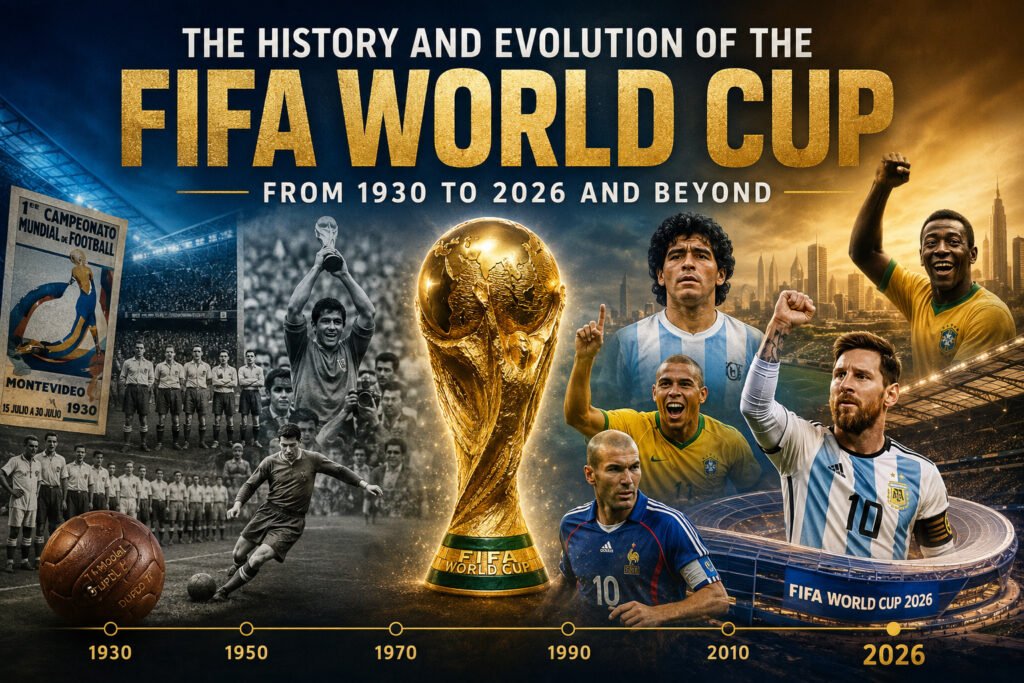
The History and Evolution of the FIFA World Cup: From 1930 to 2026 and Beyond

Introduction Every four years, the FIFA World Cup captures the imagination of billions of people across the globe. Streets come alive with celebrations, families gather around television screens, stadiums reverberate with the chants of passionate supporters, and entire nations unite behind their teams. For one month, football becomes more than a sport—it becomes a global celebration of talent, emotion, national pride, and cultural diversity. What began as a modest tournament involving just 13 teams in Uruguay in 1930 has grown into the largest sporting spectacle on Earth. Today, the FIFA World Cup is watched by billions of viewers, generates billions of dollars in economic activity, and inspires generations of footballers across every continent. But how did the tournament begin? Why is it played only once every four years? How are host countries selected? Why has India never qualified? What makes the 2026 World Cup different from all previous editions? And what does the future hold for football’s greatest tournament? This article answers these and many other fascinating questions while tracing the remarkable journey of the FIFA World Cup—from its humble beginnings to its emergence as the world’s most celebrated sporting event. The Birth of FIFA and International Football Before there could be a World Cup, there had to be an organisation capable of governing the game internationally. The Fédération Internationale de Football Association (FIFA) was founded on 21 May 1904 in Paris, France, by representatives from seven European nations: France Belgium Denmark Netherlands Spain (represented by Madrid FC) Sweden Switzerland At the beginning of the twentieth century, football was rapidly gaining popularity, but each country followed slightly different rules and there was no international governing body to organise competitions or resolve disputes. FIFA was therefore established with four principal objectives: To standardise the Laws of the Game internationally. To organise international football competitions. To promote football across the world. To encourage friendship and sporting cooperation among nations. Initially, FIFA’s activities were largely confined to Europe. However, as football spread across South America, Asia, Africa, and later North America, FIFA gradually transformed into the world’s governing body for football. Today, it comprises 211 national member associations, making it one of the largest international sporting organisations. The Birth of FIFA and International Football Before there could be a World Cup, there had to be an organisation capable of governing the game internationally. The Fédération Internationale de Football Association (FIFA) was founded on 21 May 1904 in Paris, France, by representatives from seven European nations: France Belgium Denmark Netherlands Spain (represented by Madrid FC) Sweden Switzerland At the beginning of the twentieth century, football was rapidly gaining popularity, but each country followed slightly different rules and there was no international governing body to organise competitions or resolve disputes. FIFA was therefore established with four principal objectives: To standardise the Laws of the Game internationally. To organise international football competitions. To promote football across the world. To encourage friendship and sporting cooperation among nations. Initially, FIFA’s activities were largely confined to Europe. However, as football spread across South America, Asia, Africa, and later North America, FIFA gradually transformed into the world’s governing body for football. Today, it comprises 211 national member associations, making it one of the largest international sporting organisations. Football Before the FIFA World Cup Many readers assume that international football began with the FIFA World Cup. In reality, international matches had been played for decades before 1930. The first officially recognised international football match took place in 1872 between England and Scotland. Later, football became part of the Olympic Games, beginning in 1900 as a demonstration sport and officially from 1908 onwards. Although the Olympic football tournament attracted considerable attention, it had several limitations: Participation was largely restricted to amateur players. Professional footballers were excluded for many years. The tournament was organised by the International Olympic Committee (IOC), not FIFA. Football was only one of many sports at the Olympics and lacked its own dedicated global identity. As football’s popularity continued to grow, FIFA believed the sport deserved an independent world championship where the best national teams could compete irrespective of amateur or professional status. This vision eventually led to the creation of the FIFA World Cup. The First FIFA World Cup – Uruguay 1930 The inaugural FIFA World Cup was held in Uruguay from 13 July to 30 July 1930. Uruguay was chosen for several compelling reasons: It had won consecutive Olympic football gold medals in 1924 and 1928. The country was celebrating the centenary of its Constitution. The Uruguayan government agreed to finance much of the tournament and provide travel assistance to participating teams. It had developed one of the strongest football cultures in the world. Only 13 nations participated: Seven from South America Four from Europe Two from North America Travel to Uruguay was a major challenge in 1930. Many European teams undertook lengthy sea voyages lasting several weeks to reach South America. The final was played at the iconic Estadio Centenario in Montevideo, where Uruguay defeated Argentina 4–2 to become the first FIFA World Cup champions. No one could have imagined that this relatively small tournament would evolve into the greatest sporting event on Earth. Why Is the FIFA World Cup Held Every Four Years? One of the most frequently asked questions is why the World Cup is organised every four years rather than annually. The answer lies in a combination of sporting, logistical, commercial, and historical factors. Sporting Reasons National teams require sufficient time to identify emerging talent, develop players, and prepare competitive squads. A four-year cycle allows footballing nations to build teams capable of competing at the highest level. Qualification Process Hundreds of qualifying matches are played across six continental confederations over nearly three years. Conducting this process annually would be impractical and would disrupt domestic and international football calendars. Domestic Football Calendar Professional players spend most of the year representing their clubs in domestic leagues and continental competitions such as the UEFA Champions League and Copa Libertadores. Holding a World Cup every year

The History and Evolution of the FIFA World Cup: From 1930 to 2026 and Beyond Read More »