Table of Contents
ToggleIntroduction
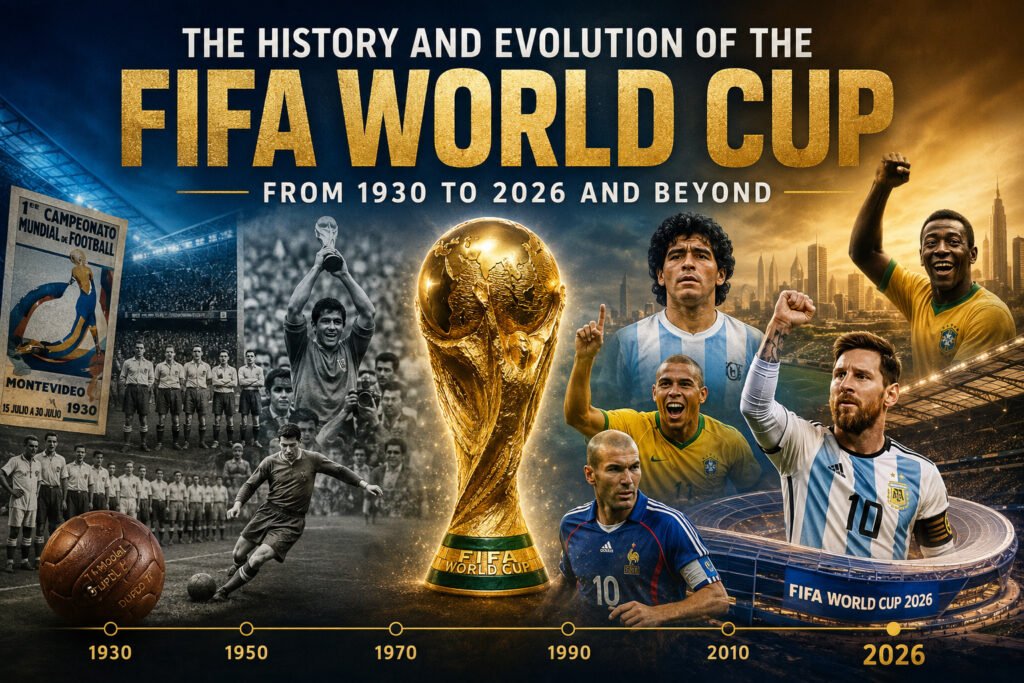
The FIFA World Cup has never remained static. From the first tournament in Uruguay in 1930 to the expanded 48-team format of 2026, the World Cup has constantly evolved with football, technology, broadcasting, politics, business and global fan culture.
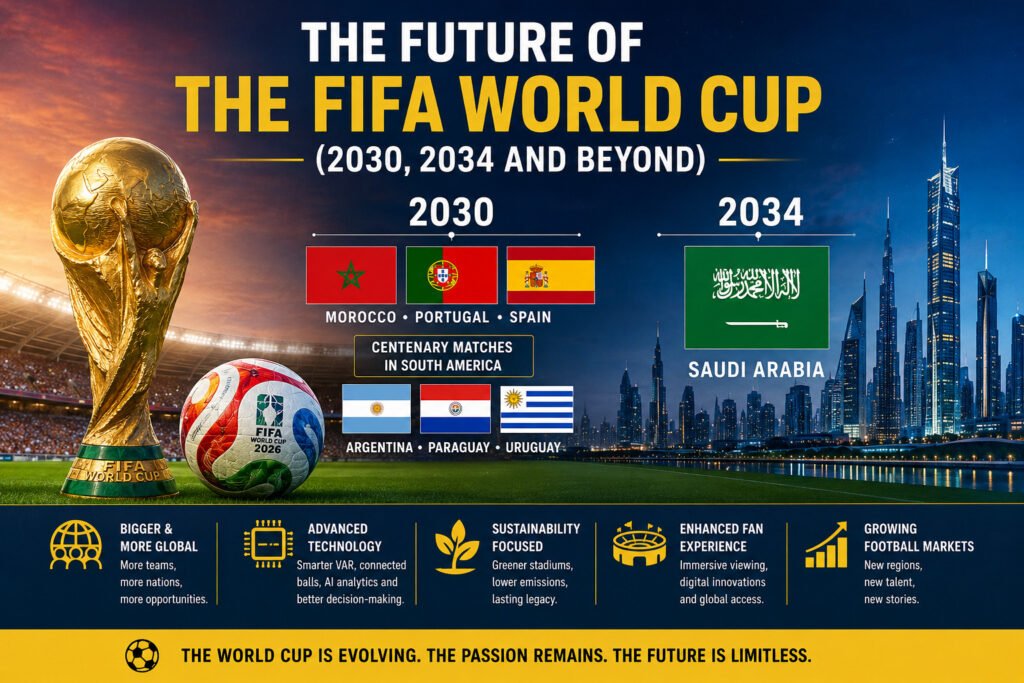
The future of the FIFA World Cup will be shaped by several major forces: more teams, more host nations, greater commercial value, advanced technology, sustainability expectations, emerging football markets and the growing desire to make the tournament more global than ever before.
The editions of 2030 and 2034 will not merely be football tournaments. They will represent the next stage in the transformation of the World Cup into a truly global sporting, cultural and commercial event.
2. FIFA World Cup 2030: A Centenary Tournament
The 2030 FIFA World Cup will be historic because it will mark 100 years since the first World Cup was held in Uruguay in 1930.
The main hosts of the 2030 tournament will be Morocco, Portugal and Spain. In addition, special centenary matches will be held in Uruguay, Argentina and Paraguay to honour the tournament’s South American origins.
This makes the 2030 World Cup unique. It will connect the past and future of football by celebrating the tournament’s birthplace while also staging the main event across Europe and Africa.
The 2030 edition will therefore be remembered not only for football, but also for symbolism, history and global unity.
3. Why the 2030 World Cup Is So Important
The 2030 edition will be important for several reasons.
First, it will celebrate the 100-year journey of the FIFA World Cup. Very few sporting events have achieved such global influence over a full century.
Second, it will be hosted across multiple continents, showing how the World Cup has expanded beyond its traditional boundaries.
Third, it will strengthen the connection between Europe, Africa and South America. Spain and Portugal bring European football history, Morocco represents Africa’s rising football confidence, while Uruguay, Argentina and Paraguay connect the tournament to its roots.
Finally, the 2030 World Cup will test FIFA’s ability to manage a tournament spread across different countries, cultures, climates and time zones.
4. FIFA World Cup 2034: Saudi Arabia’s Moment
The 2034 FIFA World Cup will be hosted by Saudi Arabia. This will be a major moment for football in Asia and the Middle East.
After the 2002 World Cup in South Korea and Japan, and the 2022 World Cup in Qatar, Saudi Arabia 2034 will further confirm Asia’s growing role in global football.
The tournament is expected to be ambitious in scale, infrastructure and presentation. Saudi Arabia has already invested heavily in football, stadiums, sports events and international visibility. Hosting the FIFA World Cup will be central to its larger sporting and economic transformation.
The 2034 World Cup will also be significant because it is expected to be the first 48-team FIFA World Cup hosted by a single nation.
5. Will the 48-Team Format Continue?
The 48-team format introduced for the 2026 FIFA World Cup is likely to remain the standard for the foreseeable future.
The expanded format allows more countries to participate, especially from Asia, Africa and North America. It also increases the number of matches, broadens global representation and creates more opportunities for developing football nations.
However, the larger format also brings challenges. More teams mean more travel, longer tournament duration, greater pressure on host infrastructure and concerns about maintaining match quality.
Even so, the 48-team structure appears to represent the future direction of the World Cup. FIFA wants the tournament to feel more inclusive, more global and more commercially powerful.
6. More Host Nations and Joint Hosting
One of the biggest changes in future World Cups will be the rise of joint hosting.
The 2026 World Cup is being hosted by the United States, Canada and Mexico. The 2030 World Cup will involve Morocco, Portugal, Spain and centenary matches in South America.
This shows that FIFA is increasingly comfortable with multi-country hosting.
Joint hosting has several advantages. It reduces the financial burden on a single country, allows the use of existing stadiums, spreads tourism benefits and enables more nations to participate in staging the tournament.
However, it also creates logistical challenges. Travel, visas, time zones, security, accommodation and broadcasting schedules become more complicated when multiple countries are involved.
In future, joint hosting may become more common, especially as the tournament grows larger.
7. Technology Will Shape Future World Cups
Technology will play an increasingly important role in the future of the FIFA World Cup.
VAR has already changed how major decisions are reviewed. Semi-automated offside technology has improved decision-making speed and accuracy. Goal-line technology has removed uncertainty over whether the ball has crossed the line.
Future World Cups may see even more advanced tools, including:
- improved semi-automated offside systems;
- AI-assisted match analysis;
- smarter referee communication systems;
- real-time player performance tracking;
- advanced fan engagement through mobile apps;
- augmented reality match experiences;
- improved broadcast graphics and tactical visualisation.
Technology will not replace the drama of football, but it will continue to influence how matches are officiated, analysed and experienced.
8. Sustainability and Climate Concerns
Future FIFA World Cups will face increasing pressure to become more sustainable.
Large tournaments require stadiums, transport systems, hotels, security infrastructure, energy consumption and international travel. These create environmental concerns, especially when tournaments are spread across large geographical areas.
Future hosts will need to focus on:
- energy-efficient stadiums;
- public transport planning;
- reduced carbon emissions;
- responsible water use;
- sustainable construction;
- legacy use of stadiums after the tournament;
- waste reduction and recycling;
- climate-sensitive scheduling.
Sustainability will no longer be a public relations issue alone. It will become a central requirement for hosting major global tournaments.
9. The Business of Future World Cups
The FIFA World Cup is already one of the most valuable sporting events in the world, and its commercial value is likely to increase further.
Broadcasting rights, sponsorships, ticketing, hospitality, digital streaming, merchandise and tourism will continue to generate enormous revenue.
The expanded format means more matches, more participating countries, more fans and more commercial inventory. This makes the tournament attractive to broadcasters, sponsors and host nations.
However, there is also a risk. If ticket prices become too high or the tournament becomes too commercial, ordinary fans may feel disconnected. The future challenge for FIFA will be balancing commercial growth with football’s emotional connection to everyday supporters.
10. Emerging Football Nations
Future World Cups may see more emerging football nations making an impact.
The expanded tournament gives additional opportunities to countries from Asia, Africa, North America and Oceania. This could help nations that previously struggled to qualify.
Countries with improving football systems, stronger domestic leagues and better youth development may become more competitive. Nations from Africa and Asia, in particular, may benefit from increased representation.
However, qualification alone is not enough. To compete seriously, emerging nations must invest in coaching, academies, sports science, domestic leagues and international exposure.
The future World Cup may therefore become more diverse, but the traditional powers will remain difficult to displace.
11. What the Future Means for India
For India, the expanded FIFA World Cup offers hope, but not a shortcut.
More Asian qualification places mean that India’s chances are better than they were in the old 32-team format. However, India still needs major improvement to compete with leading Asian football nations such as Japan, South Korea, Iran, Saudi Arabia and Australia.
India’s future World Cup hopes depend on long-term reforms:
- better grassroots football;
- stronger youth academies;
- improved coaching standards;
- competitive domestic leagues;
- better scouting systems;
- international exposure;
- investment in fitness and sports science;
- football development across schools and communities.
If India is to reach the World Cup in the future, it must treat qualification as a national football project rather than a short-term dream.
12.Will the World Cup Become Too Big?
One important question is whether the FIFA World Cup may become too large.
A bigger tournament brings more representation and more excitement, but it also risks reducing exclusivity. If too many teams participate, some critics argue that the prestige of qualification may decline.
There are also concerns about player workload. Footballers already play demanding club seasons, continental tournaments and international matches. A longer World Cup adds further pressure.
FIFA will therefore need to ensure that future expansion does not weaken the quality, rhythm and prestige of the tournament.
The World Cup must remain special. Growth should not come at the cost of footballing excellence.
13. Future Fan Experience
The way fans experience the World Cup will also change.
Future tournaments will be watched not only on television but also through streaming platforms, mobile devices, social media, virtual reality and interactive digital platforms.
Fans may be able to access multiple camera angles, live tactical data, player statistics, instant highlights and immersive viewing experiences.
Stadium experiences may also become more advanced, with digital tickets, cashless payments, smart seating, real-time translation, fan zones and interactive entertainment.
The World Cup of the future will not only be watched; it will be experienced across multiple platforms.
14. The Political and Cultural Importance of Hosting
Hosting the FIFA World Cup is no longer just a sporting honour. It is also a statement of national ambition.
Countries use the World Cup to showcase infrastructure, tourism, culture, hospitality, economic strength and international influence.
This is why future World Cups will continue to attract major bidding interest from countries and regions seeking global visibility.
However, hosts will also face scrutiny over human rights, labour conditions, environmental impact, costs and long-term legacy. Future tournaments will therefore be judged not only by football quality but also by how responsibly they are delivered.
15. The World Cup Beyond 2034
Looking beyond 2034, the FIFA World Cup may continue to move across new regions.
Future editions could involve more joint bids, more technologically advanced stadiums and greater participation from countries that have never hosted before.
There may also be discussions about tournament timing, climate adaptation, player welfare and whether the current four-year cycle should remain unchanged.
For now, the four-year cycle remains central to the World Cup’s prestige. Its rarity is part of its magic. If held too often, the tournament could lose some of its emotional power.
The future challenge will be to modernise the World Cup without diluting its greatness.
16. Conclusion
The future of the FIFA World Cup will be bigger, more global, more technological and more commercially powerful. The 2030 edition will celebrate 100 years of football history, while the 2034 tournament will highlight Asia’s growing influence and Saudi Arabia’s ambition as a major sporting host.
Yet the soul of the World Cup must remain unchanged. It is not merely about stadiums, sponsors or broadcasting rights. It is about nations dreaming together, unknown players becoming heroes, favourites falling, underdogs rising and the world pausing to watch one game.
The FIFA World Cup has already given football some of its greatest stories. The future promises even more.
Continue Exploring the FIFA World Cup Series
This article is part of the WolverineSpeaks FIFA World Cup Series, a comprehensive collection of articles exploring the history, evolution, records, qualification process and future of football’s greatest tournament. To deepen your understanding of the FIFA World Cup, you may also enjoy the following articles:
Football: The Beautiful Game That Unites the World – Discover the history, rules, culture and universal appeal of the world’s most popular sport.
The History and Evolution of the FIFA World Cup: From 1930 to 2026 and Beyond – Explore how the FIFA World Cup evolved from a 13-team tournament in Uruguay to a global sporting spectacle featuring 48 nations.
FIFA World Cup Records and Statistics: The Greatest Players, Teams and Moments Ever – Discover the legendary players, iconic teams, remarkable records and unforgettable moments that have shaped FIFA World Cup history.
How Teams Qualify for the FIFA World Cup – And Why India Is Yet to Reach Football’s Biggest Stage – Understand the qualification process across FIFA’s six continental confederations, learn why qualifying is so competitive, and explore India’s journey and future prospects of reaching football’s biggest stage.
Frequently Asked Questions (FAQs)
The FIFA World Cup is expected to become more global, technologically advanced and commercially significant. Future tournaments are likely to feature expanded participation, greater use of technology, stronger sustainability measures and wider fan engagement while preserving the tournament’s competitive spirit.
The 2030 FIFA World Cup will be jointly hosted by Morocco, Portugal and Spain, while Argentina, Paraguay and Uruguay will each stage one centenary match to commemorate the 100th anniversary of the first FIFA World Cup held in Uruguay in 1930.
Saudi Arabia has been selected by FIFA as the host nation for the 2034 FIFA World Cup. It will be the second FIFA World Cup hosted in the Middle East after Qatar 2022.
Yes. Following its introduction in 2026, the 48-team format is expected to continue for future tournaments unless FIFA decides otherwise. The expansion provides greater opportunities for nations from all six continental confederations.
FIFA expanded the tournament to increase global participation, promote football in emerging nations, provide more competitive opportunities and broaden the tournament’s commercial and broadcasting reach.
While there have been occasional discussions about further expansion, FIFA has not announced any plans to increase the tournament beyond 48 teams. Any future decision would depend on competitive balance, logistics and the overall quality of the tournament.
Yes. Joint hosting allows countries to share the financial, logistical and infrastructural responsibilities of organising the tournament. The successful examples of 2026 and 2030 suggest that multi-nation hosting may become increasingly common.
Technology will continue to improve refereeing, player analysis and fan experience. Innovations such as VAR, semi-automated offside technology, goal-line technology, connected ball technology, AI-assisted analysis and enhanced broadcasting are expected to become even more sophisticated.
Connected ball technology uses a small electronic sensor inside the football to transmit real-time data. It helps officials determine the precise moment the ball is played, assisting VAR and semi-automated offside decisions while improving the accuracy of match officiating.
No. Technology is designed to assist referees rather than replace them. Final decisions continue to rest with match officials, who combine technological evidence with their judgement and interpretation of the Laws of the Game.
Large sporting events consume significant resources. Future FIFA World Cups are expected to focus on reducing carbon emissions, improving energy efficiency, using sustainable stadiums and creating long-term environmental and community benefits.
Yes. Host nations may increasingly schedule matches to avoid extreme temperatures, invest in environmentally friendly stadiums and develop sustainable transport systems to address climate-related challenges.
Artificial intelligence is expected to assist in tactical analysis, injury prevention, performance monitoring, scouting, officiating support and personalised fan experiences. However, football will continue to rely on human skill, decision-making and emotion.
Commercial growth is inevitable, but FIFA faces the challenge of balancing sponsorship, broadcasting and revenue generation with the traditions, accessibility and emotional appeal that make the World Cup unique.
Countries from Asia, Africa, North America and Oceania are likely to benefit from the expanded tournament. Nations investing in youth development, coaching and domestic leagues could become increasingly competitive.
Yes. The increase to 48 teams gives Asia more qualification places, offering India a better opportunity than under the previous 32-team format. However, significant improvements in infrastructure, coaching and player development remain essential.
Although India has successfully hosted FIFA youth tournaments, hosting the senior FIFA World Cup would require world-class stadiums, transport infrastructure, accommodation and organisational capacity. While challenging, it remains a long-term possibility.
Yes. Connected ball technology has already been introduced in major FIFA tournaments. Future developments may provide even more precise data to assist officiating, player analysis and match statistics.
At present, yes. FIFA has considered different proposals in the past, but the four-year cycle remains fundamental to preserving the tournament’s prestige and global anticipation.
The long-term success of the FIFA World Cup will depend on maintaining competitive excellence while embracing innovation, sustainability, inclusivity and technological advancement without losing the passion, unpredictability and global unity that make it the world’s greatest sporting event