Table of Contents
ToggleIntroduction
Records are what transform great players into legends and memorable matches into football folklore. Every FIFA World Cup produces unforgettable moments, but only a handful become eternal records that survive generations.
Who has scored the most goals? Which nation has lifted the trophy most often? Who has played the highest number of World Cup matches? Which match produced the biggest upset? These questions fascinate football supporters because they connect today’s stars with the heroes of previous generations.
From Pelé and Diego Maradona to Lionel Messi and Kylian Mbappé, every era has produced extraordinary achievements that continue to inspire millions.
This article presents the most remarkable FIFA World Cup records, statistics and milestones, explaining why they matter and how they have shaped the history of the world’s greatest sporting event.
The FIFA World Cup represents the pinnacle of international football, bringing together the world’s finest players, teams and unforgettable moments. If you would like to understand how the sport evolved into the world’s most popular game, read our comprehensive guide Football: The Beautiful Game That Unites the World before exploring these extraordinary World Cup records and statistics.
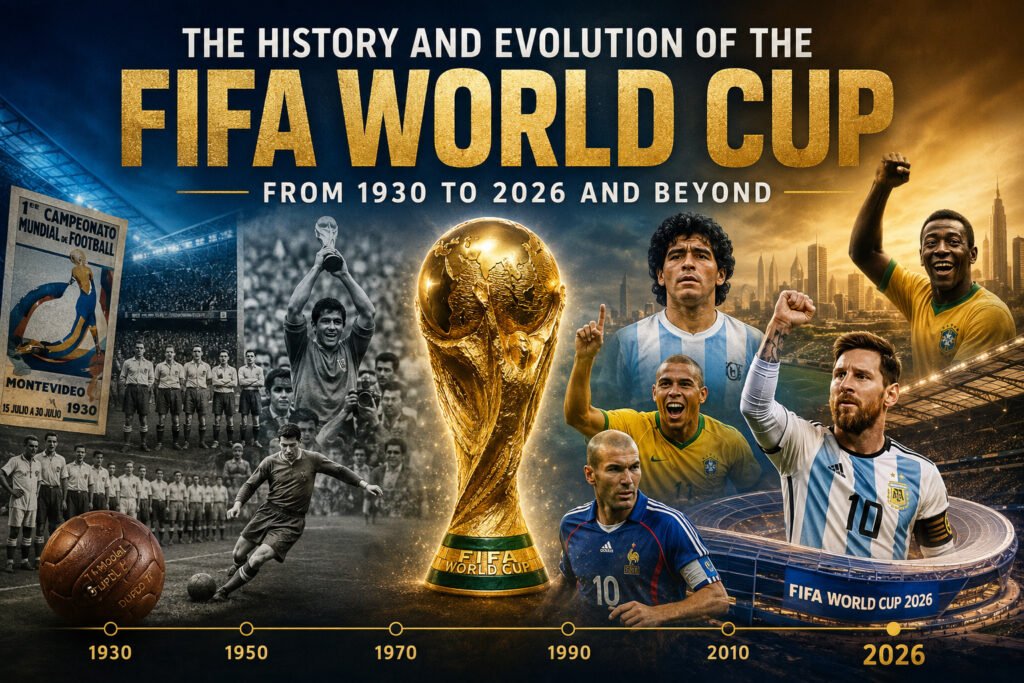
The FIFA World Cup has produced countless records, legendary players and unforgettable moments over nearly a century. To understand how these remarkable achievements evolved, read our detailed guide The History and Evolution of the FIFA World Cup: From 1930 to 2026 and Beyond, which traces the tournament’s journey from its inaugural edition in 1930 to the expanded 2026 World Cup.
1. Most Successful FIFA World Cup Teams
Only eight nations have ever become world champions.
Rank | Nation | Titles | Winning Years |
1 | Brazil | 5 | 1958, 1962, 1970, 1994, 2002 |
2 | Germany | 4 | 1954, 1974, 1990, 2014 |
3 | Italy | 4 | 1934, 1938, 1982, 2006 |
4 | Argentina | 3 | 1978, 1986, 2022 |
5 | Uruguay | 2 | 1930, 1950 |
6 | France | 2 | 1998, 2018 |
7 | England | 1 | 1966 |
8 | Spain | 1 | 2010 |
Interesting Fact
Brazil remains the only nation to have qualified for every FIFA World Cup finals tournament.
Every World Cup record begins with qualification. While football powerhouses have appeared regularly on the world’s biggest stage, many nations continue to strive for their first appearance. Learn more in How Teams Qualify for the FIFA World Cup – And Why India Is Yet to Reach Football’s Biggest Stage.
2. Players with the Most FIFA World Cup Goals
The greatest goalscorers have consistently delivered on football’s biggest stage.
Player | Goals |
Lionel Messi | 18* |
Miroslav Klose | 16 |
Kylian Mbappé | 15* |
Ronaldo Nazário | 15 |
Gerd Müller | 14 |
Just Fontaine | 13 |
Pelé | 12 |
*Updated during the ongoing 2026 FIFA World Cup.
Record that may never be broken
Just Fontaine, from France, scored 13 goals in a single World Cup (1958)—a record that has stood for nearly seven decades.
3. Most World Cup Appearances
Playing in even one FIFA World Cup is a dream. Playing across five or six editions is a mark of extraordinary fitness, consistency and longevity.
| Player | Country | World Cup Tournaments Played | Editions |
|---|---|---|---|
| Lionel Messi | Argentina | 6 | 2006, 2010, 2014, 2018, 2022, 2026 |
| Cristiano Ronaldo | Portugal | 6 | 2006, 2010, 2014, 2018, 2022, 2026 |
| Lothar Matthäus | Germany | 5 | 1982, 1986, 1990, 1994, 1998 |
| Antonio Carbajal | Mexico | 5 | 1950, 1954, 1958, 1962, 1966 |
Lionel Messi also holds the record for the most FIFA World Cup matches played, underlining his remarkable longevity at the highest level. Cristiano Ronaldo’s presence across six World Cups is equally historic, while Lothar Matthäus and Antonio Carbajal remain among the earliest symbols of long-term World Cup excellence.
4. Greatest Goalscoring Teams
The FIFA World Cup has witnessed thousands of memorable goals over the decades, but only a handful of nations have consistently dominated the scoring charts. Their attacking philosophy, world-class forwards and sustained success have enabled them to become the tournament’s most prolific goalscoring teams.
| Rank | Nation | Total World Cup Goals* |
|---|---|---|
| 1 | Brazil | 241 |
| 2 | Germany | 239 |
| 3 | Argentina | 148 |
| 4 | Italy | 128 |
*Totals updated during the ongoing FIFA World Cup 2026.
Brazil reclaimed the distinction of being the highest-scoring nation in FIFA World Cup history during the 2026 tournament, overtaking Germany after both teams added to their already impressive tallies. Argentina continues to climb the rankings thanks to another outstanding campaign led by Lionel Messi, while Italy remains among the all-time leading goalscoring nations despite not participating in every recent edition.
Interesting Fact
Brazil is not only the most successful nation with five FIFA World Cup titles, but also the highest-scoring team in the tournament’s history, underlining its long-standing reputation for entertaining, attacking football.
5. Biggest Wins in World Cup History
Some victories have become legendary.
Match | Result |
Hungary vs El Salvador (1982) | 10–1 |
Yugoslavia vs Zaire (1974) | 9–0 |
Hungary vs South Korea (1954) | 9–0 |
These remain among the highest winning margins in World Cup history.
6. Greatest Upsets Ever
Football’s beauty lies in its unpredictability.
Some of the greatest shocks include:
- Uruguay defeating Brazil in the 1950 final (“Maracanazo”)
- North Korea eliminating Italy in 1966
- Cameroon beating Argentina in 1990
- Saudi Arabia defeating Argentina in 2022
These matches changed football history forever.
7. Fastest Goal in FIFA World Cup History
The fastest goal means the goal scored in the shortest time after the referee starts the match from kick-off.
| Rank | Player | Country Represented | Time | Against | World Cup |
|---|---|---|---|---|---|
| 1 | Hakan Şükür | Türkiye | 11 seconds | South Korea | 2002 |
| 2 | Václav Mašek | Czechoslovakia | 16 seconds | Mexico | 1962 |
Hakan Şükür’s goal came in the 2002 FIFA World Cup third-place match between Türkiye and South Korea. He scored after only 11 seconds, making it the fastest goal in World Cup history.
Before Şükür broke the record, Václav Mašek of Czechoslovakia had held the record for 40 years. He scored after 16 seconds against Mexico in the 1962 World Cup.
8. Goalkeeping Records
Goalkeepers are often described as the last line of defence. Their performances can determine whether a team progresses or is eliminated from the FIFA World Cup.
What is a Clean Sheet?
A clean sheet is awarded to a goalkeeper (and the team’s defence) when they do not concede a single goal during the entire match, including extra time if played. Clean sheets are considered one of the most important measures of a goalkeeper’s performance because they reflect excellent shot-stopping, positioning, organisation of the defence and composure under pressure.
Goalkeepers with the Most FIFA World Cup Clean Sheets
| Rank | Goalkeeper | Country | Clean Sheets | World Cup Appearances | World Cups Played |
|---|---|---|---|---|---|
| 1 | Peter Shilton | England | 10 | 17 | 1982, 1986, 1990 |
| 1 | Fabien Barthez | France | 10 | 17 | 1998, 2002, 2006 |
| 3 | Jan Jongbloed | Netherlands | 8 | 12 | 1974, 1978 |
| 3 | Leão | Brazil | 8 | 14 | 1974, 1978, 1986 |
| 3 | Sepp Maier | West Germany | 8 | 18 | 1966, 1970, 1974, 1978 |
| 3 | Taffarel | Brazil | 8 | 18 | 1990, 1994, 1998 |
| 3 | Hugo Lloris | France | 8 | 20 | 2010, 2014, 2018, 2022 |
Remarkable Achievement
Peter Shilton of England was the first goalkeeper to reach 10 FIFA World Cup clean sheets, achieving the milestone across the 1982, 1986 and 1990 tournaments. More than 15 years later, France’s Fabien Barthez equalled the record through his performances in the 1998, 2002 and 2006 World Cups.
Barthez’s 1998 campaign was particularly memorable. Playing on home soil, he kept five clean sheets in seven matches, conceding only two goals throughout the tournament and helping France lift their first-ever FIFA World Cup trophy.
These records demonstrate that while spectacular goals often dominate the headlines, world-class goalkeeping and defensive discipline are equally vital ingredients for winning the FIFA World Cup.
9. Records That Define Greatness
Some achievements are likely to stand for decades.
- Most World Cup titles by a nation — Brazil (5)
- Most goals in one tournament — Just Fontaine (13)
- Youngest World Cup winner — Pelé (17 years)
- Only nation to qualify for every World Cup — Brazil
- Most appearances by one player — Lionel Messi
- Highest goals-per-game tournament — 1954
- Lowest goals-per-game tournament — 1990
The Future of the FIFA World Cup (2030, 2034 and Beyond)
The FIFA World Cup continues to evolve with expanded formats, new host nations and emerging football powers. Discover what lies ahead in The Future of the FIFA World Cup (2030, 2034 and Beyond), where we explore how the tournament is expected to develop over the coming decades.
Conclusion
The FIFA World Cup is much more than a tournament—it is a living archive of football excellence. Every edition produces new heroes, unforgettable matches and extraordinary statistics that become part of sporting history.
While records are made to be broken, some achievements—such as Brazil’s five titles, Just Fontaine’s astonishing 13 goals in a single tournament and Pelé’s triumph as a 17-year-old—remain among the greatest landmarks in world sport.
With every new World Cup, fresh names are added to football’s most prestigious record book, ensuring that the story of the beautiful game continues to evolve.
Frequently Asked Questions(FAQs)
Brazil has won the FIFA World Cup the most times, with a record five titles. Brazil became world champion in 1958, 1962, 1970, 1994 and 2002, making it the most successful nation in World Cup history.
As of the 2026 FIFA World Cup, Lionel Messi holds the record for the most goals in FIFA World Cup history, having scored 19 goals across six World Cup tournaments (2006–2026). He surpassed the previous record of 16 goals set by Miroslav Klose during the 2014 World Cup. Kylian Mbappé is currently second among active players and continues to close the gap during the 2026 tournament.
Top Five FIFA World Cup Goalscorers (Updated – June 2026)
| Rank | Player | Country | Goals | World Cups Played |
|---|---|---|---|---|
| 1 | Lionel Messi | Argentina | 19 | 2006, 2010, 2014, 2018, 2022, 2026 |
| 2 | Miroslav Klose | Germany | 16 | 2002, 2006, 2010, 2014 |
| 3 | Kylian Mbappé | France | 16 | 2018, 2022, 2026* |
| 4 | Ronaldo Nazário | Brazil | 15 | 1994, 1998, 2002, 2006 |
| 5 | Gerd Müller | Germany | 14 | 1970, 1974 |
Did You Know?
Lionel Messi’s 19 goals have come over a remarkable span of 20 years, from his World Cup debut in Germany in 2006 to the ongoing 2026 tournament. His record is considered one of the greatest achievements in football history
Lionel Messi of Argentina has played the most FIFA World Cup matches. He broke the long-standing record of Germany’s Lothar Matthäus, who had played 25 World Cup matches. Messi’s achievement reflects his exceptional longevity, consistency and importance to Argentina across multiple World Cup tournaments.
Just Fontaine of France holds the record for scoring the most goals in a single FIFA World Cup. He scored 13 goals in the 1958 World Cup held in Sweden. Remarkably, he achieved this in just one tournament, making it one of the most extraordinary individual records in football history.
Brazil is the only nation to have appeared in every FIFA World Cup since the tournament began in 1930. This unmatched record reflects Brazil’s extraordinary footballing depth, consistency and global dominance across generations.
Peter Shilton of England and Fabien Barthez of France share the record for the most FIFA World Cup clean sheets, with 10 clean sheets each. A clean sheet means that the goalkeeper’s team did not concede a goal during the match.
The biggest victory in FIFA World Cup history was Hungary’s 10–1 win over El Salvador in the 1982 World Cup in Spain. It remains the largest winning margin ever recorded in a World Cup finals match.
The fastest goal in FIFA World Cup history was scored by Hakan Şükür of Türkiye after just 11 seconds against South Korea in the 2002 World Cup. The match was the third-place play-off, and Şükür’s lightning-fast strike remains one of the most remarkable records in World Cup history.
Which country has reached the most World Cup finals?
Germany has reached the most FIFA World Cup finals, appearing in the final match eight times. Germany won the title in 1954, 1974, 1990 and 2014, and finished as runners-up in 1966, 1982, 1986 and 2002.
Pelé of Brazil is the youngest player to win the FIFA World Cup. He was only 17 years old when Brazil won the 1958 World Cup in Sweden. His extraordinary performances in that tournament made him one of football’s earliest global superstars.
Essam El-Hadary of Egypt is the oldest player to appear in a FIFA World Cup match. He played against Saudi Arabia in the 2018 World Cup at the age of 45 years and 161 days. He was also Egypt’s goalkeeper in that match, making the record even more remarkable.
Roger Milla of Cameroon is the oldest goalscorer in FIFA World Cup history. He scored against Russia in the 1994 World Cup at the age of 42 years and 39 days. His record remains one of the most celebrated examples of longevity in World Cup football.
The 2026 FIFA World Cup produced the most goals in tournament history, surpassing all previous editions. The expanded 48-team format and increased number of matches contributed to the record-breaking total, making it the highest-scoring FIFA World Cup ever held.
Note: This record was set during the 2026 tournament, which surpassed the previous highest total of 171 goals, jointly recorded at the 1998 and 2014 FIFA World Cups.
The 1930 FIFA World Cup had the fewest total goals, with 70 goals scored in 18 matches. However, this was mainly because the first World Cup had far fewer teams and matches than modern tournaments.
The 1994 FIFA World Cup in the United States recorded the highest total attendance in tournament history, with more than 3.5 million spectators attending the matches. This record is especially remarkable because the 1994 tournament had only 24 teams, far fewer than modern expanded editions.
Brazil has scored the most goals in FIFA World Cup history. This reflects the country’s long-standing attacking tradition, its record number of World Cup appearances and its legendary players across generations, including Pelé, Ronaldo Nazário, Romário, Rivaldo, Ronaldinho and Neymar.
Lionel Messi of Argentina is widely recognised as the player with the most assists in FIFA World Cup history, with 8 assists. His creativity, vision and passing have made him not only one of the greatest goalscorers but also one of the finest playmakers in World Cup history.
Germany has appeared in the most FIFA World Cup semi-finals, reaching the last four 13 times. This remarkable achievement reflects Germany’s consistency and competitiveness across different generations, making it one of the most successful nations in World Cup history.
The Maracanazo refers to Uruguay’s famous 2–1 victory over Brazil in the decisive match of the 1950 FIFA World Cup at the Maracanã Stadium in Rio de Janeiro. Played before a crowd of nearly 200,000 spectators, the result stunned the host nation and is widely regarded as one of the greatest upsets in football history. The term Maracanazo means “the blow at the Maracanã” or “the Maracanã shock” in Spanish.
The Miracle of Bern refers to West Germany’s unexpected 3–2 victory over Hungary in the 1954 FIFA World Cup Final, played on 4 July 1954 at the Wankdorf Stadium in Bern, Switzerland. Hungary entered the final unbeaten for four years and had already defeated West Germany 8–3 earlier in the tournament, making the German victory one of the greatest upsets in football history.
The triumph marked West Germany’s first FIFA World Cup title and became a powerful symbol of the nation’s post-war recovery and resurgence. The match is widely regarded as one of the most iconic moments in the history of the FIFA World Cup.
The largest winning margin in FIFA World Cup history is 9 goals. This record was set when Hungary defeated El Salvador 10–1 during the 1982 FIFA World Cup in Spain. It remains the biggest margin of victory ever recorded in a FIFA World Cup finals match.
Mexico has hosted or co-hosted the FIFA World Cup the most times. It hosted the tournament in 1970 and 1986, and is also one of the three co-hosts of the 2026 FIFA World Cup, along with the United States and Canada.
The FIFA World Cup Golden Ball is awarded to the best overall player of the tournament, recognising outstanding performances, leadership and overall contribution throughout the competition.
Lionel Messi of Argentina has won the Golden Ball a record two times—first in 2014, when he led Argentina to the final, and again in 2022, when he captained his country to its third FIFA World Cup title. He remains the only player to have won the award twice.
The FIFA World Cup Golden Boot is awarded to the top goalscorer of the tournament. If two or more players score the same number of goals, assists and minutes played are used as tie-breakers.
No player has won the FIFA World Cup Golden Boot more than once. Several legendary footballers have won the award once, including Just Fontaine (1958), Gerd Müller (1970), Paolo Rossi (1982), Gary Lineker (1986), Salvatore Schillaci (1990), Oleg Salenko (1994, shared), Ronaldo Nazário (2002), Miroslav Klose (2006), Thomas Müller (2010), James Rodríguez (2014), Harry Kane (2018) and Kylian Mbappé (2022).
The 1950 FIFA World Cup final-round match between Brazil and Uruguay at the Maracanã Stadium in Rio de Janeiro attracted the highest attendance in World Cup history. An estimated 199,854 spectators witnessed Uruguay’s dramatic 2–1 victory, a match that became known as the Maracanazo.
A total of eight national teams have won the FIFA World Cup since the tournament began in 1930. They are Brazil, Germany, Italy, Argentina, France, Uruguay, England and Spain. Brazil leads the list with a record five titles.
The 2026 FIFA World Cup is the longest FIFA World Cup tournament by duration. It runs from 11 June to 19 July 2026, lasting 39 days. The longer duration is mainly due to the expanded 48-team format, more matches and the tournament being hosted across three countries: the United States, Canada and Mexico.
This means a player who has scored at least one goal in the highest number of separate FIFA World Cup tournaments, not the total number of goals scored.
Cristiano Ronaldo of Portugal is the first male player to score in five different FIFA World Cups: 2006, 2010, 2014, 2018 and 2022. This record highlights his extraordinary longevity and consistency at the highest level of international football.
World Cup win percentage measures how often a team wins its matches at the FIFA World Cup. It is calculated by dividing the number of matches won by the total matches played and expressing the result as a percentage.
Among nations with a significant World Cup history, Brazil has the highest overall win percentage. With five FIFA World Cup titles, Brazil has consistently maintained one of the best winning records in the tournament, reflecting its long-standing dominance and success on football’s biggest stage.
Several FIFA World Cup records could be broken in future tournaments, especially because the competition has expanded to 48 teams from 2026. Records most likely to change include total goals in a tournament, total attendance, most matches played by a player, most goals by an active player, and team goalscoring records. However, some records, such as Just Fontaine’s 13 goals in a single World Cup, may remain extremely difficult to break.