Table of Contents
ToggleIntroduction
Every four years, the FIFA World Cup captures the imagination of billions of people across the globe. Streets come alive with celebrations, families gather around television screens, stadiums reverberate with the chants of passionate supporters, and entire nations unite behind their teams. For one month, football becomes more than a sport—it becomes a global celebration of talent, emotion, national pride, and cultural diversity.
What began as a modest tournament involving just 13 teams in Uruguay in 1930 has grown into the largest sporting spectacle on Earth. Today, the FIFA World Cup is watched by billions of viewers, generates billions of dollars in economic activity, and inspires generations of footballers across every continent.
But how did the tournament begin? Why is it played only once every four years? How are host countries selected? Why has India never qualified? What makes the 2026 World Cup different from all previous editions? And what does the future hold for football’s greatest tournament?
This article answers these and many other fascinating questions while tracing the remarkable journey of the FIFA World Cup—from its humble beginnings to its emergence as the world’s most celebrated sporting event.
The Birth of FIFA and International Football
Before there could be a World Cup, there had to be an organisation capable of governing the game internationally.
The Fédération Internationale de Football Association (FIFA) was founded on 21 May 1904 in Paris, France, by representatives from seven European nations:
- France
- Belgium
- Denmark
- Netherlands
- Spain (represented by Madrid FC)
- Sweden
- Switzerland
At the beginning of the twentieth century, football was rapidly gaining popularity, but each country followed slightly different rules and there was no international governing body to organise competitions or resolve disputes.
FIFA was therefore established with four principal objectives:
- To standardise the Laws of the Game internationally.
- To organise international football competitions.
- To promote football across the world.
- To encourage friendship and sporting cooperation among nations.
Initially, FIFA’s activities were largely confined to Europe. However, as football spread across South America, Asia, Africa, and later North America, FIFA gradually transformed into the world’s governing body for football. Today, it comprises 211 national member associations, making it one of the largest international sporting organisations.
The Birth of FIFA and International Football
Before there could be a World Cup, there had to be an organisation capable of governing the game internationally.
The Fédération Internationale de Football Association (FIFA) was founded on 21 May 1904 in Paris, France, by representatives from seven European nations:
- France
- Belgium
- Denmark
- Netherlands
- Spain (represented by Madrid FC)
- Sweden
- Switzerland
At the beginning of the twentieth century, football was rapidly gaining popularity, but each country followed slightly different rules and there was no international governing body to organise competitions or resolve disputes.
FIFA was therefore established with four principal objectives:
- To standardise the Laws of the Game internationally.
- To organise international football competitions.
- To promote football across the world.
- To encourage friendship and sporting cooperation among nations.
Initially, FIFA’s activities were largely confined to Europe. However, as football spread across South America, Asia, Africa, and later North America, FIFA gradually transformed into the world’s governing body for football. Today, it comprises 211 national member associations, making it one of the largest international sporting organisations.
Football Before the FIFA World Cup
Many readers assume that international football began with the FIFA World Cup. In reality, international matches had been played for decades before 1930.
The first officially recognised international football match took place in 1872 between England and Scotland.
Later, football became part of the Olympic Games, beginning in 1900 as a demonstration sport and officially from 1908 onwards. Although the Olympic football tournament attracted considerable attention, it had several limitations:
- Participation was largely restricted to amateur players.
- Professional footballers were excluded for many years.
- The tournament was organised by the International Olympic Committee (IOC), not FIFA.
- Football was only one of many sports at the Olympics and lacked its own dedicated global identity.
As football’s popularity continued to grow, FIFA believed the sport deserved an independent world championship where the best national teams could compete irrespective of amateur or professional status.
This vision eventually led to the creation of the FIFA World Cup.
The First FIFA World Cup – Uruguay 1930
The inaugural FIFA World Cup was held in Uruguay from 13 July to 30 July 1930.
Uruguay was chosen for several compelling reasons:
- It had won consecutive Olympic football gold medals in 1924 and 1928.
- The country was celebrating the centenary of its Constitution.
- The Uruguayan government agreed to finance much of the tournament and provide travel assistance to participating teams.
- It had developed one of the strongest football cultures in the world.
Only 13 nations participated:
- Seven from South America
- Four from Europe
- Two from North America
Travel to Uruguay was a major challenge in 1930. Many European teams undertook lengthy sea voyages lasting several weeks to reach South America.
The final was played at the iconic Estadio Centenario in Montevideo, where Uruguay defeated Argentina 4–2 to become the first FIFA World Cup champions.
No one could have imagined that this relatively small tournament would evolve into the greatest sporting event on Earth.
Why Is the FIFA World Cup Held Every Four Years?
One of the most frequently asked questions is why the World Cup is organised every four years rather than annually.
The answer lies in a combination of sporting, logistical, commercial, and historical factors.
Sporting Reasons
National teams require sufficient time to identify emerging talent, develop players, and prepare competitive squads. A four-year cycle allows footballing nations to build teams capable of competing at the highest level.
Qualification Process
Hundreds of qualifying matches are played across six continental confederations over nearly three years. Conducting this process annually would be impractical and would disrupt domestic and international football calendars.
Domestic Football Calendar
Professional players spend most of the year representing their clubs in domestic leagues and continental competitions such as the UEFA Champions League and Copa Libertadores. Holding a World Cup every year would significantly disrupt these competitions.
Economic and Organisational Considerations
Hosting the FIFA World Cup is one of the largest logistical exercises in global sport. Stadium construction, transport infrastructure, security arrangements, accommodation, broadcasting, and sponsorship planning require several years of preparation.
Preserving Prestige
Perhaps the most important reason is that rarity creates value. By taking place only once every four years, the FIFA World Cup remains one of the most eagerly anticipated sporting events in the world. Its infrequency adds to its prestige and ensures that every edition becomes a landmark occasion for players, supporters, and host nations alike.
How FIFA Selects Host Nations
Hosting the FIFA World Cup is one of the greatest honours in international sport. Beyond football, it represents an opportunity for a nation to showcase its culture, infrastructure, organisational capabilities and hospitality to billions of people worldwide. Consequently, the process of selecting a host country is rigorous, transparent and highly competitive.
The FIFA Bidding Process
Countries wishing to host the tournament must submit a formal bid to FIFA several years in advance. The bidding process involves extensive documentation, financial guarantees and detailed plans covering every aspect of organising the competition.
An independent FIFA evaluation team studies each bid before presenting its findings to the FIFA Council, which ultimately decides the successful host nation or nations.
Key Selection Criteria
FIFA considers numerous factors before awarding hosting rights, including:
Stadium Infrastructure
Host nations must provide world-class stadiums capable of accommodating large crowds, media facilities, hospitality areas and advanced broadcasting infrastructure. Existing stadiums may be renovated, while new venues are often constructed.
Transport and Connectivity
Efficient airports, highways, rail networks and public transport systems are essential to ensure millions of supporters, players, officials and journalists can travel conveniently between host cities.
Accommodation
Thousands of hotel rooms and other accommodation facilities are required to house teams, match officials, media personnel and supporters from across the world.
Financial Capability
Governments are generally expected to provide financial guarantees for infrastructure development, security arrangements and tournament operations.
Safety and Security
The safety of players, officials and spectators remains paramount. Comprehensive security planning forms an important part of every bid.
Sustainability
Modern FIFA tournaments place increasing emphasis on environmental sustainability, renewable energy, carbon reduction and responsible use of resources.
Football Legacy
FIFA also evaluates how hosting the World Cup will promote football development, youth participation and long-term sporting infrastructure within the host nation.
Joint Hosting
For the first time in history, the 2002 FIFA World Cup was jointly hosted by Japan and South Korea.
The concept has since evolved further. The 2026 FIFA World Cup will be jointly hosted by Canada, Mexico and the United States, demonstrating that multiple nations can successfully collaborate in organising the world’s largest sporting event.
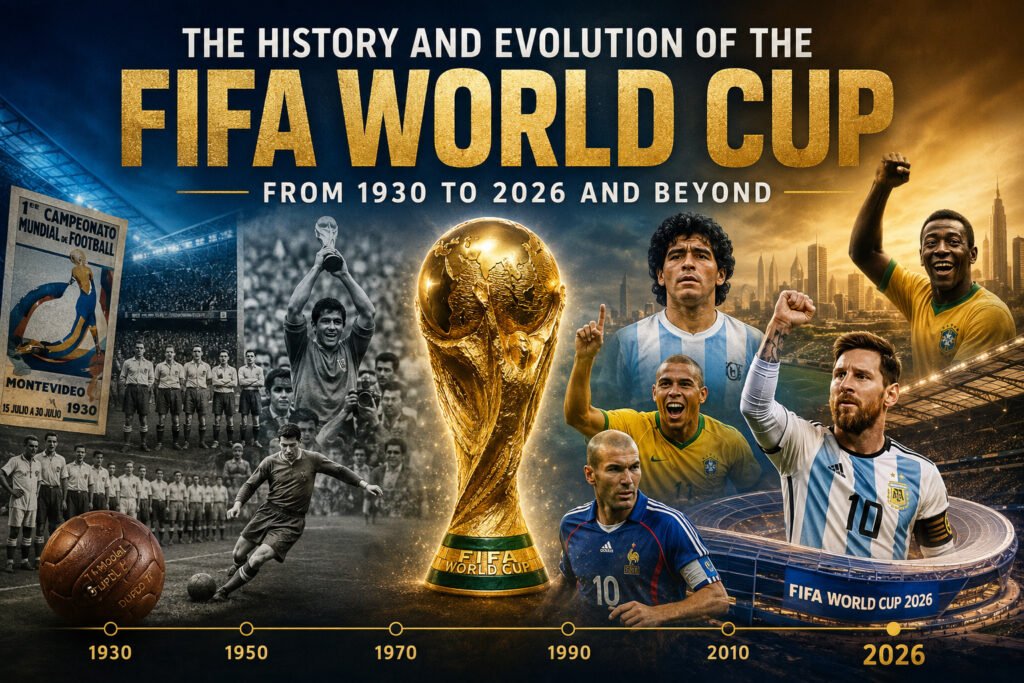
The Evolution of the FIFA World Cup Through the Decades (1930–2026)
The FIFA World Cup has continually evolved over the past nine decades, reflecting changes in football, technology, global politics and international participation.
1930 – The Beginning
The inaugural tournament featured only 13 teams and was played entirely in Uruguay.
1934 and 1938
Italy hosted consecutive pre-war World Cups, while qualification rounds were introduced to determine participating nations.
1950 – Football Returns
Following a 12-year interruption caused by the Second World War, the World Cup returned in Brazil. Uruguay once again created history by defeating the hosts in the famous ‘Maracanazo’.
1954–1970 – Television Changes Everything
Live television transformed football into a truly global spectacle. Millions of viewers could now witness legendary players such as Pelé, Garrincha and Eusébio.
1974 – A New Trophy
The original Jules Rimet Trophy was permanently awarded to Brazil after its third World Cup triumph in 1970. It was replaced by the current FIFA World Cup Trophy, which remains in use today.
1982 – Expansion Begins
The number of participating teams increased from 16 to 24, reflecting football’s growing popularity worldwide.
1998 – A Truly Global Tournament
The competition expanded again to 32 teams, giving greater representation to Africa, Asia and North America.
2010 – A Historic First
South Africa became the first African nation to host the FIFA World Cup, marking a significant milestone in football’s global expansion.
2018 – The VAR Era
Video Assistant Referee (VAR) technology was introduced, revolutionising decision-making during matches.
2022 – A Winter World Cup
For the first time, the tournament was staged during November and December due to climatic conditions in Qatar.
2026 – The Biggest World Cup Ever
The FIFA World Cup enters a completely new era:
- 48 participating nations.
• 104 matches.
• Three host countries.
• 16 host cities.
• Millions of travelling supporters.
• Record-breaking global television audiences expected.
The evolution of the tournament mirrors football’s transformation into the world’s most popular sport.
The FIFA World Cup: A Legacy That Continues to Inspire
Few sporting events have left a lasting impact on humanity quite like the FIFA World Cup. Since the inaugural tournament in Uruguay in 1930, the competition has grown far beyond the boundaries of football. It has become a symbol of hope, national pride, sporting excellence and global unity, bringing together people from diverse cultures, languages and backgrounds through their shared passion for the beautiful game.
A Celebration of National Pride
For every participating nation, the FIFA World Cup represents far more than a football tournament. It is an opportunity to showcase national identity, culture and sporting excellence before a global audience. Every goal scored, every victory achieved and every trophy lifted becomes part of a country’s sporting heritage, celebrated for generations.
Uniting the World Through Football
Perhaps no other sporting event has the ability to unite billions of people quite like the FIFA World Cup. During the tournament, differences of nationality, language, religion and politics often give way to a common love for football. Families, friends and even strangers gather in homes, public squares, restaurants and stadiums to share moments of joy, heartbreak and celebration.
The World Cup demonstrates how sport can build bridges between nations and promote mutual respect, friendship and understanding.
Inspiring Future Generations
For countless young boys and girls across the world, the FIFA World Cup is the beginning of a dream. Watching legendary players perform on football’s biggest stage inspires children to take up the sport and aspire to represent their own countries one day.
Many of today’s greatest footballers have often spoken about how childhood memories of watching the World Cup shaped their ambitions and careers.
A Platform for Sporting Legends
The World Cup has provided the stage on which some of football’s greatest legends have etched their names into sporting history. Players such as Pelé, Diego Maradona, Zinedine Zidane, Ronaldo Nazário, Lionel Messi and Cristiano Ronaldo have captivated millions through unforgettable performances that transcended the sport itself.
Their achievements have inspired not only footballers but generations of sports enthusiasts around the world.
Driving Innovation in Football
The tournament has also played a significant role in the evolution of football itself. Over the decades, the FIFA World Cup has witnessed remarkable advances in sports science, coaching techniques, refereeing standards, broadcasting technology and player safety.
Innovations such as goal-line technology, the Video Assistant Referee (VAR) system, semi-automated offside technology and advanced player performance analytics have transformed how the modern game is played, officiated and experienced by supporters.
Economic and Cultural Impact
Hosting the FIFA World Cup often accelerates investment in stadiums, transport networks, airports, hotels and urban infrastructure. The tournament generates employment, boosts tourism and enhances a nation’s international visibility.
Beyond economics, the World Cup has become a celebration of music, art, culture and hospitality. Opening ceremonies, fan festivals and cultural programmes provide host nations with an opportunity to share their traditions with visitors from every corner of the globe.
More Than Just a Tournament
What truly distinguishes the FIFA World Cup is its emotional connection with billions of people. Every edition creates stories of triumph against adversity, unforgettable upsets, dramatic comebacks and moments of extraordinary sportsmanship that remain etched in collective memory.
Whether it is a child’s first experience of watching football, a veteran supporter witnessing another historic campaign, or an underdog nation defying expectations, the World Cup continually reminds us that sport has the power to inspire, unite and transcend boundaries.
As football continues to evolve, the FIFA World Cup remains its ultimate stage—celebrating not only the pursuit of sporting excellence but also the enduring values of teamwork, perseverance, respect and fair play.
Over nearly a century, the FIFA World Cup has not only evolved into the world’s most celebrated sporting event but has also created countless unforgettable records, legendary performances and historic moments. Readers wishing to explore these remarkable achievements can continue with our dedicated article “FIFA World Cup Records and Statistics: The Greatest Players, Teams and Moments Ever”, where the tournament’s most extraordinary milestones are presented in detail.
FIFA World Cup 2026 – A New Era Begins
The 2026 FIFA World Cup will represent the most significant transformation in the tournament’s history. For the first time:
- 48 national teams will compete.
• 104 matches will be played.
• Three countries will jointly host the tournament.
• Sixteen modern stadiums will stage matches.
The tournament will be held across:
- Canada
• Mexico
• United States
The Host Cities
Sixteen host cities have been selected across North America, each offering world-class sporting infrastructure and extensive transport networks.
The Final
The FIFA World Cup Final will be played at MetLife Stadium in East Rutherford, New Jersey, one of the largest and most modern sporting venues in the world.
The Semi-finals
The two semi-finals will be played at:
- AT&T Stadium, Arlington (Dallas), Texas.
• Mercedes-Benz Stadium, Atlanta, Georgia.
Tournament Format
The competition expands from 32 to 48 teams. This allows more nations from Africa, Asia, North America and Oceania to participate, making the tournament even more representative of world football.
New Rules and Innovations
The 2026 tournament is expected to showcase further technological advancements, including enhanced semi-automated offside technology, improved VAR systems, advanced player tracking and more sophisticated fan engagement through digital platforms.
The expanded format also increases opportunities for emerging football nations to compete on the world’s biggest stage, reinforcing FIFA’s objective of making football truly global.
How Teams Qualify for the FIFA World Cup – And Why India Is Yet to Reach Football's Biggest Stage
Qualifying for the FIFA World Cup is one of the most challenging achievements in international football. Unlike the host nation, which automatically qualifies for the tournament, every other country must earn its place through a rigorous qualification process conducted over nearly three years.
For the 2026 FIFA World Cup, the expansion from 32 to 48 teams has provided greater opportunities for countries across every continent. Nevertheless, qualification remains fiercely competitive, with more than 200 FIFA member nations competing for only 48 places.
How Teams Qualify
FIFA divides the world into six continental confederations, each responsible for organising its own qualifying competition.
These are:
-
AFC (Asia)
-
CAF (Africa)
-
CONCACAF (North and Central America & Caribbean)
-
CONMEBOL (South America)
-
OFC (Oceania)
-
UEFA (Europe)
Each confederation is allocated a specific number of qualification places based on factors such as footballing strength, competitiveness and the number of member associations.
National teams compete in multiple qualifying rounds, usually involving both home and away matches. Only the best-performing teams secure direct qualification, while others may enter intercontinental play-offs for the remaining places.
This demanding qualification system ensures that only the strongest and most consistent teams reach football’s biggest stage.
Why Has India Never Qualified?
India’s absence from the FIFA World Cup has often surprised sports enthusiasts, particularly given the country’s population and growing passion for football.
The reasons are complex and extend far beyond the performance of the national team.
Limited Football Infrastructure
Although football enjoys tremendous popularity in states such as West Bengal, Kerala, Goa, Manipur and Mizoram, the country has historically lacked sufficient world-class training facilities, academies and grassroots development programmes compared with leading football nations.
Cricket’s Overwhelming Popularity
Cricket has traditionally dominated India’s sporting landscape, attracting the majority of sponsorship, media attention and sporting infrastructure. As a result, football has received comparatively fewer financial resources and developmental opportunities.
Grassroots Development
Many successful football nations invest heavily in identifying and nurturing talented children from an early age. While India has made encouraging progress in youth development, consistent nationwide programmes are still evolving.
Competitive Qualification Path
Asia has become increasingly competitive. Nations such as Japan, South Korea, Iran, Saudi Arabia, Australia and, more recently, Uzbekistan and Jordan have significantly strengthened their football programmes, making qualification increasingly difficult.
Domestic League Development
The establishment of the Indian Super League (ISL) and improvements in the I-League have enhanced the standard of domestic football. Increased professionalism, improved coaching standards and better infrastructure are gradually raising the overall quality of Indian football.
A Historic Opportunity Ahead
The expansion of the FIFA World Cup to 48 teams has increased Asia’s allocation of qualification places, providing countries like India with a better opportunity than ever before.
Although qualification remains a formidable challenge, the gap between traditional football powers and emerging nations is gradually narrowing. Continued investment in youth academies, coaching, sports science and domestic competitions could significantly enhance India’s prospects in future World Cups.
A Journey of Hope Rather Than Disappointment
India’s football story should not be viewed solely through the lens of World Cup qualification. The country possesses one of the world’s largest youth populations, a rapidly growing football fan base, improving professional leagues and increasing investment in grassroots development.
Recent successes in age-group tournaments, expanding football academies and stronger international exposure suggest that Indian football is moving in the right direction. While qualification for the FIFA World Cup may not happen immediately, the dream is no longer unrealistic.
For millions of Indian football supporters, the aspiration remains clear—to one day witness the Indian tricolour proudly represented on football’s greatest stage.
The journey may be long, but every great football nation began with a dream. With sustained planning, investment and commitment, India has the potential to become a competitive force in world football in the decades ahead.
Financial Rewards of Qualifying for the FIFA World Cup
Qualifying for the FIFA World Cup is not only a matter of national pride but also brings significant financial benefits. FIFA distributes prize money to every participating nation, with the amount increasing as teams progress through the tournament.
The 2026 FIFA World Cup offers the largest prize fund in the tournament’s history, reflecting the expansion to 48 participating teams and the growing commercial success of world football.
The performance-based prize money is approximately as follows:
| Final Position | Prize Money (USD) |
|---|---|
| Champions | $50 million |
| Runners-up | $33 million |
| Third Place | $29 million |
| Fourth Place | $27 million |
| Quarter-finalists (5th–8th) | $19 million each |
| Round of 16 (9th–16th) | $15 million each |
| Round of 32 (17th–32nd) | $11 million each |
| Group Stage (33rd–48th) | $9 million each |
In addition to the performance-based rewards, every qualified nation receives:
-
Qualification Payment: USD 10 million
-
Tournament Preparation Grant: USD 2.5 million
This means that even a team eliminated in the group stage receives a guaranteed minimum financial contribution of USD 12.5 million, helping national football associations invest in player development, coaching, grassroots programmes and football infrastructure.
For emerging football nations, qualification therefore brings benefits that extend far beyond the tournament itself. Increased sponsorship, broadcasting revenue, international exposure and government support often follow a successful World Cup campaign, accelerating the long-term development of football within the country.
The Future of the FIFA World Cup (2030, 2034 and Beyond)
As the FIFA World Cup approaches its centenary, the tournament continues to evolve in scale, technology and global reach. What began as a competition involving just 13 teams in 1930 is now transforming into an event that brings together 48 nations and billions of supporters across every continent.
The future of the FIFA World Cup is likely to be shaped not only by football itself but also by technological innovation, sustainability, changing fan expectations and the growing popularity of the game in emerging football nations.
FIFA World Cup 2030 – Celebrating a Century of Football
The 2030 FIFA World Cup will mark the 100th anniversary of the tournament, making it one of the most historic editions in football history.
To celebrate this remarkable milestone, FIFA has adopted an unprecedented hosting model.
Main Host Nations
The majority of the tournament will be jointly hosted by:
-
Spain
-
Portugal
-
Morocco
However, in recognition of the tournament’s origins, the opening celebratory matches will be played in:
-
Uruguay
-
Argentina
-
Paraguay
This unique six-nation format honours the birthplace of the FIFA World Cup while showcasing football’s global expansion over the past century.
The centenary edition is expected to combine football, history and culture on an unprecedented scale, celebrating a hundred years of the world’s greatest sporting competition.
FIFA World Cup 2034 – Saudi Arabia
The 2034 FIFA World Cup has been awarded to Saudi Arabia.
The country has announced ambitious plans to develop state-of-the-art stadiums, smart cities, transport infrastructure and environmentally sustainable sporting venues.
The tournament is expected to form part of Saudi Arabia’s broader Vision 2030 programme, which aims to diversify the country’s economy through investments in tourism, sport, entertainment and infrastructure.
Hosting the FIFA World Cup is expected to accelerate football development across the Middle East while further strengthening the region’s role in global sport.
The Future of Host Selection
Selecting a FIFA World Cup host has become increasingly complex.
Beyond football infrastructure, FIFA now evaluates bids based on several important considerations:
-
Stadium readiness.
-
Transport infrastructure.
-
Accommodation capacity.
-
Financial guarantees.
-
Environmental sustainability.
-
Human rights commitments.
-
Security arrangements.
-
Long-term football development.
-
Legacy benefits for local communities.
Joint bids involving multiple countries are also becoming increasingly common, allowing nations to share costs, infrastructure and organisational responsibilities.
Technology Will Continue to Transform Football
Technology has become an integral part of the modern FIFA World Cup.
Future tournaments are expected to make greater use of:
-
Artificial Intelligence for performance analysis.
-
Enhanced Video Assistant Referee (VAR) systems.
-
Semi-automated offside technology.
-
Smart footballs with embedded sensors.
-
Wearable player-performance monitoring.
-
Advanced injury-prevention systems.
-
Immersive viewing experiences through Augmented Reality (AR) and Virtual Reality (VR).
These innovations aim to improve fairness, player safety and the overall experience for supporters both inside stadiums and watching around the world.
Sustainability Will Become a Priority
Future FIFA World Cups are expected to place increasing emphasis on sustainability.
Host nations are likely to invest in:
-
Carbon-neutral stadiums.
-
Renewable energy.
-
Sustainable public transport.
-
Water conservation.
-
Waste management and recycling.
-
Green building practices.
FIFA’s objective is to ensure that future tournaments leave a positive environmental and social legacy for host communities.
Greater Global Representation
The expansion to 48 teams in 2026 reflects FIFA’s commitment to making football more inclusive.
Future tournaments may witness stronger participation from:
-
Asia
-
Africa
-
North America
-
Oceania
This broader representation provides emerging football nations with greater opportunities to compete against the world’s elite while accelerating football development across new regions.
Will India One Day Qualify?
One question frequently asked by Indian football supporters is whether India will one day play in a FIFA World Cup.
Although qualification remains a formidable challenge, the expanded tournament format, increasing investment in football infrastructure, growing popularity of the Indian Super League (ISL), improved youth academies and greater international exposure offer encouraging signs.
If India continues to invest in grassroots development, coaching, sports science and professional football, the dream of seeing the Indian tricolour on football’s biggest stage may eventually become a reality.
Beyond Football
The FIFA World Cup is no longer simply a sporting competition.
It has evolved into a global platform for cultural exchange, technological innovation, tourism, diplomacy and economic development.
Each tournament leaves behind not only unforgettable sporting memories but also new infrastructure, stronger international partnerships and lasting inspiration for future generations.
As football enters its second century as a truly global sport, the FIFA World Cup will continue to evolve while remaining faithful to its founding purpose—to unite nations through the universal language of football.
The venues may change, the technology may advance and new footballing powers may emerge, but the passion, excitement and sense of unity that define the FIFA World Cup will continue to inspire billions of people around the world for generations to come.