Table of Contents
ToggleIntroduction – Does Non-Alignment Still Matter?
For much of the twentieth century, India’s foreign policy was closely associated with one idea: non-alignment.
The principle was simple. India would not become part of a military bloc led by either the United States or the Soviet Union. Instead, it would try to preserve the freedom to judge each international issue on its own merits.
That approach made sense in the Cold War world.
But the world has changed.
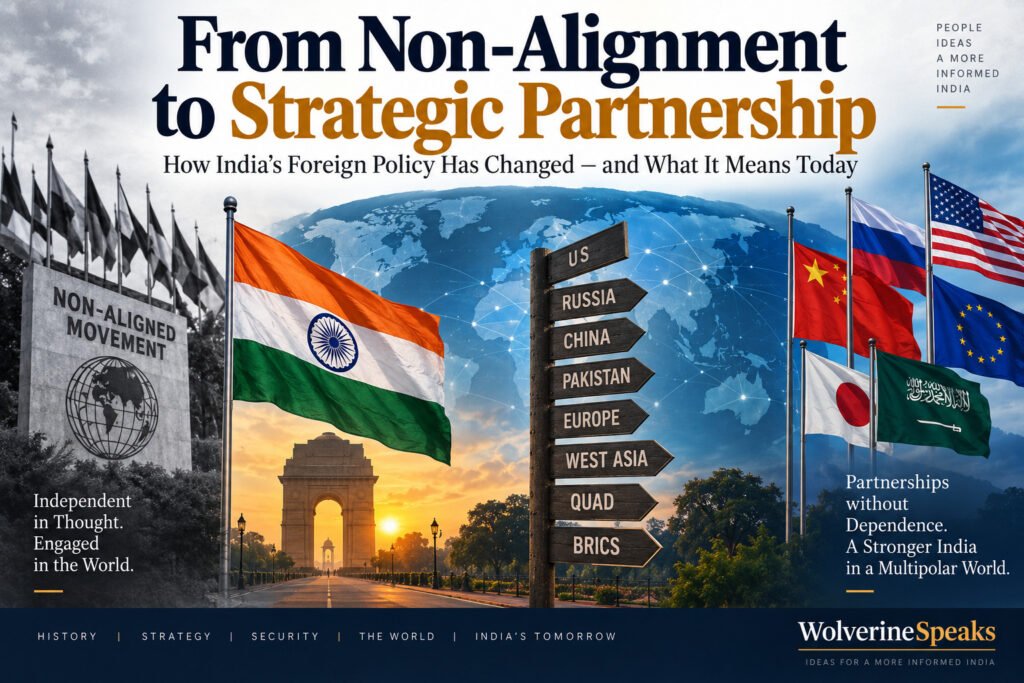
Today, India works closely with the United States, is part of the Quad, remains a member of BRICS, continues important ties with Russia and must also manage a difficult relationship with China.
This raises an obvious question:
Has India moved away from non-alignment, or has it simply adapted the same idea to a more complicated world?
Supporters of the present approach call it strategic autonomy — the ability to cooperate with different powers without becoming dependent on any one of them.
Critics, however, may ask whether closer strategic partnerships could gradually reduce the very freedom of action that non-alignment was meant to protect.
That debate has become more relevant as new regional alignments emerge around India and major powers compete for influence in Asia.
This article looks at how India moved from non-alignment to strategic autonomy, why that shift took place, and whether the change represents an evolution of India’s traditional policy — or a departure from it.
Explore the Wider History & World Affairs Series
This article forms part of WolverineSpeaks’ broader History & World Affairs series, which connects today’s geopolitical developments with the historical forces that shaped them.
Read: History & World Affairs
[Insert link to the main History & World Affairs pillar post]
2. Why India Chose Non-Alignment
When India became independent in 1947, the world was already dividing into two powerful camps.
On one side stood the United States and its Western allies. On the other stood the Soviet Union and the communist bloc.
For a newly independent country, joining either side carried risks.
India had only recently emerged from colonial rule and was determined to protect its political independence. Becoming closely tied to another great power could have limited that freedom.
There were practical reasons as well.
India needed economic development, technology, defence equipment and diplomatic support. It could not afford to depend entirely on one bloc when useful partnerships were available on both sides.
There was also a wider moral argument.
Indian leaders believed that newly independent countries in Asia and Africa should not simply become extensions of the old power rivalry. They should have the right to make their own choices.
This became the foundation of non-alignment.
It did not mean that India would remain neutral on every international issue.
It meant that India would try to judge each issue independently rather than automatically follow one bloc or the other.
That distinction is important.
Non-alignment was not about standing aside from world affairs.
It was about preserving freedom of judgement.
And for a newly independent India, that freedom was seen as essential to both sovereignty and national interest.
3. Nehru, the Cold War and Strategic Independence
Jawaharlal Nehru became the strongest early voice of India’s non-aligned foreign policy.
He believed that a newly independent country should not surrender its judgement to either of the two Cold War blocs. India, in his view, had to remain free to support or oppose a major power depending on the issue.
This was an important distinction.
Non-alignment did not mean equal distance from the United States and the Soviet Union. Nor did it mean silence.
India sometimes agreed with the West, sometimes with the Soviet Union, and sometimes with neither.
Nehru also wanted India to play a larger role among the newly independent countries of Asia and Africa. This wider movement eventually became associated with the Non-Aligned Movement, which sought to give developing countries a stronger collective voice in world affairs.
India’s position was therefore both idealistic and practical.
It spoke about peace, anti-colonialism and national independence, but it also protected India’s ability to seek economic, diplomatic and defence cooperation from different countries.
There were tensions and contradictions, of course.
India’s relations with China deteriorated badly, culminating in the 1962 war, while Pakistan developed closer military ties with the United States.
These events tested the limits of non-alignment.
Yet the underlying principle survived:
India would cooperate where necessary, but would resist becoming formally tied to a great-power bloc.
That principle remained central to Indian foreign policy long after Nehru.
4. India and the Soviet Union – Partnership Without Formal Alliance
As the Cold War deepened, India’s relations with the Soviet Union became increasingly important.
Moscow supported India on several major diplomatic and defence issues, while India received military equipment, industrial assistance and technological cooperation from the Soviet side.
The relationship became particularly significant after tensions with China and Pakistan increased.
One of the most important moments came in 1971, when India and the Soviet Union signed the Treaty of Peace, Friendship and Cooperation.
The timing mattered.
India was facing a serious regional crisis that would eventually lead to the creation of Bangladesh. Pakistan had close links with the United States and China, so Soviet support gave India important diplomatic confidence.
Yet India still stopped short of becoming a formal Soviet ally.
There was no commitment that India would automatically support Moscow in every conflict or join a Soviet-led military bloc.
This is why the relationship is best understood as a strategic partnership rather than an alliance.
India remained non-aligned in principle, but its security needs pushed it closer to one superpower at certain moments.
That raises an important lesson for the present day:
Non-alignment never meant avoiding close partnerships. It meant avoiding permanent dependence on them.
5. The 1991 Turning Point
The year 1991 changed India’s foreign policy environment dramatically.
The Soviet Union collapsed, the Cold War ended, and the world was no longer divided neatly between two superpower blocs.
For India, this created both a challenge and an opportunity.
One of its closest strategic partners had disappeared, while the United States emerged as the dominant global power. At the same time, India was facing a serious economic crisis and began major economic reforms that opened the country more widely to global trade and investment.
Foreign policy could no longer operate in the same way as before.
India needed stronger relations with the United States, Europe and East Asia, while still preserving ties with Russia and continuing to speak for developing countries.
This period marked the beginning of a more flexible approach.
The old language of non-alignment did not disappear, but India increasingly began to think in terms of national interest, multiple partnerships and freedom of action.
That shift would later be described as strategic autonomy.
In simple terms, the principle remained familiar:
Work with many countries, but do not become dependent on any one of them.
6. From Non-Alignment to Strategic Autonomy
After the Cold War, India no longer faced a world divided into two rigid camps.
Instead, it had to deal with several major powers at the same time — the United States, Russia, China, Europe and, increasingly, other influential countries in Asia and the Middle East.
This is where the idea of strategic autonomy became important.
In simple terms, strategic autonomy means:
India should be free to work closely with different countries without allowing any one of them to decide its foreign policy.
That sounds similar to non-alignment — and in many ways it is.
The difference lies mainly in the world around India.
During the Cold War, non-alignment meant staying outside rival military blocs.
Today, strategic autonomy means building multiple partnerships, sometimes even very close ones, while still keeping the final decision in Indian hands.
India may cooperate with the United States in the Indo-Pacific, remain part of BRICS, buy defence equipment from Russia and engage with countries in West Asia — all at the same time.
This flexibility is now one of the defining features of Indian foreign policy.
But it also creates a new question:
How close can India move towards major powers before strategic autonomy starts looking like alignment?
That is the debate at the heart of modern Indian foreign policy.
7. India–US Relations – Closer, but Not an Alliance
India and the United States were never natural Cold War partners.
For decades, the relationship was marked by mistrust. Washington was closer to Pakistan, while India developed a much stronger relationship with the Soviet Union.
That began to change after the Cold War.
Economic reforms, growing trade, shared concerns about terrorism, advances in technology cooperation and the rise of China gradually brought India and the United States closer.
Today, the relationship is far deeper than it was a generation ago. India and the US cooperate in defence, technology, space, maritime security and the Indo-Pacific. India is also recognised by the US as a Major Defence Partner, and the two countries hold regular military exercises and strategic dialogues.
Yet India is still not a formal US ally.
There is no treaty requiring India to automatically support the United States in a war, and India continues to take independent positions on issues where its interests differ from Washington.
The Quad is a good example. India works closely with the United States, Japan and Australia through the grouping, but the Quad itself is not a military alliance.
This makes the India–US relationship a useful example of strategic autonomy in practice.
India is willing to cooperate closely where interests converge, but it still avoids binding itself completely to another power.
That balance is becoming more difficult as strategic competition in Asia intensifies.
The question, therefore, is no longer whether India and the United States are close.
They clearly are.
The more important question is:
How close can India become to Washington while still preserving an independent foreign policy?
Explore Related Topics
India–US Relations: From Cold War Distance to Strategic Partnership
8. Russia – Why the Relationship Still Matters
India’s relationship with Russia has deep roots in the Cold War era.
For decades, the Soviet Union was one of India’s most important partners in defence, diplomacy, heavy industry, space and technology. After the Soviet collapse, that relationship continued with the Russian Federation.
Why does it still matter?
One reason is defence.
A large part of India’s military equipment has historically been of Soviet or Russian origin. That creates long-term links involving spare parts, maintenance, upgrades and training.
Energy is another factor.
Russia has also become an important source of oil and other energy supplies for India, particularly when global markets are under pressure.
Diplomatically, India has generally tried to keep communication open with Moscow even while strengthening ties with the United States and Europe.
This is a good example of strategic autonomy.
India does not want its relationship with one major power to automatically determine its relationship with another.
At the same time, this balancing act has become more difficult in recent years, especially because of the war in Ukraine and growing tensions between Russia and the West.
India has faced pressure to take clearer sides, but has largely preferred a more independent position centred on national interest, dialogue and strategic flexibility.
That raises another important question:
Can India continue to maintain close ties with Russia while deepening its partnerships with the United States and Europe?
So far, India has tried to do exactly that.
Whether this balance can be sustained in a more polarised world remains one of the key tests of strategic autonomy.
9. China – Rivalry, Border Tensions and Limited Cooperation
India’s relationship with China is one of the most difficult parts of its foreign policy.
The two countries are major Asian powers, share a long border and have growing economic and strategic interests. Yet they also carry deep mistrust.
The 1962 war left a lasting scar, and border tensions have continued for decades. More recent military confrontations have shown that the boundary dispute remains a serious security concern.
At the same time, India and China cannot avoid dealing with each other.
They are both members of BRICS, participate in other multilateral forums and have important economic links.
This creates an unusual relationship:
competition and cooperation at the same time.
India also watches China’s growing influence in South Asia and the Indian Ocean, including its close relationship with Pakistan.
That has encouraged India to strengthen partnerships with countries such as the United States, Japan and Australia.
Yet India has stopped short of joining a formal anti-China alliance.
That again reflects strategic autonomy.
India wants to protect its interests, strengthen its security and resist pressure from China — but without giving up the freedom to engage with Beijing when necessary.
The challenge is therefore not simply how to confront China.
It is how to compete, deter, negotiate and cooperate — all at the same time.
That may be one of the hardest tests of Indian foreign policy in the years ahead.
10 Pakistan and the Changing Regional Alliance System
Pakistan has always been an important factor in India’s foreign-policy thinking.
During the Cold War, Pakistan joined Western-backed security arrangements and developed close military ties with the United States. India, by contrast, remained formally non-aligned.
Today, the pattern is different but the strategic concern remains.
Pakistan’s relationship with China has become exceptionally close. In May 2026, the two countries again described their ties as an “All-Weather Strategic Cooperative Partnership” and agreed to deepen political, economic and security cooperation.
Pakistan has also moved towards stronger defence coordination with Türkiye and Saudi Arabia. In August 2026, the three countries agreed to establish political and military mechanisms under a joint defence arrangement, including closer coordination among their foreign ministers, defence ministers and military leadership.
For India, developments such as these cannot be ignored.
But they do not automatically mean that India must respond by joining an opposing military bloc.
India has traditionally preferred another approach: strengthen its own military capabilities, build partnerships with several countries and avoid becoming dependent on any single alliance.
That is the logic behind closer cooperation with the United States, France, Israel, Japan, Australia and others — while still maintaining relationships with Russia and countries across West Asia.
Pakistan therefore presents an interesting test of India’s strategic autonomy.
If neighbouring countries are developing stronger alliances, should India also seek firm alliance guarantees?
Or does that make it even more important for India to retain freedom of action and avoid being drawn permanently into somebody else’s strategic camp?
There is no simple answer.
But the question highlights the central dilemma of modern Indian foreign policy:
How can India build strong partnerships for security without losing the independence of judgement that non-alignment was originally designed to protect?
11. The Quad, BRICS and the Art of Balancing
Few things illustrate India’s foreign policy better than its simultaneous participation in the Quad and BRICS.
The two groupings bring India together with very different sets of partners.
Through the Quad, India works with the United States, Japan and Australia on issues such as the Indo-Pacific, maritime security, technology, resilient supply chains and regional cooperation.
Through BRICS, India sits alongside countries such as China, Russia, Brazil and South Africa, and increasingly engages with a wider group of emerging economies.
At first glance, this may look contradictory.
But from India’s point of view, it reflects a deliberate strategy:
work with different countries on different issues, without allowing one partnership to define the whole of foreign policy.
This is strategic autonomy in practice.
The Quad helps India respond to concerns in the Indo-Pacific, including the rise of China.
BRICS gives India a platform to engage with major emerging powers, argue for reforms in global institutions and remain connected to the broader Global South.
India therefore does not treat international groupings as permanent camps.
It treats them as platforms.
That approach gives India flexibility, but it also demands careful diplomacy.
Too much dependence on one grouping could weaken India’s room for manoeuvre. Too much distance from all groupings, on the other hand, could reduce India’s influence.
The challenge is to remain engaged without becoming tied down.
In that sense, India’s foreign policy today is less about staying away from blocs and more about joining multiple forums while preserving freedom of judgement.
That is why the debate over non-alignment has not disappeared. It has simply changed form.
Explore Related Topics
The Quad: Strategic Partnership or an Asian Counterweight to China?
Coming Soon
BRICS: From Emerging Economies to a Geopolitical Power Bloc?
Coming Soon.
Does India Still Need Non-Alignment Today?
The Cold War is over, but the basic question behind non-alignment has not disappeared:
Should India allow any major power or alliance to determine its foreign-policy choices?
The answer, for many, is still no.
Today’s world is not divided neatly into two camps, but rivalry among the United States, China, Russia and other powers is increasing. New security partnerships are forming, and countries are being pushed to take clearer positions.
That makes the old principle of independence of judgement relevant once again.
India may no longer practise non-alignment in exactly the form associated with the 1950s and 1960s. It now participates in the Quad, builds strategic partnerships and works closely with several major powers.
But the underlying instinct remains familiar:
cooperate widely, avoid permanent dependence and retain the freedom to decide according to national interest.
There is also a practical reason for caution.
Formal alliances can provide security, but they can also create obligations. A country may eventually be expected to support positions or conflicts that do not fully match its own interests.
For India, with its complex neighbourhood and relationships stretching from the United States and Europe to Russia, West Asia and the Global South, flexibility has real value.
At the same time, too much distance from major partnerships can also carry a cost.
India needs defence technology, intelligence cooperation, investment, energy security and diplomatic support. It cannot remain detached from the strategic competition around it.
So the real choice is not between alignment and isolation.
It is about finding the right balance between partnership and independence.
Perhaps, therefore, India does still need the spirit of non-alignment — even if the language has changed.
Today, that spirit is more commonly expressed through strategic autonomy.
Strategic Autonomy – Strength or Vulnerability?
Strategic autonomy gives India room to manoeuvre.
It allows New Delhi to work with the United States without becoming a formal ally, maintain ties with Russia, engage China where necessary, participate in BRICS and remain active in the Quad.
That flexibility is a major strength.
It reduces dependence on any one power and allows India to respond differently to different situations.
But there is another side to the argument.
A policy built on balancing many relationships can sometimes create uncertainty. Partners may question how far India is willing to go in a crisis. Rivals may test the limits of that flexibility.
There is also the risk of trying to satisfy too many competing interests at once.
In a sharply divided world, strategic autonomy may become harder to maintain, especially if major powers begin demanding clearer choices.
So is strategic autonomy India’s greatest diplomatic strength — or could it become a vulnerability?
The answer may depend on how confidently India uses it.
If strategic autonomy means independent judgement backed by economic strength, military capability and diplomatic credibility, it can be a powerful policy.
But if it becomes merely an excuse to avoid difficult choices, its value may weaken.
That is why the debate remains important.
Independence of judgement is valuable — but it is strongest when supported by the ability to act on that judgement.
Conclusion – Independence of Judgement in a Multipolar World
India’s foreign policy has travelled a long way from the early days of non-alignment.
The Cold War world of two rigid blocs has disappeared. India today works closely with the United States, remains connected with Russia, competes and cooperates with China, participates in both the Quad and BRICS, and builds partnerships across Europe, West Asia and the Indo-Pacific.
At first glance, this may seem very different from classical non-alignment.
Yet one principle has remained remarkably consistent:
India wants to retain the freedom to make its own decisions.
That was the essence of non-alignment, and it remains at the heart of strategic autonomy.
What has changed is the method.
Instead of staying outside rival blocs, India now engages with several groupings at the same time. Instead of keeping its distance from major powers, it builds partnerships with them — but tries to avoid becoming dependent on any one of them.
This approach offers flexibility, but it also requires judgement.
As global rivalries deepen and regional alignments become stronger, India may increasingly face situations where remaining balanced becomes more difficult.
That is why the debate over non-alignment is still relevant.
Perhaps the real question is not whether India has abandoned non-alignment.
It is whether India can preserve its original spirit — independence of judgement — while becoming a more influential global power.
For India, that may ultimately be the real test of strategic autonomy.
Frequently Asked Questions (FAQs)
Non-alignment was India’s policy of avoiding formal membership of either major Cold War military bloc while retaining the freedom to decide international issues independently.
No. Neutrality generally means remaining outside a particular conflict. Non-alignment was a broader foreign-policy approach. India could take positions on international disputes while still refusing to become part of a permanent power bloc.
Prime Minister Jawaharlal Nehru played the central role in shaping India’s non-aligned foreign policy after Independence.
NAM brought together countries that wanted to preserve their independence from the rival US- and Soviet-led blocs during the Cold War. India became one of its leading voices.
Panchsheel refers to five principles of peaceful coexistence, including respect for sovereignty, non-aggression, non-interference, equality and peaceful coexistence. They became closely associated with India’s early foreign-policy thinking.
No. Non-alignment did not require equal distance. India sometimes developed much closer relations with one power when its national interests required it, particularly with the Soviet Union.
The Treaty of Peace, Friendship and Cooperation gave India important diplomatic and strategic support during the crisis that eventually led to the creation of Bangladesh. However, India did not become a formal Soviet military ally.
The Soviet Union collapsed, the Cold War ended and India began major economic reforms. India consequently had to build wider relationships with the United States, Europe, East Asia and other powers while maintaining its traditional partnerships.
Strategic autonomy means maintaining the freedom to take foreign-policy decisions according to India’s own national interests while developing close partnerships with several countries.
Traditional non-alignment developed in a world dominated by two rival blocs. Strategic autonomy operates in a more multipolar world in which India actively builds several partnerships while trying to avoid dependence on any single power.
No. India and the United States have developed a very close strategic partnership, particularly in defence, technology and the Indo-Pacific, but India is not bound to the United States by a formal mutual-defence alliance.
The two groupings serve different purposes. The Quad brings India together with the United States, Japan and Australia, while BRICS gives India a platform alongside major emerging economies including China and Russia. Participation in both illustrates India’s policy of working with different partners on different issues.
Russia has long-standing links with India in defence, energy, space and strategic cooperation. India has therefore tried to preserve the relationship even while developing much closer ties with the United States and Europe.
Growing rivalry among major powers could increasingly force countries to make clearer strategic choices. India’s challenge is to build strong partnerships without allowing those partnerships to limit its freedom of judgement.
There is no simple answer. India no longer follows classical Cold War non-alignment, but the underlying principle of maintaining independent judgement continues through what is now called strategic autonomy.
The Indo-Soviet Treaty of Peace, Friendship and Cooperation.
India, the United States, Japan and Australia.
An alliance normally creates formal security commitments between countries. A strategic partnership allows close cooperation without necessarily creating an obligation to defend one another.
A balanced answer would say that the principle of independent decision-making continues, but the method has changed. India today actively enters multiple strategic partnerships rather than primarily remaining outside competing blocs.
There are arguments on both sides. An alliance could provide stronger security guarantees, but it could also restrict India’s freedom of action. India has so far preferred stronger partnerships combined with strategic autonomy.
India has attempted to do so by treating each relationship according to its own interests. However, increasing confrontation between major powers could make such balancing progressively more difficult.
It can be a strength when backed by economic capability, military power and diplomatic influence. Without those strengths, maintaining independence between competing powers becomes considerably harder.
Rather than alignment or non-alignment being objectives in themselves, the broader objective should be protecting India’s sovereignty, security, economic interests and freedom to take decisions in its own national interest.