Table of Contents
ToggleIntroduction – From Distance to Strategic Convergence
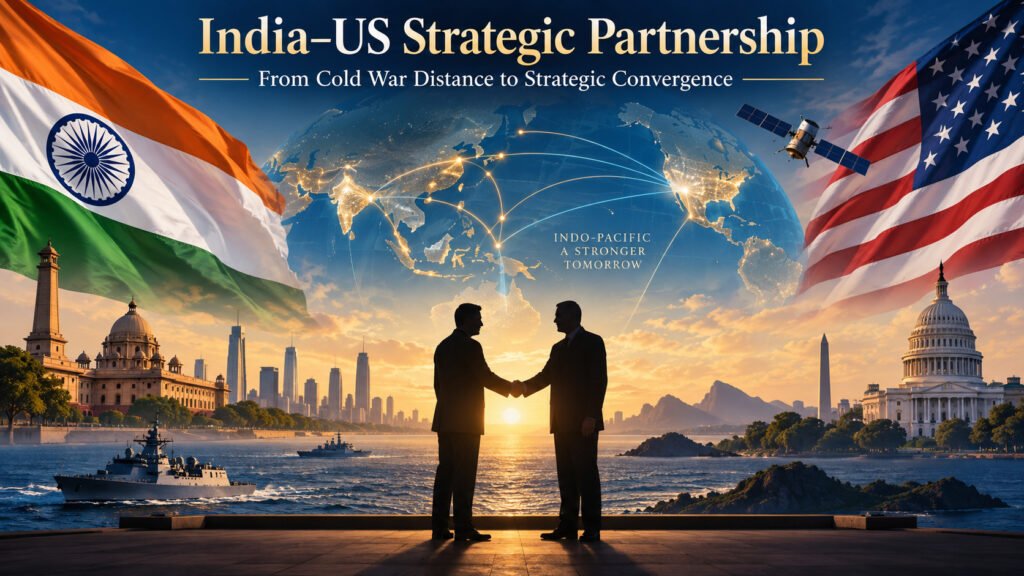
India and the United States are often described today as natural strategic partners.
That was not always the case.
For much of the Cold War, the relationship was marked by mistrust. The United States maintained close ties with Pakistan, while India followed non-alignment and developed a strong relationship with the Soviet Union.
The situation began to change after the Cold War.
India’s economic reforms, the rise of China, growing defence cooperation, technology partnerships and the importance of the Indo-Pacific gradually brought New Delhi and Washington closer.
Today, the relationship is far deeper than it was a generation ago.
Yet India is still not a formal US ally.
That makes the partnership especially interesting.
How did two countries that once kept their distance move towards strategic convergence — and how far can that partnership go without limiting India’s strategic autonomy?
This article traces that journey in simple terms, from Cold War suspicion to one of India’s most important strategic relationships.
Why India and the US Drifted Apart During the Cold War
India and the United States began their post-Independence relationship with very different strategic priorities.
India wanted to preserve its freedom of judgement through non-alignment. The United States, however, was building military alliances to contain communism and viewed global politics largely through the Cold War lens.
Pakistan soon became a major point of difference.
Washington developed close defence ties with Pakistan, which joined US-backed security arrangements and received military assistance. From India’s perspective, this created a serious security concern because the same military support could also strengthen Pakistan against India.
At the same time, India’s relationship with the Soviet Union became steadily closer.
Moscow supported India on several diplomatic and defence issues, while India obtained military equipment, industrial cooperation and political backing from the Soviet side.
The relationship reached one of its most difficult moments during the 1971 Bangladesh crisis.
The United States supported Pakistan diplomatically, while India signed the Treaty of Peace, Friendship and Cooperation with the Soviet Union and received important strategic support from Moscow.
By then, the pattern was clear.
India had not formally abandoned non-alignment, but in practice it had moved much closer to the Soviet Union, while the United States remained closely linked with Pakistan.
For several decades, therefore, India and the US were not enemies — but neither were they natural partners.
That would begin to change only after the Cold War itself came to an end.
1991 and the Beginning of a New Relationship
The end of the Cold War changed the India–US relationship more than any earlier diplomatic effort had managed to do.
In 1991, two things happened almost together: the Soviet Union collapsed, and India began major economic reforms.
For India, this meant rethinking both foreign policy and economic engagement.
The United States was now the world’s dominant power, while India was opening its economy, seeking investment, technology and wider international partnerships.
Relations did not improve overnight.
Differences remained over nuclear policy, Pakistan and several strategic issues. But the atmosphere gradually became less suspicious and more practical.
India and the United States began to discover areas where their interests increasingly overlapped — trade, technology, education, defence and regional stability.
The large Indian community in the United States also helped bring the two societies closer.
Most importantly, both countries began to see each other differently.
India was no longer viewed only through the Cold War lens of non-alignment and Soviet friendship. The United States increasingly saw India as a rising democratic power with growing economic and strategic importance.
For India, the US became a country with which closer cooperation was possible without necessarily entering into an alliance.
The real breakthrough, however, would come later — through an issue that had once divided the two countries sharply:
nuclear cooperation.
The Nuclear Deal – The Real Turning Point
For years, nuclear policy was one of the biggest sources of tension between India and the United States.
India had refused to sign the Nuclear Non-Proliferation Treaty (NPT) as a non-nuclear-weapon state and conducted nuclear tests in 1998, after which the United States imposed sanctions.
Yet within a few years, the relationship changed dramatically.
The turning point came with the India–US Civil Nuclear Agreement, announced in 2005 and taken forward through subsequent agreements and international approvals.
Its significance went far beyond nuclear energy.
For the first time, the United States accepted a special framework that allowed India to engage in civilian nuclear commerce despite remaining outside the NPT as a recognised nuclear-weapon state.
That required a major political shift in Washington — and an equally important strategic decision in New Delhi.
The deal signalled that the United States was beginning to treat India not as a problem to be managed, but as a major power with which a long-term partnership was desirable.
For India, it opened access to international civilian nuclear cooperation and helped end decades of nuclear isolation.
More importantly, it created trust.
The nuclear deal showed that both countries were willing to move beyond old suspicions and invest political capital in the relationship.
In that sense, it became much more than an energy agreement.
It was the moment when India–US relations moved decisively from cautious engagement towards strategic partnership.
Defence, Technology and the Indo-Pacific
As political trust improved, India–US cooperation expanded well beyond diplomacy.
Defence became one of the strongest areas of the relationship.
The two countries began holding more military exercises, improving maritime cooperation and signing agreements that made it easier to share information, logistics and defence technology.
The relationship also moved into new areas such as space, semiconductors, artificial intelligence, critical technologies and advanced manufacturing.
Another major factor was the rise of China.
As China became more powerful in Asia, both India and the United States developed a stronger interest in maintaining an open and stable Indo-Pacific region.
This helped bring India closer to the Quad, alongside the United States, Japan and Australia.
Yet India has been careful about how far this cooperation goes.
It supports a stronger Indo-Pacific partnership, but continues to resist the idea of turning such cooperation into a formal military alliance.
That distinction is important.
India wants access to technology, stronger defence capabilities and closer strategic cooperation — but it also wants to preserve its freedom of action.
The India–US partnership has therefore become much deeper, but still stops short of alliance.
That leads to the next question:
How close can two countries become without becoming formal allies?
Partners, But Not Allies
India and the United States today cooperate more closely than at any time in the past.
They conduct military exercises, share strategic concerns, work together on technology and the Indo-Pacific, and increasingly see each other as important long-term partners.
Yet India is still not a formal US ally.
There is no treaty requiring India to automatically join the United States in a war or follow Washington’s position on every major international issue.
That distinction matters.
India wants the benefits of close cooperation — defence technology, intelligence sharing, investment, maritime security and diplomatic support — without giving up the freedom to take an independent position when its interests differ.
This is why India can work closely with the United States while still maintaining important ties with Russia, remaining part of BRICS and taking its own position on international crises.
For Washington, this can sometimes be frustrating.
For India, however, it is central to the idea of strategic autonomy.
The relationship can therefore be described as:
close partnership without automatic alignment.
That formula has worked reasonably well so far.
But the real test comes when the two countries disagree.
Where India and the US Still Differ
Closer relations do not mean that India and the United States agree on everything.
One important difference is Russia.
India continues to value its long-standing defence and strategic relationship with Moscow, while the United States has taken a much harder position towards Russia, especially since the war in Ukraine.
There are also differences over trade, market access, sanctions and the pace at which strategic cooperation should move.
India is often cautious about any arrangement that could appear to limit its freedom of action. The United States, by contrast, sometimes expects closer strategic partners to align more clearly with its wider geopolitical priorities.
Another area of difference is the idea of alliances themselves.
The United States is accustomed to formal alliance systems. India is not.
India prefers partnerships that leave room for independent decisions.
That can create friction, but it does not necessarily weaken the relationship.
In fact, one reason the partnership has survived differences is that both sides increasingly understand that they do not need to agree on every issue to work together effectively.
The relationship is therefore based less on complete alignment and more on convergence where interests overlap.
That makes the next question especially important:
Can India continue moving closer to the United States without weakening the strategic autonomy it has tried to preserve for decades?
Can India Move Closer to the US Without Losing Strategic Autonomy?
This is perhaps the most important question in the India–US relationship.
Closer cooperation with Washington gives India clear advantages — access to advanced technology, stronger defence links, wider diplomatic support and greater influence in the Indo-Pacific.
But India has always been cautious about becoming too dependent on any one major power.
That caution comes from history.
For decades, Indian foreign policy has been built around the idea that important decisions should ultimately be taken in New Delhi, not shaped by the expectations of another capital.
So the challenge is not whether India should work closely with the United States.
It clearly should where interests overlap.
The real challenge is how to deepen that partnership while still retaining the freedom to differ on Russia, trade, sanctions, global conflicts or other strategic questions.
This is where strategic autonomy becomes practical rather than theoretical.
If India can cooperate closely with the United States without becoming automatically aligned with it, the partnership can strengthen India’s position.
But if cooperation begins to create pressure to follow Washington on issues where Indian interests differ, the balance becomes more difficult.
For India, therefore, the best outcome may be neither distance nor alliance.
It may be a relationship based on trust, convergence and cooperation — but with room for independent judgement.
That is what makes the India–US partnership distinctive.
It is close, important and increasingly strategic — yet still deliberately short of alliance.
Conclusion – Partnership Without Alliance
The India–US relationship has travelled a remarkable distance.
From Cold War suspicion and strategic differences, the two countries have moved towards close cooperation in defence, technology, space, the Indo-Pacific and global diplomacy.
Yet the relationship has stopped short of becoming a formal alliance.
That is not an accident.
India wants a strong partnership with the United States, but it also wants to preserve the freedom to take independent decisions on Russia, trade, regional conflicts and other strategic issues.
For Washington, India is an increasingly important partner in Asia.
For New Delhi, the United States offers technology, investment, defence cooperation and strategic weight.
The relationship therefore works best when both sides accept that partnership does not require complete agreement.
That may ultimately be the defining feature of India–US ties.
The two countries are moving closer because their interests increasingly converge, not because India has abandoned strategic autonomy.
The real test will be whether this balance can survive future disagreements.
If it can, the India–US relationship may remain one of the most important strategic partnerships of the twenty-first century — close, consequential and deliberately short of alliance.
Frequently Asked Questions (FAQs)
The relationship began improving after the end of the Cold War, especially from the 1990s onwards, when India opened its economy and both countries began finding more areas of common interest.
India followed non-alignment and developed close ties with the Soviet Union, while the United States built strong military relations with Pakistan. These differences created mistrust on both sides.
During the Bangladesh crisis, the United States remained close to Pakistan while India received important diplomatic and strategic support from the Soviet Union. This widened the distance between New Delhi and Washington.
The agreement helped end India’s long nuclear isolation and marked a major political shift in Washington’s approach towards India. It also demonstrated growing strategic trust between the two countries.
No. India and the United States have a very close strategic partnership, but India is not part of a formal mutual-defence alliance with the US.
It describes the broad relationship between the two countries across defence, technology, trade, space, energy, education and global strategic issues. India’s Ministry of External Affairs continues to use this description for the relationship.
The designation, announced in 2016, reflects the importance of defence cooperation between the two countries and has supported closer military, technology and procurement ties.
The rise of China has increased strategic convergence between India and the United States, particularly in the Indo-Pacific, maritime security and efforts to maintain a balance of power in Asia.
The Quad brings India, the United States, Japan and Australia together on Indo-Pacific cooperation, maritime security, technology and other regional issues. It is an important platform for strategic coordination, but it is not a formal military alliance.
Differences remain over issues such as Russia, trade, sanctions, the pace of strategic alignment and India’s insistence on maintaining strategic autonomy.
India has tried to maintain both relationships by treating them according to different national interests. Whether this balance remains sustainable will depend on how sharply global rivalries develop.
Not necessarily. It can strengthen India if cooperation improves defence, technology and diplomatic capability while leaving New Delhi free to take independent decisions. The challenge is to avoid becoming overly dependent on any one partner.
The India–US Civil Nuclear Agreement.
India, the United States, Japan and Australia.
India seeks close partnerships while retaining the freedom to take foreign-policy decisions independently.
China is an important factor, but the relationship is broader. Defence, technology, trade, education, space and people-to-people ties also contribute significantly.
Yes. The current model is based on cooperation where interests converge, while India retains independence on issues where its interests differ.
Whether both countries can manage disagreements without allowing them to disrupt the broader strategic relationship.
That remains a matter of debate. An alliance could offer stronger security guarantees, but it could also reduce India’s room for independent decision-making.