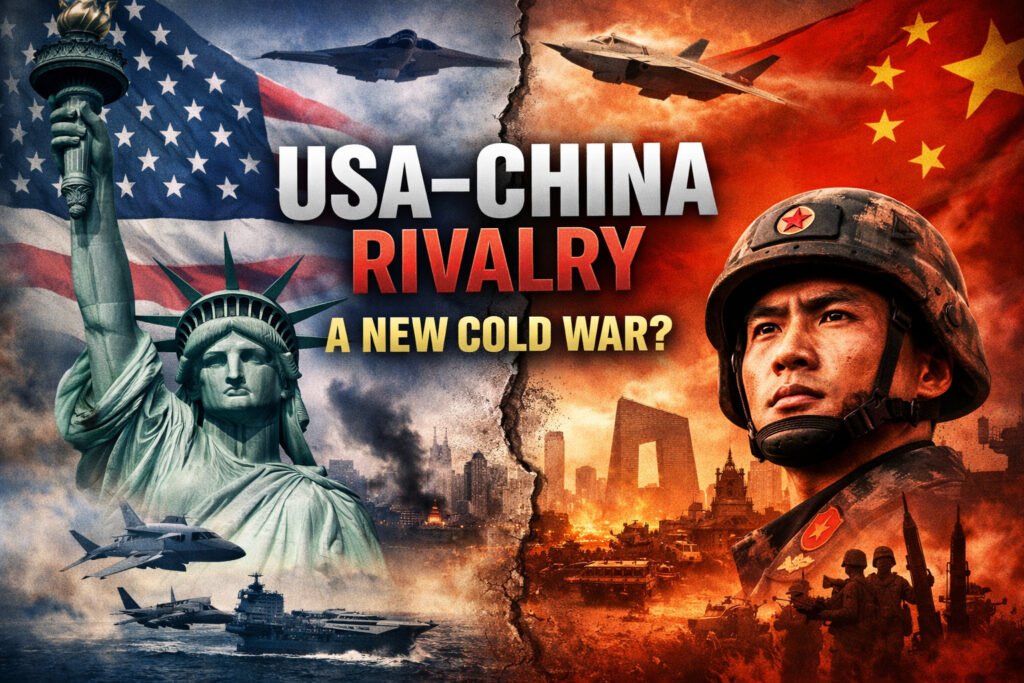
In today’s world, one relationship stands out more than most—that between the United States and China. These two nations are not just powerful; they influence almost every part of global affairs, from trade and technology to security and diplomacy. Many experts have even started asking: Are we witnessing a new Cold War?
To understand this rivalry, we must look at how it developed.
Table of Contents
ToggleFrom Cooperation to Competition
For many years, the United States and China had a cooperative relationship. The US supported China’s entry into global trade systems, and both countries benefited economically. China became a manufacturing hub, while American companies gained access to a vast market. However, as China’s economy grew rapidly, so did its global ambitions. What was once seen as a partnership slowly began to turn into competition.
From Cooperation to Competition
For many years, the United States and China had a cooperative relationship. The US supported China’s entry into global trade systems, and both countries benefited economically. China became a manufacturing hub, while American companies gained access to a vast market. However, as China’s economy grew rapidly, so did its global ambitions. What was once seen as a partnership slowly began to turn into competition.
The Rise of China
Over the past few decades, China has transformed itself into an economic powerhouse. It is now one of the largest economies in the world and a key player in international trade. But China’s rise is not limited to economics. It is also investing heavily in:
- Military strength
- Advanced technology
- Global infrastructure projects
This growing influence has naturally raised concerns in the United States, which has long been the dominant global power.
Trade Wars and Economic Tensions
One of the most visible aspects of this rivalry has been the trade conflict between the two nations. Both countries have imposed tariffs on each other’s goods, leading to what is often called a “trade war.” Beyond tariffs, there are deeper concerns:
Control over supply chains
Dependence on critical materials
Protection of domestic industries
This has made economic relations more strained and uncertain.
The Battle for Technology
Perhaps the most important front in this rivalry is technology. The United States and China are competing in areas such as:
- Artificial Intelligence (AI)
- Semiconductors (computer chips)
- Telecommunications (like 5G)
Technology today is not just about innovation—it is about power. Whoever leads in these fields can shape the future.
The Taiwan Issue
One of the most sensitive and potentially dangerous aspects of this rivalry is Taiwan.
China considers Taiwan to be a part of its territory, while Taiwan sees itself as independent. The United States does not officially recognise Taiwan as a separate country but supports it in many ways, including defense.
Any conflict over Taiwan could have serious global consequences, making it a major point of concern.
Alliances and Global Influence
Both nations are also trying to strengthen their global position through partnerships.
The United States works closely with its allies in Europe and Asia. China, on the other hand, has expanded its influence through economic initiatives and partnerships with developing countries.
This competition for influence is shaping global politics in significant ways.
Is This a New Cold War?
There are similarities between today’s situation and the Cold War:
- Two powerful nations competing globally
- Ideological differences
- Strategic rivalry
However, there is one key difference—economic interdependence. The US and China are deeply connected through trade, making a complete separation difficult.
The Way Forward
The relationship between the United States and China is complex. It involves competition, cooperation, and sometimes confrontation.
The challenge for both nations—and for the world—is to manage this rivalry responsibly. History has shown that when great powers clash without restraint, the consequences can be severe.
At the same time, cooperation on global issues such as climate change, health, and economic stability remains essential.
Conclusion
The USA–China rivalry is likely to shape the 21st century. Whether it leads to conflict or cooperation will depend on the choices made by leaders on both sides.
For readers and observers, one thing is clear: understanding this relationship is key to understanding the future of global affairs.