Table of Contents
ToggleVirus: The Invisible Force That Challenges Life Itself
A virus between life and non-life is one of nature’s most intriguing mysteries. It exists in a strange space—neither fully alive nor completely inert—yet has the power to influence life on a global scale.There are many things in nature that we can see and understand. And then there are those that quietly exist beyond our senses—yet have the power to change the course of human life.And then there are those that quietly exist beyond our senses—yet have the power to change the course of human life. A virus is one such entity.
It is so small that it cannot be seen even under a normal microscope. Yet, at different points in history, it has brought the world to a standstill. This raises a simple but intriguing question—what exactly is a virus? And perhaps more importantly, is it even alive?
👉 To understand the larger connection between nature and health, read our pillar post: Nature Health
A Discovery That Changed Science
The story of viruses began in the late 19th century. Scientists studying plant diseases noticed something unusual. Even after filtering out bacteria, the infection continued to spread. This puzzled them.
A Russian scientist, Dmitri Ivanovsky, was among the first to observe this phenomenon. Later, a Dutch scientist, Martinus Beijerinck, concluded that this infectious agent was something entirely different—something much smaller than bacteria. He called it a “virus,” meaning poison.
It was the beginning of a new understanding of life—one that challenged existing definitions.
What Does a Virus Look Like?
Unlike living organisms, a virus has a very simple structure.
At its core, it carries genetic material—either DNA or RNA. This is surrounded by a protective protein layer called a capsid. Some viruses also have an outer envelope.
That’s all. No organs, no cells, no independent systems.
In many ways, a virus is like a coded message wrapped in a protective shell—waiting for the right moment to come alive.
Between Life and Non-Life
This is where things become truly fascinating.
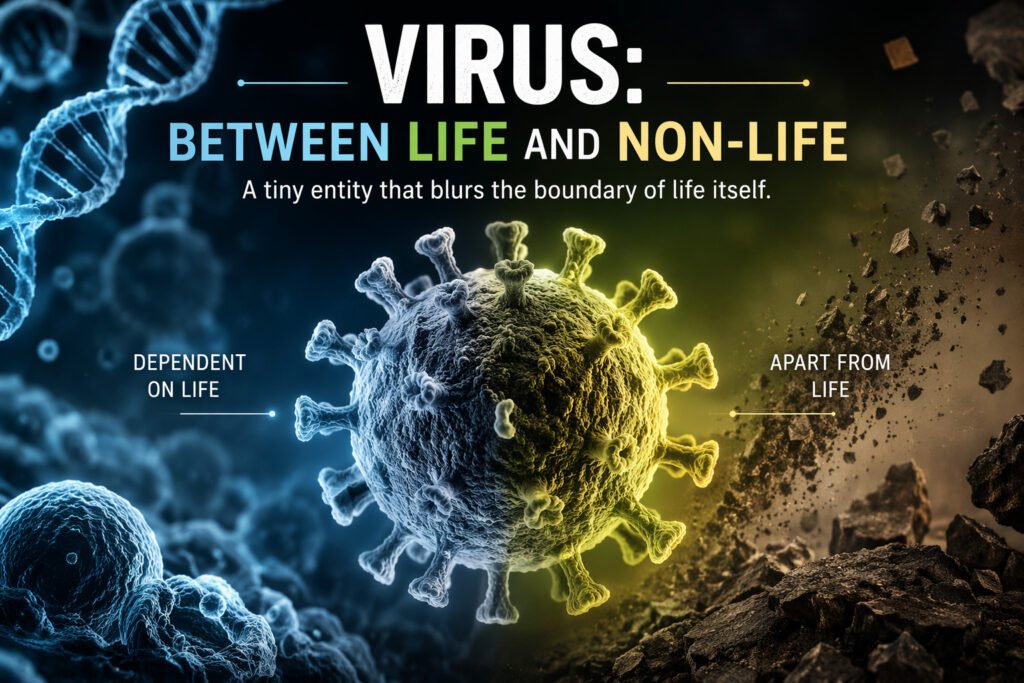
A virus cannot grow, move, or reproduce on its own. Outside a living cell, it remains inactive—almost like a lifeless particle. But once it enters a host cell, it suddenly becomes active and begins to multiply.
So, is it alive?
Science does not have a simple answer. A virus exists in a grey zone—somewhere between living and non-living. And perhaps that is what makes it so mysterious.
DNA or RNA – Why It Matters
Every virus carries genetic material, but not all are the same. Some have DNA, while others have RNA.
This difference affects how they behave. RNA viruses, for example, tend to change more quickly. This is why some viral diseases are harder to control—they keep evolving.
It is nature’s way of adapting, constantly and quietly.
How a Virus Enters and Spreads
A virus cannot do much on its own. It needs a host.
It can enter the human body in several ways—through the air we breathe, the food we eat, physical contact, or even through insects like mosquitoes.
Once inside, it attaches itself to a cell and injects its genetic material. The cell, unknowingly, starts producing more copies of the virus. Slowly, the infection spreads.
It is almost as if the virus borrows the machinery of life to create more of itself.
Diseases Caused by Viruses
We encounter viruses more often than we realise.
Some cause mild illnesses like the common cold or seasonal flu. Others, however, have had a far more serious impact—HIV, dengue, influenza outbreaks, and most recently, COVID-19.
These events remind us how something invisible can influence lives, economies, and even the course of history.
Why Are Viruses Difficult to Control?
Unlike bacteria, viruses do not respond to antibiotics. This makes them harder to treat.
They also mutate quickly, especially RNA viruses. This constant change makes it difficult to develop long-lasting solutions.
In a way, viruses teach us humility. They remind us that despite scientific progress, nature still holds many uncertainties.
Do Viruses Have a Role in Nature?
We often think of viruses only as harmful. But the story may not be that simple.
Some scientists believe that viruses play a role in evolution. By interacting with living organisms over time, they may have influenced genetic changes.
They are part of the natural system—silent, unseen, yet deeply connected to life itself.
A Question Beyond Science
The study of viruses also raises deeper questions.
How far should scientific research go? Should we study and manipulate viruses in laboratories? Where do we draw the line between knowledge and risk?
These are not easy questions, but they are important ones.
Conclusion: A Quiet Reminder from Nature
A virus does not think, feel, or act with intent. Yet, it has the power to disrupt the world in ways few things can.
Perhaps the real lesson lies not just in understanding the virus, but in understanding our place in nature. We often believe we are in control—but something as small as a virus reminds us otherwise.
In the end, a virus is more than a biological entity. It is a quiet reminder of nature’s complexity, its unpredictability, and its enduring power.
🔙Return to the World of Ideas: Wolverine Speaks : Discover more stories, insights, and perspectives across science, art, culture, and human experience — all under one voice.