Table of Contents
ToggleIntoduction
Everyday life depends on Data. Then the question come – What is data?
In today’s digital world, data is generated every moment—from social media interactions, emails, banking transactions, streaming platforms, and artificial intelligence. In its raw form, this information is often scattered and unstructured. When organised systematically, it becomes knowledge, and when applied with understanding, it leads to better decision-making at all levels. This growing importance of data raises a fundamental question—where is all this data stored and managed?
Data centres are not just technological assets—they are central to modern business operations, a theme we explore across our Business section.
What is a Data Centre?
A data centre is, in simple terms, a dedicated facility where large amounts of data are stored, processed, and managed. It houses powerful computers known as servers, along with storage systems and networking equipment that work together to handle the continuous flow of information.
Whenever we send an email, make an online payment, watch a video, or access cloud-based services, the data involved is not floating in the air—it is stored and processed inside these data centres. They act as the backbone of the digital world, ensuring that information is available whenever and wherever it is needed.
One way to understand a data centre is to think of it as a digital warehouse. Just as a warehouse stores physical goods in an organised manner for easy access, a data centre stores vast amounts of digital information in a structured and secure way. This organisation allows businesses, governments, and individuals to retrieve and use data quickly and efficiently.
In essence, while data may begin as scattered pieces of information, it is within data centres that it is stored, organised, and made useful—supporting everything from everyday communication to complex business operations.
How Data Centres Work
At first glance, a data centre may look like a complex setup filled with machines and cables. But its working can be understood in a very simple way.
When you use your phone or computer—whether to send a message, check your bank balance, or watch a video—a request is sent through the internet. This request reaches a data centre, where powerful computers called servers process it.
These servers quickly locate the required information, process it, and send it back to you within seconds. That is why everything appears so fast and seamless, even though a lot is happening behind the scenes.
Data centres also ensure that this process runs smoothly at all times. They have backup systems for power, cooling arrangements to prevent overheating, and strong security measures to protect data. This ensures that services remain available without interruption.
In simple terms, a data centre works like a well-organised system that receives requests, processes information, and delivers it back almost instantly—making our digital experiences smooth and reliable.
Lorem ipsum dolor sit amet, consectetur adipiscing elit. Ut elit tellus, luctus nec ullamcorper mattis, pulvinar dapibus leo.
Types of Data Centres
Not all data centres are the same. They differ based on who owns them and how they are used. However, we can understand them through a few broad types.
First, there are enterprise data centres. These are owned and operated by individual companies for their own use. Large organisations, such as banks or big corporations, often have their own data centres to manage their internal data securely.
Then come cloud data centres. These are operated by technology companies that provide services to many users over the internet. When we use cloud storage, streaming platforms, or online applications, we are often relying on these data centres without even realising it.
A third type is hyperscale data centres. These are extremely large facilities built to handle massive amounts of data. They support services used by millions of people worldwide, such as search engines, social media platforms, and large-scale digital services.
While the scale and ownership may differ, the basic purpose remains the same—to store, process, and deliver data efficiently.
This variation in types reflects the diverse and growing needs of the digital world.
For a deeper look at data centres in India, including capacity, key players, and upcoming developments, we explore this in a separate article. 👉“Data Centres in India: Growth, Trends and Opportunities”
Why Data Centres Matter Today
In today’s world, almost every activity has a digital connection. From communication and banking to entertainment and healthcare, data plays a central role in how systems function.
Data centres make all of this possible. They ensure that information is available instantly, services run smoothly, and businesses operate without interruption. Without them, the digital economy as we know it would simply not exist.
The growing use of technologies such as cloud computing and artificial intelligence has further increased the importance of data centres. As more data is created every day, the need to store and manage it efficiently continues to rise.
Role in Business and the Economy
For businesses, data is no longer just support—it is a key driver of growth and decision-making.
Companies rely on data centres to:
- Manage customer information
- Run online services
- Analyse trends and make quick decisions
Industries such as banking, retail, healthcare, and even government services depend heavily on data centres. They enable organisations to operate on a global scale while maintaining speed and efficiency.
In many ways, data centres have become as important to the modern economy as roads and ports were in earlier times.
The Supporting Ecosystem: Beyond Servers
While data centres are often associated with servers and storage systems, a significant part of their functioning depends on a wide range of supporting infrastructure.
Power supply is one of the most critical elements. Data centres require uninterrupted electricity, which is supported by backup systems such as generators and power distribution units. Even a brief interruption can disrupt services.
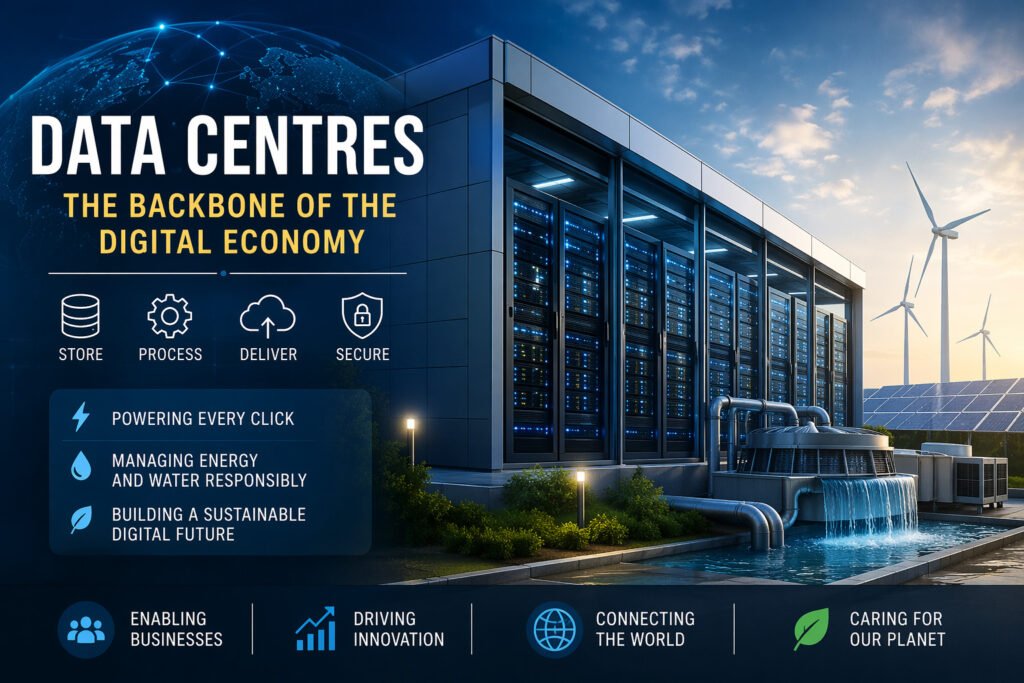
Cooling systems are equally important. Large volumes of data processing generate heat, and specialised cooling units—often using water—are needed to maintain optimal temperatures.
In addition, there are extensive networks of cables, switches, and connectivity equipment that ensure smooth and fast data transmission. These components form the backbone of communication within and outside the data centre.
Together, these supporting systems create an entire ecosystem around data centres. In fact, the investment in such ancillary infrastructure can be as significant as the investment in the core computing systems themselves.
From an investor’s perspective, this opens up a wider opportunity. Companies involved in power equipment, cooling technologies, electrical systems, and connectivity solutions are all part of the larger data centre value chain. As demand for data centres grows, these supporting industries are also likely to see increased demand.
The broader investment potential of data centres and their supporting ecosystem is discussed in greater detail in our article on investment opportunities in this sector. Data Centres as an Investment Opportunity.
We also take a closer look at listed companies in India that are connected to this ecosystem and may benefit from its growth. Data Centres: Listed Companies (India)
Energy Consumption and Sustainability
Data centres may be invisible to most of us, but they consume a significant amount of energy. These facilities operate round the clock, storing and processing enormous volumes of data every second. The servers inside them require continuous power, and equally important is the need to keep them cool to prevent overheating.
Cooling systems are essential because servers generate a lot of heat. Without proper cooling, performance can drop, and equipment can be damaged. As a result, a large portion of energy used in data centres goes not just into computing, but into maintaining the right temperature.
Recognising this, many companies are now taking steps to make data centres more sustainable. There is a growing shift towards using renewable energy sources such as solar and wind power. Efforts are also being made to design more energy-efficient systems and reduce the overall environmental footprint.
The increasing energy demand of data centres also connects closely with broader discussions on energy use and sustainability, a subject we explore further in our Energy section.
Challenges and Risks
While data centres are critical to the digital economy, they also face several challenges.
One of the most important concerns is energy consumption, which can be very high. This not only increases operational costs but also raises environmental concerns.
Another significant challenge—often less discussed—is the large quantity of water required for cooling. Many data centres use water-based cooling systems to manage heat. In regions where water is scarce, this can put additional pressure on local resources and communities.
There are also issues related to data security. With vast amounts of sensitive information being stored, protecting data from cyber threats is a constant challenge.
In addition, system failures or downtime can disrupt services on a large scale. Even a short interruption can affect businesses, financial systems, and everyday users.
These challenges highlight the need for careful planning, responsible use of resources, and continuous improvement in technology.
Data Privacy and Regulatory Framework in India
As data centres grow in importance, the question of data privacy and protection becomes equally critical. With vast amounts of personal and business information being stored and processed, ensuring the security and responsible use of data is no longer optional—it is essential.
In India, this has led to the introduction of the Digital Personal Data Protection Act, 2023. The Act lays down a framework for how personal data should be collected, stored, and processed. It places responsibility on organisations to handle data with care and transparency.
One of the key implications of this law is the growing emphasis on data localisation and secure data management. This has encouraged companies to invest in local data centre infrastructure to ensure compliance with regulatory requirements.
For data centres, this means higher standards of security, stronger governance systems, and increased accountability. While this may add to operational complexity, it also strengthens trust in digital systems.
From a broader perspective, such regulations play an important role in shaping the future of the digital economy. They ensure that growth is balanced with responsibility, protecting both businesses and individuals.
As digital adoption continues to expand, regulatory frameworks like this will play a defining role in how data centres evolve in the future.
We explore this subject further in our article on Data Privacy Laws and Their Impact on Business in India.
The Future of Data Centres
As the world becomes more digital, the role of data centres will continue to grow. Emerging technologies such as artificial intelligence, cloud computing, and the Internet of Things are generating vast amounts of data, increasing the demand for storage and processing. As we explore the growing role of technology, it is also interesting to reflect on how science continues to challenge our understanding of life itself—as discussed in our article,Virus: Between Life and Non-Life.
In the future, we are likely to see more efficient and environmentally friendly data centres. Innovations in cooling systems, better energy management, and increased use of renewable energy will play an important role.
There is also a growing trend towards edge computing, where data is processed closer to where it is generated. This can reduce delays and improve efficiency, especially for real-time applications.
The challenge will be to balance this growth with sustainability, ensuring that progress does not come at the cost of the environment.
Conclusion
Data centres may not be visible in our daily lives, but their presence is felt everywhere. From a simple message to complex business operations, they quietly support the systems we depend on.
They represent the transformation of raw data into meaningful information, enabling faster decisions and smoother operations. At the same time, they remind us that progress comes with responsibility—especially in terms of energy use and natural resources.
In many ways, data centres are the silent engines of the digital age. As our dependence on data continues to grow, their importance will only increase, making it essential to manage them wisely and sustainably.
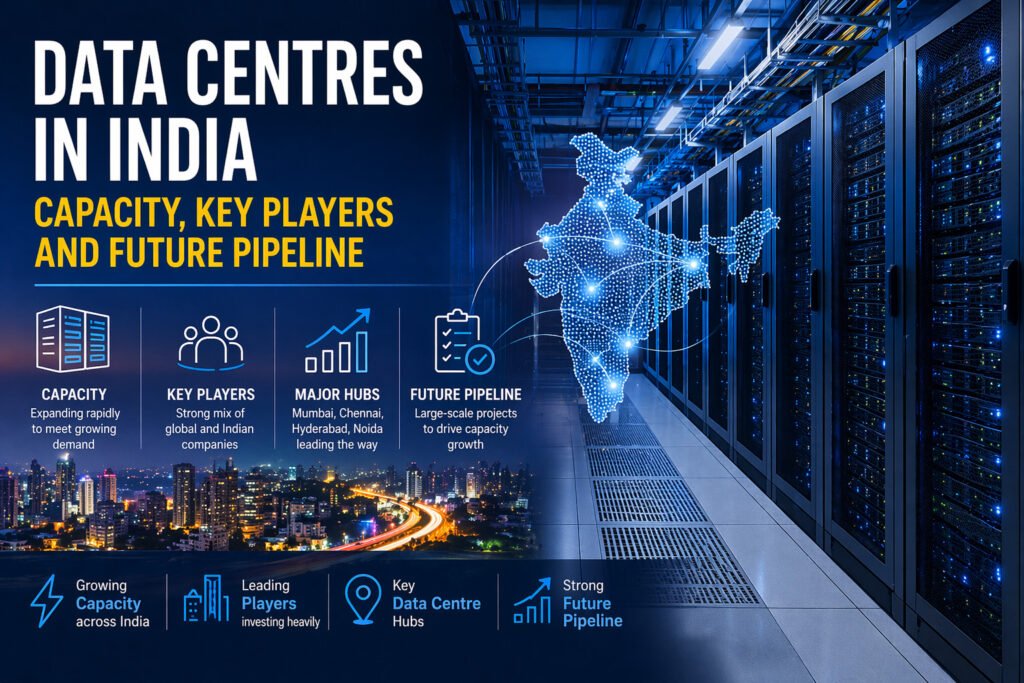
For a deeper look at data centres in India, including capacity, key players, and upcoming developments, we explore this in a separate article. 👉 Data Centres in India: Capacity, Key Players and Future Pipeline
Explore More on Data Centres
For a deeper understanding of data centres and their broader ecosystem, you may also read:
FAQs on Data Centres: The Backbone of the Digital Economy
A data centre is a facility where data is stored, processed, and managed using servers and networking systems. It supports everything from emails to online banking and streaming.
Data centres are essential because they enable digital services to run smoothly. Without them, modern communication, business operations, and online platforms would not function.Accordion Content
Data centres require continuous electricity to power servers and cooling systems. A large portion of energy is used to keep equipment at the right temperature.
Many data centres use water-based cooling systems to control heat generated by servers. This helps maintain efficiency but also raises concerns about water usage.
Key challenges include high energy consumption, water usage, data security risks, and the need for uninterrupted operations.
The future lies in more energy-efficient, sustainable, and distributed systems, especially with the growth of AI, cloud computing, and edge technologies.
Not directly. Yet, they quietly support almost every digital activity we rely on, making them an unseen but essential part of modern life.
One of the largest data centres in the world is operated by China Telecom in Inner Mongolia. These hyperscale facilities span vast areas and are designed to handle massive volumes of data for cloud services and digital applications.
India’s data centre capacity is growing rapidly. One of the largest facilities is developed by Yotta Infrastructure, including its large data centre parks such as Yotta NM1 near Mumbai, which is among the biggest in the country.
India’s data centre capacity is growing rapidly. One of the largest facilities is developed by Yotta Infrastructure, including its large data centre parks such as Yotta NM1 near Mumbai, which is among the biggest in the country.