Table of Contents
ToggleIntroduction
In recent years, India has witnessed a rapid transformation in the way data is created, consumed, and managed. From digital payments and online services to cloud computing and artificial intelligence, data has become central to everyday life and business operations.
This growing dependence on digital systems naturally raises an important question—where is all this data stored and processed? The answer lies in data centres, which are increasingly becoming a critical part of India’s digital infrastructure.
India is now emerging as a significant hub for data centres, driven by rising internet usage, government initiatives, and the expansion of global technology companies. What was once a niche infrastructure is today at the heart of the country’s digital growth story.
The Growth of Data Centres in India
The demand for data centres in India has grown steadily over the past decade, but the pace has accelerated in recent years.
Several factors have contributed to this growth:
- Rapid increase in internet users
- Expansion of digital services such as e-commerce and streaming
- Growth in cloud computing and enterprise data needs
- Government initiatives like Digital India
India, with its large population and increasing digital adoption, presents a vast and growing market. As more individuals and businesses move online, the need for reliable data storage and processing continues to rise.
Key Drivers Behind the Expansion
The rise of data centres in India is not accidental—it is supported by strong underlying drivers.
1. Digital Economy Expansion
India’s economy is becoming increasingly digital. Payments, banking, retail, and even governance are moving online, generating vast amounts of data.
2. Cloud Adoption
Businesses are shifting from traditional systems to cloud-based platforms, which require robust data centre infrastructure.
3. Data Localisation Trends
There is a growing emphasis on storing data within the country. This has encouraged companies to invest in local data centre capacity.
4. Rise of Artificial Intelligence
AI applications require massive computing power and data storage, further increasing demand for data centres.
India as a Preferred Data Centre Destination
India is increasingly being seen as an attractive destination for data centre investments.
Some of the advantages include:
- Large and growing digital user base
- Strategic geographic location
- Availability of skilled manpower
- Government support for infrastructure development
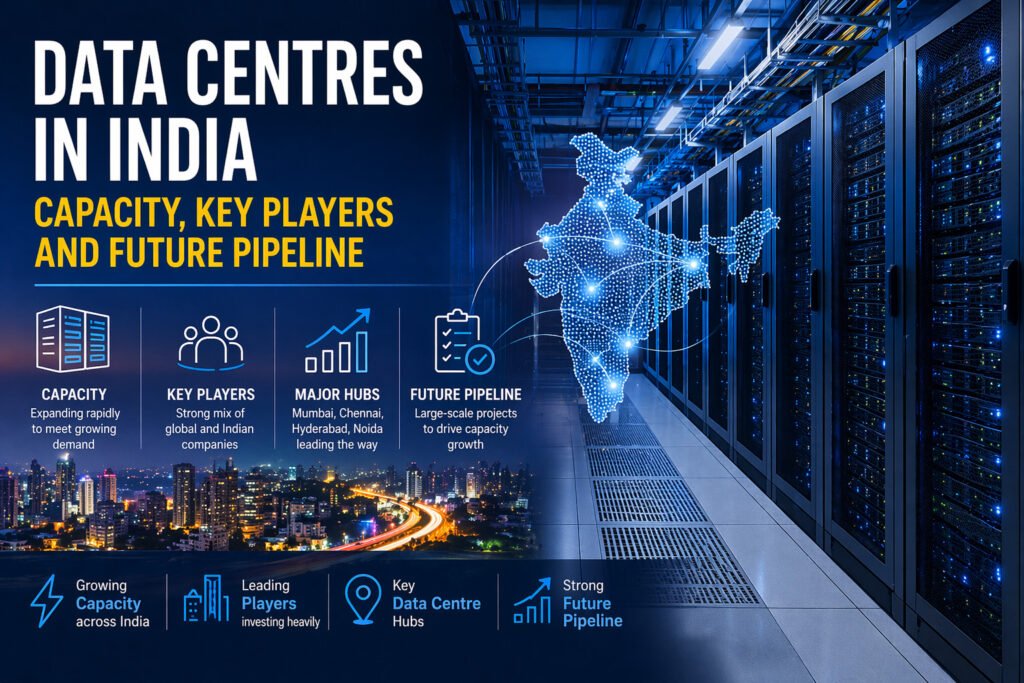
Cities such as Mumbai, Chennai, Hyderabad, and Noida have emerged as key data centre hubs due to better connectivity and infrastructure.
Opportunities and Emerging Trends
The growth of data centres is creating new opportunities across sectors.
- Increased demand for infrastructure development
- Growth in supporting industries such as power, cooling, and networking
- Rising investments from both domestic and global players
There is also a noticeable shift towards building larger and more efficient data centres to handle increasing data loads.
Challenges to Address
Despite the strong growth, there are challenges that need attention.
- High energy consumption
- Dependence on reliable power supply
- Significant water usage for cooling
- Land and infrastructure constraints in urban areas
Addressing these challenges will be crucial for sustainable growth.
The Road Ahead
The future of data centres in India looks promising. As digital adoption continues to grow, the demand for data storage and processing will only increase.
The focus will likely be on:
- Building more efficient and sustainable facilities
- Expanding capacity to meet future demand
- Integrating advanced technologies
India is well-positioned to become a major player in the global data centre landscape.
Conclusion
Data centres are no longer just technical facilities—they are becoming an essential part of India’s economic and digital infrastructure.
Their growth reflects a broader shift towards a data-driven economy. While challenges remain, the opportunities are significant, not just for businesses but also for investors and supporting industries.
In many ways, the story of data centres in India is a story of transformation—one that is still unfolding and holds immense potential for the future.
FAQs ( Frequently Asked Qusetions)
Data centres are facilities where digital information is stored, processed, and managed. In India, they are becoming increasingly important as more services—banking, communication, entertainment, and governance—move online.
The growth is driven by rising internet usage, expansion of digital services, increasing cloud adoption, and government initiatives such as Digital India. The growing use of artificial intelligence is also adding to the demand.
Cities like Mumbai, Chennai, Hyderabad, and Noida have emerged as key hubs due to better connectivity, infrastructure, and proximity to business centres.
Key challenges include high energy consumption, the need for reliable power supply, water usage for cooling, and space constraints in urban areas.
Data centres support online services, enable real-time data processing, and help businesses operate efficiently. They are a critical part of the infrastructure behind the digital economy.
Yes, many global technology companies and investors are showing interest in India due to its large and growing digital market and strong future potential.
They create opportunities in infrastructure development, power supply, cooling systems, networking, and other supporting industries, forming a large ecosystem around them.
Yes, data centres represent a long-term growth opportunity. Investors can benefit not only from data centre operators but also from companies involved in supporting infrastructure such as power, cooling, and connectivity.
Explotre More
For a more detailed analysis of capacity, key players, and upcoming developments, you may read our article on Data Centres in India: Capacity, Key Players and Future Pipeline.