Table of Contents
ToggleIntroduction
As India’s digital economy expands, the role of data centres is becoming increasingly significant. While the broader growth story highlights rising demand, it is equally important to understand the scale, key players, and future capacity that are shaping this sector.
This article takes a closer look at how data centres in India are evolving—not just in terms of presence, but in terms of capacity, investment, and future expansion.
For a broader overview of the sector, you may also read our article on Data Centres: The Backbone of the Digital Economy.
Understanding Capacity in Data Centres
Data centres are often measured not just by physical size, but by their power capacity, typically expressed in megawatts (MW).
- Smaller facilities may operate at a few megawatts
- Large data centres can go beyond 50–100 MW
- Hyperscale facilities may exceed even that
Capacity reflects the ability of a data centre to:
- Handle large volumes of data
- Support high-performance computing
- Serve multiple users simultaneously
As demand grows, there is a clear shift towards building larger, high-capacity facilities.
Current Data Centre Capacity in India
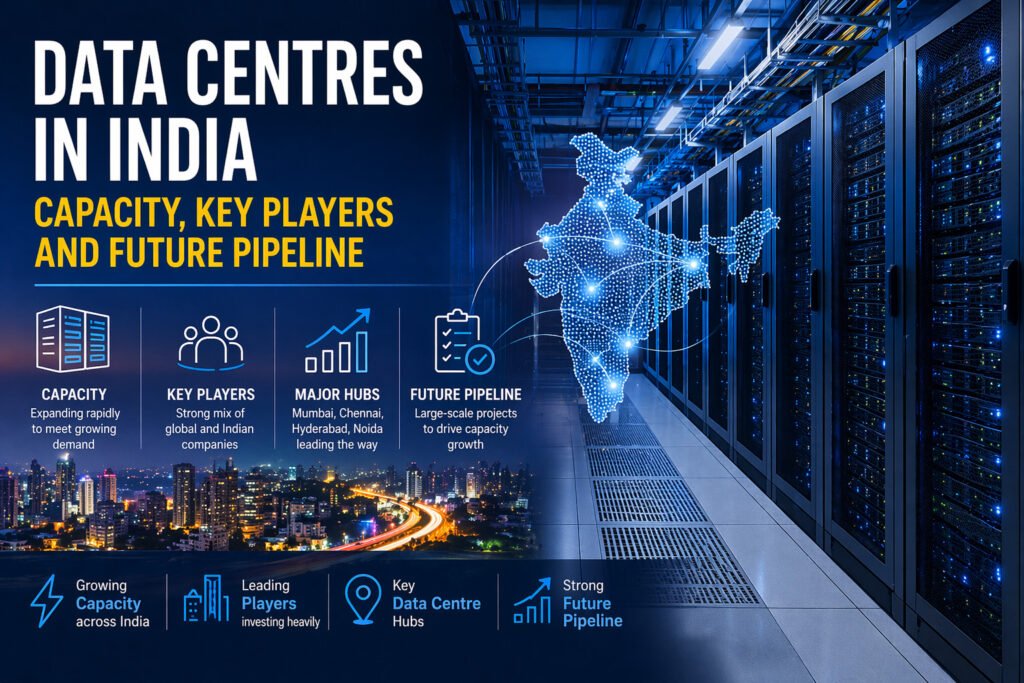
India’s data centre capacity has been expanding rapidly over the past few years.
- Major hubs include:
- Mumbai
- Chennai
- Hyderabad
- Noida
Mumbai, in particular, has emerged as the leading data centre hub, due to:
- Strong connectivity
- Presence of financial institutions
- Submarine cable landing stations
India’s total capacity continues to grow as new facilities are commissioned and existing ones expand.
Key Players in the Indian Data Centre Industry
The Indian data centre ecosystem includes both domestic groups and global players.
🔹 Indian Players
- Yotta Infrastructure
- Adani Group (through AdaniConneX)
- Reliance Industries
- Bharti Airtel (Nxtra Data Centres)
🔹 Global Players
- NTT Data
- Equinix
- ST Telemedia Global Data Centres
These players are investing heavily to expand capacity and strengthen their presence in India.
Future Pipeline and Expansion Plans
The future of data centres in India is driven by large-scale investments and planned expansions.
- New hyperscale facilities are being developed
- Existing centres are increasing capacity
- Global and domestic players are entering new cities
There is also a shift towards:
- Tier II and Tier III cities
- More efficient and sustainable designs
👉 The pipeline indicates that India’s capacity is expected to grow significantly over the next few years.
Emerging Trends
Several trends are shaping the future of data centres in India:
- Growth of cloud computing
- Increasing use of artificial intelligence
- Rising demand for edge computing
- Focus on sustainability and energy efficiency
These trends are influencing both design and scale of data centres.
Opportunities and Challenges
Opportunities
- Strong demand for digital infrastructure
- Increasing investments
- Expansion of supporting industries
Challenges
- High energy consumption
- Water usage for cooling
- Land and infrastructure constraints
- Regulatory requirements
Conclusion
India’s data centre industry is entering a phase of rapid expansion. The combination of growing demand, strong investment, and technological advancement is shaping a robust future for the sector.
Understanding capacity, key players, and future developments provides valuable insight—not just into infrastructure growth, but also into broader economic and investment opportunities.
FAQs - Frequently Asked Questions
Data centre capacity is typically measured in megawatts (MW), which indicates the amount of power available to run servers and infrastructure. Higher capacity means the ability to handle larger volumes of data and users.
Mumbai currently leads in data centre capacity due to its strong connectivity, presence of financial institutions, and access to submarine cable landing stations.
Some of the key players include Yotta Infrastructure, Adani Group, Reliance Industries, and Bharti Airtel, along with global companies like NTT Data and Equinix.
The future pipeline refers to data centres that are planned, under construction, or proposed. It indicates the expected growth and expansion of capacity in the coming years.
India offers a large digital user base, growing internet penetration, increasing cloud adoption, and supportive government policies, making it an attractive destination for investment.
Hyperscale data centres are very large facilities designed to handle massive amounts of data and serve millions of users. They are typically built by large technology companies.
Yes, there is a growing trend towards developing data centres in Tier II and Tier III cities to improve efficiency and reduce congestion in major hubs.
Challenges include high energy requirements, water usage for cooling, availability of land, and regulatory approvals.
The growth of data centres creates opportunities not only in core operations but also in supporting industries such as power, cooling, and connectivity, offering multiple investment avenues.