Table of Contents
ToggleIntroduction: From Real Estate to Digital Real Estate
For decades, investors have looked at real estate, roads, and power as core infrastructure bets. Today, a new asset class is emerging—data centres, often referred to as digital real estate.
With India’s rapid digitisation, exponential data consumption, and policy support, data centres are fast becoming one of the most attractive investment opportunities of this decade.
Why Data Centres Are Gaining Investor Attention
1. Explosive Data Growth The rapid expansion of India’s digital ecosystem has led to an unprecedented surge in data generation and consumption. This growth is being driven by multiple converging forces. The following evidences show the phenomenal and unprecedented surge in Data Growth :
- India’s average monthly mobile data usage per user crossed 31 GB in 2025, growing at ~18% CAGR over five years
- Total mobile data traffic exceeded 27 exabytes per month, reflecting exponential growth
- Data consumption has increased hundreds of times over the past decade.
This clearly validates the phrase “unprecedented surge”
- Rise of OTT, UPI, AI, and cloud computing –
- India’s OTT ecosystem has reached ~1.45 billion monthly active users
- Growth driven by:
- Cheap data
- Smartphone penetration
- Video consumption
Video streaming is one of the largest drivers of data demand
- India among the fastest-growing data markets globally –
2. Strong Policy Support
Government policy in India has moved from being neutral to actively supportive of data centre development. This policy backing reduces risk, improves project viability, and enhances long-term investor confidence.
Infrastructure Status: Lower Cost of Capital, Better Financing
The recognition of data centres as infrastructure assets is a major milestone.
Why it matters for investors:
- Access to long-term, low-cost financing (similar to roads, power, ports)
- Eligibility for institutional funding (banks, pension funds, infrastructure funds)
- Improved project viability due to extended repayment tenures
In simple terms, this shifts data centres from a technology expense to a financeable infrastructure asset class.
State-Level Incentives: Competitive Federal Push
Several Indian states are actively competing to attract data centre investments by offering tailored policy packages.
Key incentives include:
- Subsidised land in designated data centre parks
- Concessional electricity tariffs (a major cost component)
- Exemptions on stamp duty and registration charges
- Faster approvals through single-window clearance systems
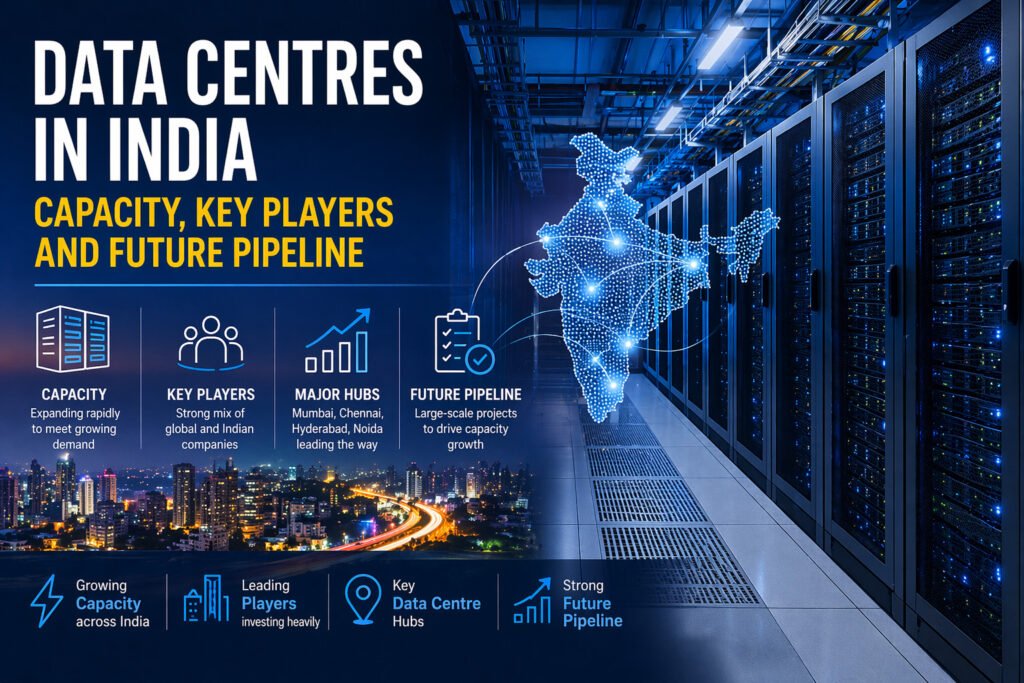
Leading states: Maharashtra, Tamil Nadu, Uttar Pradesh, Telangana
This competitive federalism is accelerating the creation of regional data centre hubs, particularly around Mumbai, Chennai, and Noida.
Data Localisation Push: Creating Domestic Demand
One of the most powerful structural drivers is India’s emphasis on data localisation, supported by the
Digital Personal Data Protection Act, 2023.What this means:
- Certain categories of data must be stored and processed within India
- Global companies are required to build or lease local infrastructure
Investment impact:
- Ensures captive domestic demand
- Encourages global hyperscalers to invest in India
- Reduces dependence on overseas data storage
This effectively anchors demand within the country, making the sector more resilient and predictable.
Together, these policy measures reduce financial risk, improve returns visibility, and create a strong foundation for sustained investment in India’s data centre ecosystem.
data privacy and regulatory framework in India
3. Long-Term Contracts (Stable Income)
- Clients like cloud providers sign 10–15 year leases
- Predictable and annuity-like cash flows
4. High Entry Barriers
- Capital intensive
- Requires technical expertise
- Regulatory compliance
Result: Limited competition, better pricing power“
Types of Investment Opportunities
🔹Direct Investment –Building and Owning Data Centres
Direct investment refers to owning the physical data centre asset—including land, buildings, power infrastructure, cooling systems, and servers—and generating income by leasing capacity to clients such as cloud providers and large enterprises.
🧩 What It Involves
- Acquisition of land in strategic locations (near connectivity hubs)
- Development of high-spec infrastructure (power, cooling, security)
- Securing long-term clients (hyperscalers, enterprises)
- Managing operations and uptime (typically 99.99%+)
👉 It is a capital-intensive but high-control model
🏢 Real-World Examples
- AdaniConneX
A joint venture between Adani Group and EdgeConneX, investing billions to build hyperscale data centres across India. - Reliance Industries
Through its digital arm, Reliance is building large-scale data centre capacity to support its telecom and digital ecosystem. - ST Telemedia Global Data Centres
One of India’s largest data centre operators, owning and operating multiple facilities across key cities. - Yotta Infrastructure
Developing large hyperscale parks like the Navi Mumbai data centre.
👤 Who Typically Invests Directly?
- Large corporates
- Infrastructure funds
- Sovereign wealth funds
- Global data centre operators
👉 These investors have:
- Deep pockets
- Long investment horizons
- Technical and operational capabilities
⚖️ Why It Matters
✔ Full control over asset and operations
✔ Higher long-term returns potential
✔ Ability to secure large anchor clients
❗ But also:
- High upfront capital (₹500–1000+ crore)
- Long gestation period
- Operational complexity
💡 Direct investment in data centres is like owning a commercial office building—except your tenants are cloud companies, and your rent depends on data usage instead of floor space.
🎯 Direct investment offers the highest control and return potential, but requires significant capital, expertise, and patience.
🔹 REITs / Infrastructure Trusts
Accessing Data Centres Without Owning Them
For investors who may not have the scale or expertise for direct ownership, Real Estate Investment Trusts (REITs) and Infrastructure Investment Trusts (InvITs) offer an attractive alternative.
These vehicles allow investors to participate in income-generating assets—including data centres—without directly building or operating them.
🧩 How This Model Works
- A trust owns a portfolio of income-generating assets (e.g., data centres, office parks, transmission lines)
- Investors purchase units of the trust, similar to shares
- Income generated from leasing these assets is distributed periodically
👉 In essence, investors earn a share of the rental-like income from data centre operations.
🌍 Global Context (Important for Perspective)
In developed markets, data centres are already a well-established REIT asset class.
- Equinix
- Digital Realty
These companies:
- Own and operate global data centre portfolios
- Generate stable, recurring revenues
- Are widely held by institutional and retail investors
👉 Their success demonstrates that data centres can function as yield-generating infrastructure assets
🇮🇳 Indian Context (Emerging Opportunity)
India’s REIT/InvIT market is still evolving, and pure-play data centre REITs are not yet widely available.
However:
- The regulatory framework for REITs and InvITs is well established
- Existing REITs (office assets) have shown strong investor acceptance
- As data centre assets mature, listing through REIT/InvIT structures is a logical next step
👉 This creates a future opportunity for retail investors to participate in the sector.
⚖️ Investment Characteristics
✔ Lower entry barrier compared to direct investment
✔ Regular income (dividend-like distributions)
✔ Diversified exposure to infrastructure assets❗ Limitations:
- Limited availability in India (currently)
- Less control over underlying assets
- Returns depend on trust performance
💡 Investing in a data centre REIT is like owning a fraction of a large commercial complex—where your income comes from rent paid by tenants, without the hassle of managing the property.
REITs and InvITs democratise access to data centre investments, transforming a capital-intensive asset class into a more accessible, income-generating opportunity.
🔹 Listed Companies (India Focus)
Here are some key players investors track:
- Reliance Industries
- Adani Enterprises
- CtrlS Datacenters
- ST Telemedia Global Data Centres
🔹 Indirect Bets
- Power companies
- Cooling technology providers
- Real estate developers
India’s Strategic Advantage
🔹 Digital Population Scale
- Over 800 million internet users
🔹 Data Localisation Push
- Drives domestic infrastructure demand
🔹 Cost Advantage
- Lower construction and operating costs vs West
Risks & Challenges
🔸 High Capital Requirement
- ₹500–1000 crore for large facilities
🔸 Power Consumption
- Data centres are energy-intensive
🔸 Regulatory Evolution
- Policies still evolving
🔸 Technology Obsolescence
- Rapid changes (AI, edge computing)
Investment Outlook: Bullish but Selective
The sector offers:
✔ Long-term structural growth
✔ Stable cash flows
✔ Strategic importance
But investors must be:
👉 Selective
👉 Patient
👉 Policy-aware
The Future: AI, Edge & Hyperscale
- AI-driven demand explosion
- Edge data centres for 5G
- Hyperscale facilities by global giants
India is poised to become a global data hub
Key Players in India’s Data Centre Ecosystem
India’s data centre landscape is being shaped by a mix of large conglomerates and specialised operators, each contributing to the rapid expansion of digital infrastructure.
- Reliance Industries
Leveraging its telecom and digital ecosystem, Reliance is investing in large-scale data centre capacity to support cloud, retail, and enterprise services. - Adani Enterprises
Through its joint venture AdaniConneX, the group is building hyperscale data centres across key Indian cities with a long-term infrastructure focus. - CtrlS Datacenters
One of India’s earliest and most established data centre operators, known for its Tier IV certified facilities and enterprise clientele. - ST Telemedia Global Data Centres
A major global player with a strong presence in India, operating multiple facilities and catering to hyperscale and enterprise clients.
💡Together, these players reflect the growing institutional interest and long-term capital commitment shaping India’s data centre ecosystem.
Conclusion
Data centres are no longer just IT infrastructure—they are core economic assets powering India’s digital future.
For investors, this presents a rare opportunity to participate in a high-growth, policy-backed, infrastructure-led sector.
However, success will depend on understanding the intersection of technology, regulation, and capital.
FAQs (Frequently Asked Questions)
Yes, they offer long-term growth, stable income, and strong policy support, making them an attractive infrastructure investment.
Lorem ipsum dolor sit amet, consectetur adipiscing elit. Ut elit tellus, luctus nec ullamcorper mattis, pulvinar dapibus leo.
Companies like Reliance, Adani, CtrlS, and STT GDC are key players in India’s data centre ecosystem.
High capital costs, energy consumption, regulatory changes, and rapid technological evolution.
It increases demand for domestic data centres, making the sector more attractive for investors.