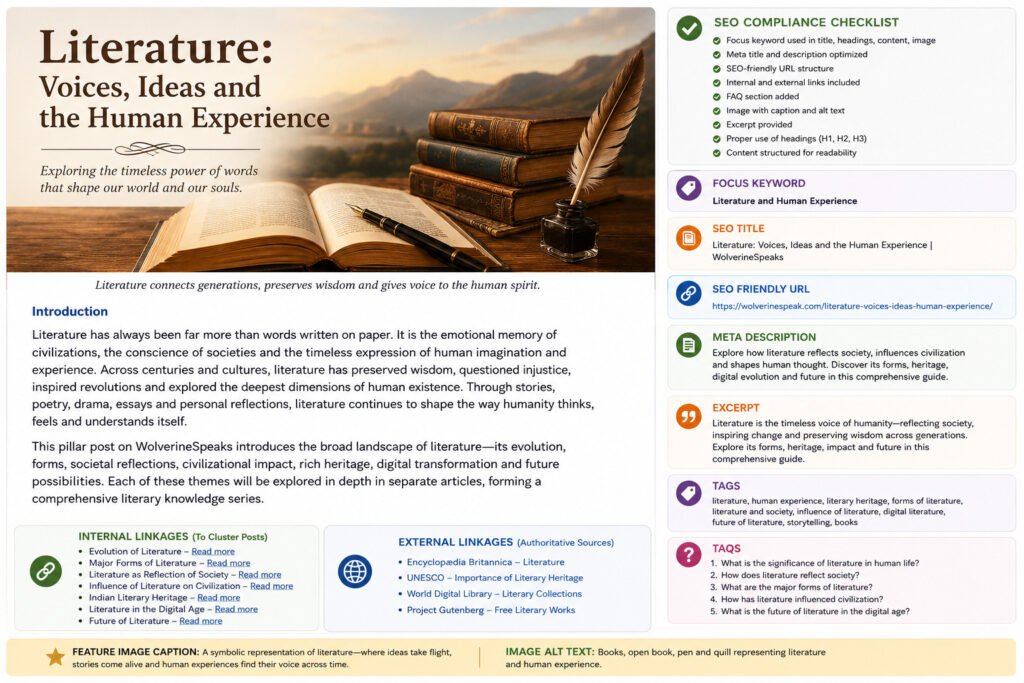
Literature: Voices, Ideas and the Human Experience

Introduction Literature has always been far more than words written on paper. It is the emotional memory of civilizations, the conscience of societies and the timeless expression of human imagination and experience. Across centuries and cultures, literature has preserved wisdom, questioned injustice, inspired revolutions and explored the deepest dimensions of human existence. Through stories, poetry, drama, essays and personal reflections, literature continues to shape the way humanity thinks, feels and understands itself. From ancient oral traditions and sacred epics to modern novels and digital storytelling, literature has evolved alongside civilization itself. Yet despite changing forms and technologies, its essential purpose remains unchanged — to capture the human journey in all its complexity, beauty and contradiction. In today’s fast-moving world dominated by technology, information overload and shrinking attention spans, literature continues to offer something uniquely valuable: depth. It encourages reflection in a distracted age, empathy in divided societies and imagination in increasingly mechanized environments. Literature allows humanity to pause and rediscover the emotional and intellectual dimensions of life that often become neglected amidst material progress and digital speed. The Literature section of WolverineSpeak.com seeks to approach literature not merely as academic study or book discussion, but as a living exploration of civilization, society, philosophy and human consciousness. Unlike many conventional literary blogs focused only on reviews or summaries, this platform aims to examine the deeper relationship between literature and life itself. Evolution of Literature: From Oral Traditions to the Digital Age The evolution of literature mirrors the evolution of humanity. Long before written language emerged, stories were preserved through oral traditions, folklore and poetry passed across generations. Ancient civilizations used literature to preserve spiritual wisdom, cultural values and historical memory. As writing systems developed, literature expanded into philosophical texts, epics, poetry, drama and intellectual discourse. Works such as the Ramayana, the Mahabharata, Greek epics and classical philosophical writings became foundational pillars of civilization itself. Over time, literature evolved through: Religious and devotional movements Classical artistic traditions Social reform movements Political revolutions Modern psychological exploration Contemporary digital expression Each era shaped literature, and literature in turn shaped each era. Major Forms of Literature Literature expresses itself through diverse forms, each offering a unique way of understanding human experience. Poetry transforms emotion into rhythm and imagery, often expressing feelings and ideas that ordinary language cannot fully capture. Fiction uses imagination and storytelling to explore society, morality, relationships and the complexities of human behavior. Drama brings literature into performance, transforming written words into living emotional experience through theatre and dialogue. Essays encourage reflection, intellectual inquiry and critical thinking, while memoirs preserve personal journeys and lived experiences that often carry universal emotional significance. Together, these forms create the rich and evolving landscape of literary expression across civilizations and generations. Literature as Reflection of Society One of literature’s greatest strengths lies in its ability to reflect society with honesty and emotional depth. Literature captures not only historical events, but also the thoughts, fears, aspirations and moral struggles of the people living through them. Every age produces literature shaped by its realities: Ancient literature explored mythology and spirituality Medieval literature reflected faith and kingship Modern literature examined industrialization, inequality and nationalism Contemporary literature explores identity, technology and globalization Literature often acts as society’s moral conscience. Writers have historically challenged injustice, questioned power structures and given voice to marginalized communities. Through emotional storytelling and reflective thought, literature helps societies understand both their strengths and their failures. Influence of Literature on Civilization Few forces have shaped civilization as profoundly as literature. Beyond entertainment, literature has influenced: Cultural identity Moral values Philosophical thought Political awareness Social reform Spiritual understanding Sacred texts, epics, philosophical writings and literary movements have guided civilizations for centuries. Literature preserves the intellectual and emotional heritage of humanity while continuously inspiring change and reflection. Many reform movements and national awakenings were deeply influenced by literary thought. Through books, poetry and essays, societies have debated freedom, justice, morality and human dignity across generations. In many ways, literature serves as the living memory of civilization itself. Indian Literary Heritage India possesses one of the world’s richest literary traditions. From the Vedas and Upanishads to regional poetry, devotional literature and modern fiction, Indian literary heritage reflects extraordinary diversity of language, philosophy and spiritual inquiry. Indian literature has continuously explored: Dharma and morality Spiritual consciousness Human relationships Social harmony Emotional sensitivity Philosophical reflection The Ramayana and Mahabharata remain among the world’s greatest literary and civilizational works, influencing culture and ethics across generations. Regional literary traditions in Hindi, Bengali, Tamil, Urdu, Marathi and many other languages have further enriched India’s cultural identity. Bhakti and Sufi poetry brought spirituality into the language of ordinary people, while modern writers used literature as an instrument of social reform and national awakening. Indian literary heritage remains not merely a cultural asset, but a continuing source of intellectual and emotional inspiration Literature in the Digital Age The digital revolution has transformed how literature is created, distributed and consumed. E-books, audiobooks, online publishing and social media writing have expanded literary accessibility on an unprecedented scale. Writers today can reach global audiences instantly, while readers can explore literature from diverse cultures and languages through digital platforms. Regional voices and independent creators now possess opportunities that were once unimaginable. At the same time, modern literary culture faces serious challenges: Declining reading attention spans Information overload Commercialization of content Preference for speed over reflection Yet despite these changes, literature continues to remain deeply relevant because human beings continue to seek meaning, emotional connection and thoughtful expression beyond mere information. Future of Literature The future of literature will likely be shaped by both technological innovation and enduring human needs. Artificial intelligence, interactive storytelling and immersive digital experiences may transform literary formats and methods of creation. However, literature’s deepest strength lies in qualities that remain profoundly human: Emotion Memory Imagination Empathy Reflection Moral inquiry As societies become increasingly automated and technologically driven, literature may become even more valuable because it preserves the emotional and philosophical dimensions of human existence. The future of

Literature: Voices, Ideas and the Human Experience Read More »