
Table of Contents
ToggleIntroduction
Some court cases become more than legal proceedings and go on to shape public opinion, social thinking and even legal systems. The Nanavati case remains one of the most widely discussed criminal trials in India and continues to occupy a unique place in the country’s legal history.
The case involved love, betrayal, murder, public sympathy and intense media attention. More importantly, it raised serious questions about justice and eventually contributed to the end of the jury system in India.
Background of the Case
Commander Kawas Manekshaw Nanavati was a respected naval officer serving in the Indian Navy. He was married to Sylvia Nanavati and they had children.
During Nanavati’s prolonged naval assignments, Sylvia developed a relationship with businessman Prem Ahuja.
When Nanavati discovered the relationship, events took a dramatic turn.
The Incident
On 27 April 1959, Nanavati confronted his wife and later went to meet Prem Ahuja.
What happened inside Ahuja’s residence became the centre of legal debate. Gunshots were fired and Prem Ahuja died.
Nanavati later surrendered to the police.
Trial and Public Reaction
The case immediately captured public attention.
Newspapers covered the story extensively and public sympathy largely favoured Nanavati. Many viewed him as a wronged husband who had acted in a moment of emotional distress.
The case was initially heard before a jury, which returned a verdict in Nanavati’s favour.
However, the Bombay High Court disagreed and ordered a retrial.
Why the Case Became Historic
The Nanavati case became important for several reasons:
- It highlighted the influence of media on public opinion.
- It raised concerns regarding emotional bias in jury decisions.
- It questioned whether justice should be influenced by sympathy.
- It eventually contributed to the abolition of the jury system in India.
Presidential Mercy and Later Developments
Nanavati was later convicted by the court.
However, political and public discussions continued and he eventually received relief through the process of pardon and clemency.
The case remains an important example of the interaction between law, public sentiment and executive powers.
Lessons for Society
The Nanavati case demonstrates that legal decisions often involve more than facts and laws alone.
It reminds us that:
- Public emotions can influence perception.
- Media narratives can shape opinions.
- Justice systems must remain balanced and objective.
Conclusion
More than six decades later, the Nanavati case continues to be remembered not merely as a murder trial but as a landmark event that changed India’s legal thinking. It became a story where law, society and human emotions intersected, leaving a lasting impact on the country’s legal history.
Note to Readers:
The content in this article has been prepared using information available in the public domain and is intended for educational and informational purposes. While every effort has been made to ensure accuracy, readers are encouraged to refer to original sources for detailed information.
Frequently Asked Questions(FAQs)
A landmark legal case is a court decision that significantly influences future laws, legal principles or public policy.
Landmark cases shape legal systems, influence judicial interpretation and often create lasting social and constitutional impact.
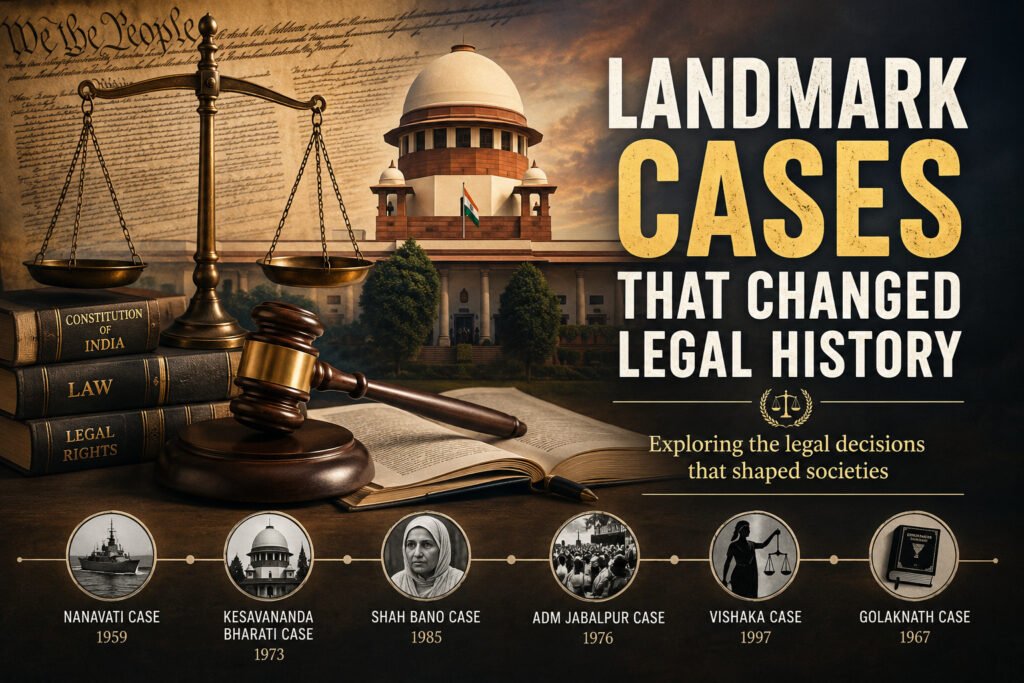
Some important landmark cases include the Nanavati case, Kesavananda Bharati case, Shah Bano case, Golaknath case and the Vishaka case.
Legal decisions can affect social values, rights, governance and public policy and may lead to long-term changes in society.
This section may be useful for students of Law, Sociology and Political Science, researchers and readers interested in understanding legal developments.
This section may be useful for students of Law, Sociology and Political Science, researchers and readers interested in understanding legal developments.
A case becomes historically important when it changes legal thinking, influences constitutional interpretation or affects society on a larger scale.
Commander Nanavati eventually received clemency from Vijaya Lakshmi Pandit in her capacity as Governor of Maharashtra. The relief was granted under the constitutional powers available to the Governor.
No. After his release, Commander Nanavati, his wife Sylvia and their children emigrated to Canada. The family settled in Burlington, Ontario, where they later lived a relatively private life.
The case was heard before a Sessions Court jury consisting of nine members. The jury initially returned a verdict in favour of Nanavati by an 8–1 majority, accepting the argument of sudden and grave provocation. However, the verdict was later set aside by the Bombay High Court.
The Bombay High Court set aside the jury verdict and convicted Nanavati under Section 302 of the Indian Penal Code. The matter later proceeded to the Supreme Court, where the conviction was upheld.
The Nanavati case became significant because it highlighted the influence of media and public opinion on legal proceedings and contributed to the eventual decline of the jury system in India.
The case itself did not immediately abolish the jury system, but it exposed weaknesses in the process and strongly influenced the move towards its gradual discontinuation in India.
Yes. The case inspired books, films and television productions over the years, including later cinematic adaptations and web series based on its themes and events.
One of the most interesting aspects of the Nanavati case was that support for clemency came from multiple quarters. Public opinion had largely shifted in favour of Commander Nanavati, and the issue received strong media attention. Significantly, a written expression of support for pardon was also obtained from Mamie Ahuja, the sister of Prem Ahuja, the deceased. This became an important development before clemency was eventually granted by the Governor of Maharashtra.