Table of Contents
ToggleIntroduction
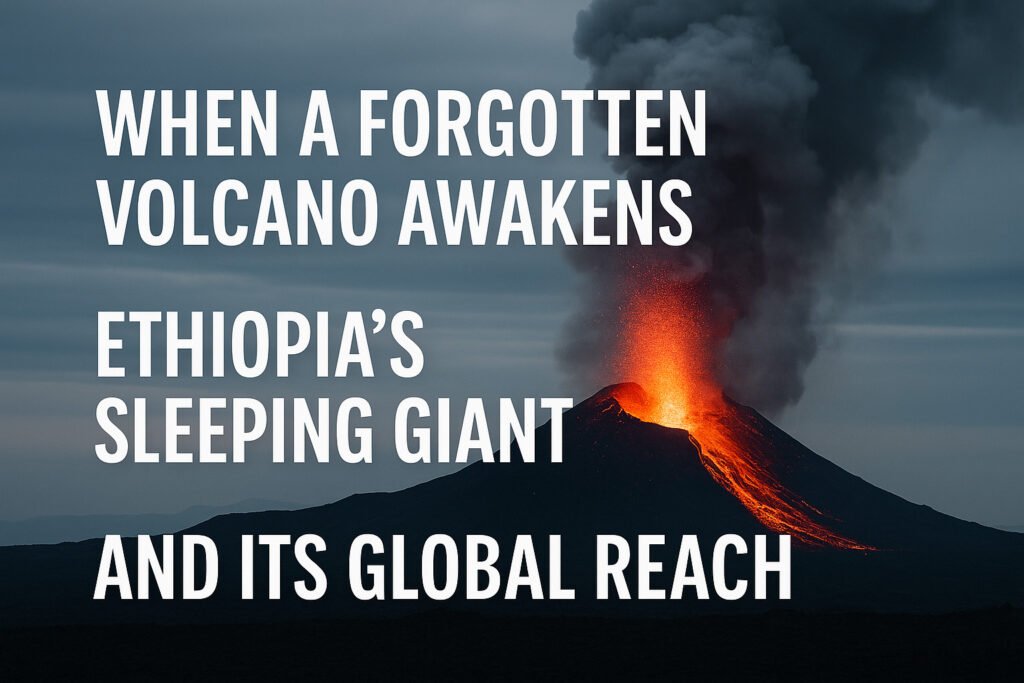
On Sunday, 23 November 2025, a long-dormant volcano known as Hayli Gubbi erupted in the remote Afar Region of northern Ethiopia, startling scientists and local communities alike. This low shield volcano lies within the Erta Ale range of the East African Rift System, approximately 800 kilometres north-east of Addis Ababa, close to the isolated district of Afdera near the Eritrean border.
The eruption commenced at around 8:30 a.m. UTC and its most explosive phase subsided by approximately 8:00 p.m. the same day — a dramatic yet relatively short-lived display of nature’s raw power. A towering ash plume surged nearly 13–14 kilometres (about 45,000 feet) into the sky, spreading across the Red Sea and drifting over Yemen and Oman before travelling further eastward across Pakistan and northern India. This atmospheric trail briefly disrupted aviation routes across the region before continuing its journey towards China.
The above facts have been sourced from LiveScience, a trusted science publication. https://www.livescience.com/planet-earth/volcanoes/long-dormant-volcano-erupts-in-ethiopia-after-10-000-years
Mapping the Eruption: Place and Moment
While the spectacle of the eruption captured global attention, its deeper significance lies beneath the surface — both literally and metaphorically. Hayli Gubbi had been considered dormant for over 10,000 years, with no recorded eruptions in known history. Its sudden reawakening raises compelling questions about the hidden dynamics of the Earth’s crust, the reliability of volcanic classifications, and the silent geological processes unfolding beneath some of the world’s most remote landscapes.
This event not only challenges scientific assumptions about “extinct” volcanoes but also serves as a powerful reminder that the planet’s natural forces operate on timescales far beyond human memory — quietly building pressure, awaiting the moment to reveal their presence.
Why Do Volcanoes Erupt – And Why Here?
Volcanoes erupt as a result of immense forces operating deep within the Earth’s interior. Beneath the planet’s surface lies a semi-molten layer known as the mantle. When intense heat and pressure cause sections of this mantle to melt, magma is formed. This lighter, buoyant magma begins to rise, collecting in reservoirs beneath the crust. As gases dissolved within the magma expand, pressure builds relentlessly. When this pressure exceeds the strength of the surrounding rock, the surface fractures — and a volcano erupts, releasing lava, ash and gases into the atmosphere.
The eruption of Hayli Gubbi is not an isolated caprice of nature but a consequence of its location within one of the most geologically active zones on the planet: the East African Rift System. This vast rift marks the point where the African tectonic plate is slowly splitting into two — the Nubian and Somali plates — a process that has been unfolding for millions of years. As the land stretches and thins, deep cracks form, creating pathways through which magma can ascend.
The Afar Region, where Hayli Gubbi sits, is often described as a geological laboratory. It is one of the few places on Earth where three tectonic plates meet — the African, Arabian and Somali plates — making it exceptionally prone to volcanic activity and earthquakes. The ground here is in a constant state of subtle tension, silently adjusting, shifting, and occasionally reaching a breaking point.
In essence, Hayli Gubbi did not erupt because it “chose to awaken”; it erupted because the Earth beneath it is being pulled apart, allowing long-buried magma to find its way to the surface. What appears to us as a sudden and dramatic event is, in reality, the visible expression of a slow, powerful geological process that has been building momentum over thousands of years.
This eruption, therefore, is not just an episode of destruction or spectacle — it is a reminder that the planet beneath our feet is alive, restless, and perpetually reshaping itself.
Learn more about how and why volcanoes erupt from the United States Geological Survey (USGS).
https://www.usgs.gov/mission-areas/natural-hazards/science/volcano-hazards
Was There Any Advance Warning?
Although the eruption appeared sudden to the outside world, subtle signs had been quietly forming beneath the surface. Satellite observations in recent months detected unusual ground swelling in parts of the Afar Region — a classic indication that magma was accumulating underground. Scientists also observed rising heat signatures and faint gas emissions near the summit, suggesting increased internal activity.
However, the remoteness of Hayli Gubbi and the limited monitoring infrastructure in this sparsely populated region meant that these warning signs did not translate into effective early alerts for local communities. To them, the eruption felt abrupt and overwhelming — a dramatic interruption in an otherwise silent landscape.
This gap between scientific detection and public preparedness highlights a growing global concern: many of the world’s most dangerous volcanoes lie in remote or economically disadvantaged regions, where continuous monitoring and rapid warning systems remain a challenge.
Hayli Gubbi: Active, Dormant or Misunderstood?
Before November 2025, Hayli Gubbi was widely regarded as dormant, with no recorded eruptions for over 10,000 years. For all practical purposes, it had faded into geological obscurity. Its sudden reawakening has now altered that perception entirely.
In scientific terms:
An active volcano has erupted in recent geological history and shows potential to erupt again.
A dormant volcano has remained quiet for long periods but retains the capacity to awaken.
An extinct volcano is believed to have permanently ceased activity.
Hayli Gubbi now re-enters the category of an active volcano, challenging the notion that silence equates to safety. Its awakening serves as a cautionary tale — that even the most forgotten landscapes may conceal powerful forces waiting patiently beneath.
Why This Eruption Matters
This event is not merely about one volcano in a distant land. Its ash reached the skies over India. Its gases travelled across continents. Its plume forced international flights to change course. What occurred in a remote corner of Ethiopia subtly touched global systems, trade, aviation and environmental awareness.
In doing so, Hayli Gubbi reminds us that nature respects no borders. A disturbance in one part of the world can ripple across oceans and nations — binding humanity together under a shared sky and a shared planet.
Human and Environmental Impact
While the eruption of Hayli Gubbi did not claim human lives, its imprint on daily existence in the Afar Region has been profound and unsettling. The surrounding villages, largely inhabited by pastoral communities, found themselves blanketed in fine volcanic ash that settled over homes, grazing lands and scarce water sources. For people whose livelihoods depend almost entirely on livestock, this has meant more than inconvenience — it threatens their very survival.
Ash-contaminated ponds and wells have rendered traditional water sources unsafe, forcing herders and families to travel longer distances in search of drinkable water. Livestock, already vulnerable in this arid landscape, now struggle to find clean forage, ingesting ash that can damage their digestive systems and weaken immunity. Reports of respiratory irritation, persistent coughing and eye discomfort among residents further underline the silent but serious health burden that follows such eruptions.
Environmentally, the eruption has altered the fragile balance of the region. Ash deposits change soil composition, initially smothering vegetation and disrupting plant photosynthesis. While volcanic soil may eventually become fertile, the immediate aftermath is one of suffocation rather than renewal. Native flora, already adapted to harsh desert conditions, now faces yet another stress factor, and local wildlife retreats further into marginal habitats.
Beyond Ethiopia’s borders, the environmental impact extended into the atmosphere. The ash plume and sulphur dioxide released during the eruption travelled thousands of kilometres, crossing the Red Sea, drifting over the Arabian Peninsula and touching the skies over the Indian subcontinent. Though much of this remained in upper atmospheric layers, its presence served as a stark reminder that environmental consequences do not respect geographic or political boundaries.
In essence, Hayli Gubbi’s awakening did not only reshape a distant Ethiopian horizon; it quietly disrupted ecosystems, strained vulnerable communities and reminded the world how swiftly nature can recalibrate the conditions of life.
Satellite observations of volcanic gases are monitored by the European Space Agency.https://www.esa.int/Applications/Observing_the_Earth/Copernicus/Sentinel-5P
Economic Consequences
Although the eruption of Hayli Gubbi unfolded far from major urban centres, its economic repercussions ripple through an already fragile regional economy. The Afar Region is home predominantly to pastoral communities whose wealth is measured not in currency, but in livestock. As ash settled over grazing lands and contaminated vital water sources, cattle, goats and camels faced immediate stress — and for their owners, this translated into diminished productivity, lower market value and, in some cases, irreversible loss.
For families already living on the margins, even a temporary disruption can carry long-term consequences. Milk production declines, animals weaken, and traditional trade routes become uncertain. The erosion of these livelihoods is not simply an economic setback; it unsettles social stability and food security in a region where resilience is built on delicate balance.
Beyond local hardship, the Ethiopian state is compelled to shoulder the cost of emergency response, health interventions, infrastructure rehabilitation and future monitoring mechanisms. Resources must be diverted toward relief efforts, clean water provision, healthcare support and restoration of disrupted services — all of which place additional pressure on public expenditure.
Tourism, though limited in volume, has also felt the tremor. The wider Danakil and Erta Ale region is known for its stark, other-worldly beauty and attracts adventurous travellers. With reports of ash fallout and restricted access, visitor movement has slowed, affecting guides, transport operators, local accommodation providers and ancillary businesses.
Internationally, the disruption of air routes over parts of the Middle East and South Asia added further indirect costs. Flight diversions, cancellations and logistical adjustments by airlines translate into financial losses, delays and increased operational expenses — a subtle but telling reminder of how even a remote eruption can influence global commerce.
In sum, the economic story of Hayli Gubbi is not one of dramatic collapse, but of cumulative strain — a quiet erosion of livelihoods, public resources and regional stability that may take years to fully recover.
Could It Erupt Again?
The short answer is: yes, the possibility cannot be ruled out.
Volcanoes, particularly those situated within active rift zones, do not follow predictable schedules. Once a volcanic system awakens after prolonged dormancy, it enters a new phase of geological relevance. Hayli Gubbi’s recent eruption has demonstrated that magma pathways beneath it are still alive, responsive and capable of reactivation.
Although the most explosive phase has subsided, scientists remain cautious. Eruptions are often not isolated events but part of a wider cycle of subterranean activity. In some cases, a major eruption is followed by smaller secondary episodes or intermittent gas emissions over months or even years. In rift environments such as the Afar Region, ongoing tectonic stretching continues to generate ideal conditions for renewed movement of magma.
Volcanologists will now closely monitor several indicators to assess future risk:
Seismic activity beneath the volcano, indicating magma movement
Ground deformation, measured via satellite imagery, which reveals swelling or subsidence
Gas emissions, particularly sulphur dioxide levels
Thermal anomalies, signifying rising heat from below
None of these signals yet suggest an immediate repeat eruption, but the scientific consensus is clear: Hayli Gubbi can no longer be considered a quiet or forgotten feature of the landscape.
Instead, it stands as a reawakened system — one that now commands attention, surveillance and respect. Its future behaviour remains uncertain, but its recent awakening has permanently altered how it will be viewed by the scientific community and local populations alike.
In that uncertainty lies an important lesson: nature does not announce its next move. It simply waits — and then reminds us of its presence when we least expect it.
Volcanic early warning and monitoring systems explained by the Smithsonian Global Volcanism Program.https://volcano.si.edu/
Conclusion – When the Earth Speaks
The eruption of Hayli Gubbi is more than a geological event recorded on satellite images and scientific charts. It is a quiet yet powerful reminder that beneath the stillness of our everyday world lies a restless planet, constantly reshaping itself beyond the reach of human control or comprehension. What appeared as a distant incident in a remote corner of Ethiopia became, within hours, a global narrative — crossing skies, disrupting flight paths and touching lives thousands of kilometres away.
In an age where humanity prides itself on technological mastery and predictive precision, such moments humble us. They remind us that nature does not conform to calendars, borders or assumptions. A volcano forgotten for millennia can awaken in a single day, altering landscapes, economies and perceptions with silent authority.
Yet, within this disruption lies an opportunity — to understand, to respect and to coexist more thoughtfully with the forces that govern our planet. Hayli Gubbi’s awakening urges us to listen more closely to the Earth’s subtle signals, to invest in scientific foresight, and to recognise the interconnectedness of life systems across continents.
This is the essence of Nature’s Secret: not merely documenting dramatic phenomena, but interpreting what they reveal about our fragile relationship with the world we inhabit. For when the Earth speaks, it is not only science that must listen — it is humanity itself.
FAQs
Fortunately, no deaths were reported. However, the eruption posed health risks due to ash inhalation and contamination of water sources, particularly affecting pastoral communities and livestock.
The ash plume rose high into the atmosphere and was carried eastward by prevailing winds across the Arabian Sea, eventually reaching parts of South Asia, including India.
Yes, it was believed to be dormant or effectively extinct due to no recorded activity for over 10,000 years. This eruption has changed its classification to active.
Accordion Content
Absolutely. Ash particles can damage aircraft engines and reduce visibility, which is why several flights were diverted or cancelled as a precaution.
Yes. Many volcanoes around the world lie in remote regions with limited monitoring, making sudden eruptions possible without significant public warning.
Current assessments suggest that the volume of gas released is not sufficient to cause long-term global climate change, though local atmospheric effects are noticeable.
Through continuous monitoring
using satellites, seismic sensors and gas detection instruments, scientists
attempt to forecast increased volcanic activity — though precision remains
limited.
Nature does not always whisper before it speaks — sometimes it simply reminds us who truly governs the rhythm of this planet.