Table of Contents
ToggleIntroduction: Data is the New Trust Currency



In today’s digital economy, data is often described as the new oil. But unlike oil, data is deeply personal—reflecting identities, behaviours, and financial footprints.
As India rapidly advances towards becoming a global digital powerhouse, data centres are no longer mere storage facilities. They are evolving into custodians of trust, responsible for safeguarding sensitive information in an increasingly interconnected world.
This transformation has made a robust data privacy and regulatory framework not just desirable, but essential.
For a broader overview of the sector, you may also read our article on Data Centres: The Backbone of the Digital Economy.
The Legal Backbone of Data Privacy in India
India’s regulatory landscape has undergone a significant shift, moving towards a more structured and accountable system.
📘 The Cornerstone Law
Digital Personal Data Protection Act, 2023
This landmark legislation represents India’s most comprehensive effort to regulate personal data.
Key Highlights:
- Introduction of Data Fiduciaries responsible for handling user data
- Mandatory user consent for data collection and processing
- Emphasis on purpose limitation and data minimisation
- Penalties for breaches up to ₹250 crore
For data centres, this marks a transition from passive infrastructure providers to active participants in data governance.
The Foundational Framework Information Technology Act, 2000
While relatively older, the IT Act continues to underpin India’s digital legal system.
Relevance Today:
- Defines cyber offences and penalties
- Recognises electronic records and transactions
- Supports enforcement of cybersecurity measures
Implications for Businesses
For businesses, the regulatory framework brings both responsibilities and opportunities.
Key Implications:
- Need for stronger data security systems
- Greater transparency in data usage
- Compliance requirements for data handling
While compliance may increase operational efforts, it also builds trust among customers, which is essential in a digital economy.
Enforcement & Cyber Resilience Indian Computer Emergency Response Team
CERT-In acts as the operational backbone of India’s cybersecurity framework.
Key Requirements:
- Reporting cyber incidents within 6 hours
- Maintaining logs for 180 days
- Coordinating national cybersecurity response
For data centres, compliance with CERT-In guidelines is critical to maintaining operational integrity.
Government Incentives for Data CentresData Localisation: Driving Domestic Infrastructure
One of the defining features of India’s data policy is its emphasis on data localisation.
🔹 What It Means:
Certain categories of data must be stored and processed within Indian borders.
🔹 Why It Matters:
- Strengthens national security
- Enhances regulatory oversight
- Drives investment in local data centres
This policy has already encouraged global players to expand their presence in India, reinforcing the country’s position as a strategic data hub.
Cross-Border Data Transfer: A Balanced Approach
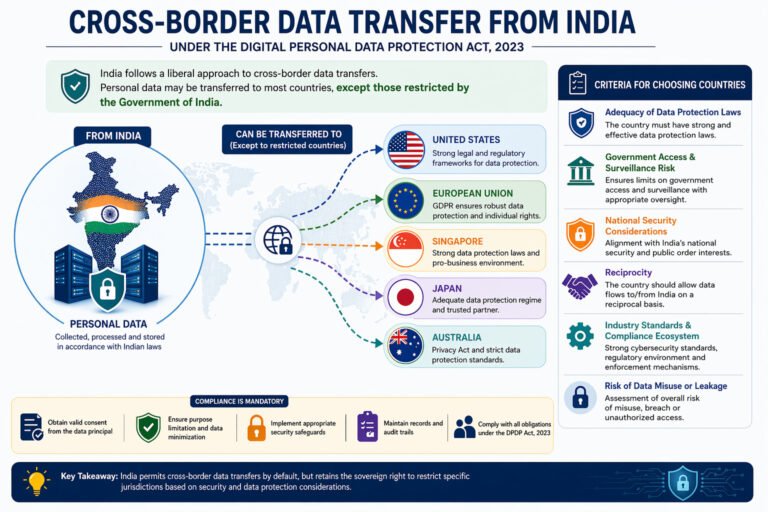
Under the Digital Personal Data Protection Act, 2023, India adopts a liberal yet controlled approach to cross-border data transfers.
Personal data may be transferred to most countries except those specifically restricted by the Government of India. As of now, no such restricted list has been officially notified, allowing relatively free global data movement.
🔹 Key Criteria for Selecting Countries:
- Strength of data protection laws
- Government access and surveillance safeguards
- National security considerations
- Reciprocity in data-sharing arrangements
- Robust cybersecurity frameworks
Countries such as the US, EU nations, Singapore, and Japan are generally considered trusted destinations due to their mature regulatory ecosystems.
👉 However, permission to transfer does not dilute responsibility—compliance obligations remain fully applicable.
Government Incentives: Catalysing Growth
India is not only regulating data—it is actively promoting infrastructure development.
🔹 Key Incentives:
- Grant of infrastructure status
- Subsidies on land and electricity
- Exemptions on stamp duty
- Faster approvals via single-window systems
🔹 State-Level Leadership:
States like Maharashtra, Tamil Nadu, and Uttar Pradesh are emerging as data centre hubs, offering tailored incentive packages.
Compliance Requirements for Data Centres
Operating within India’s regulatory framework requires a multi-layered compliance approach:
✔️ Data Protection Measures
- Encryption and secure storage
- Access control mechanisms
✔️ Monitoring & Reporting
- Regular data audits
- Mandatory incident reporting
✔️ Cross-Border Compliance
- Adherence to transfer rules
- Ensuring equivalent protection standards abroad
Challenges in Implementation
While the framework is robust, challenges remain:
- Regulatory complexity across jurisdictions
- High cost of compliance
- Rapidly evolving policy landscape
For smaller players, these challenges can be particularly demanding, while larger firms may adapt more easily.
The Road Ahead
India’s approach reflects a careful balancing act—between innovation and regulation, and between economic growth and individual privacy.
With the rise of AI, fintech, and digital public infrastructure, the importance of secure and compliant data handling will only increase.
Data centres will increasingly be judged not just by their capacity, but by their credibility and compliance standards.
Conclusion
The Data Privacy and Regulatory Framework in India is central to the country’s digital ambitions.
Through progressive legislation, proactive enforcement, and supportive incentives, India is positioning itself as a secure and attractive destination for data centre investments.
The journey ahead will depend on how effectively the ecosystem aligns trust, technology, and transparency.
The Digital Personal Data Protection Act, 2023 is India’s primary law governing how personal data is collected, processed, and stored. It mandates user consent, defines responsibilities of data handlers (data fiduciaries), and imposes penalties for data breaches.
Data centres store vast amounts of sensitive personal and financial data. Strong data privacy ensures:
- Protection against cyber threats
- Compliance with Indian laws
- Trust among users and businesses
Data localisation refers to the requirement that certain types of data must be stored and processed within India. This policy strengthens national security and boosts domestic data centre infrastructure.
Yes, all data centres operating in India must comply with laws such as the IT Act and DPDP Act, along with cybersecurity guidelines issued by CERT-In.
Under the DPDP Act, penalties for non-compliance can go up to ₹250 crore, depending on the severity of the violation and nature of the data breach.
The government provides incentives such as:
- Infrastructure status
- Subsidised land and power
- Tax benefits
- State-specific policies
These measures encourage investment in data centre infrastructure.
Yes, but only to countries approved by the government and subject to compliance with prescribed data protection standards.
The Ministry of Electronics and Information Technology (MeitY) is responsible for framing policies, implementing digital laws, and overseeing India’s data governance framework.
Some key challenges include:
- High cost of compliance
- Complex regulatory environment
- Rapidly evolving data laws
- Infrastructure and energy demands
With increasing digitisation, India is expected to strengthen its data protection ecosystem further, making compliance stricter while encouraging innovation and investment in data infrastructure.