
Table of Contents
ToggleLessons from the Past, Challenges of the Present
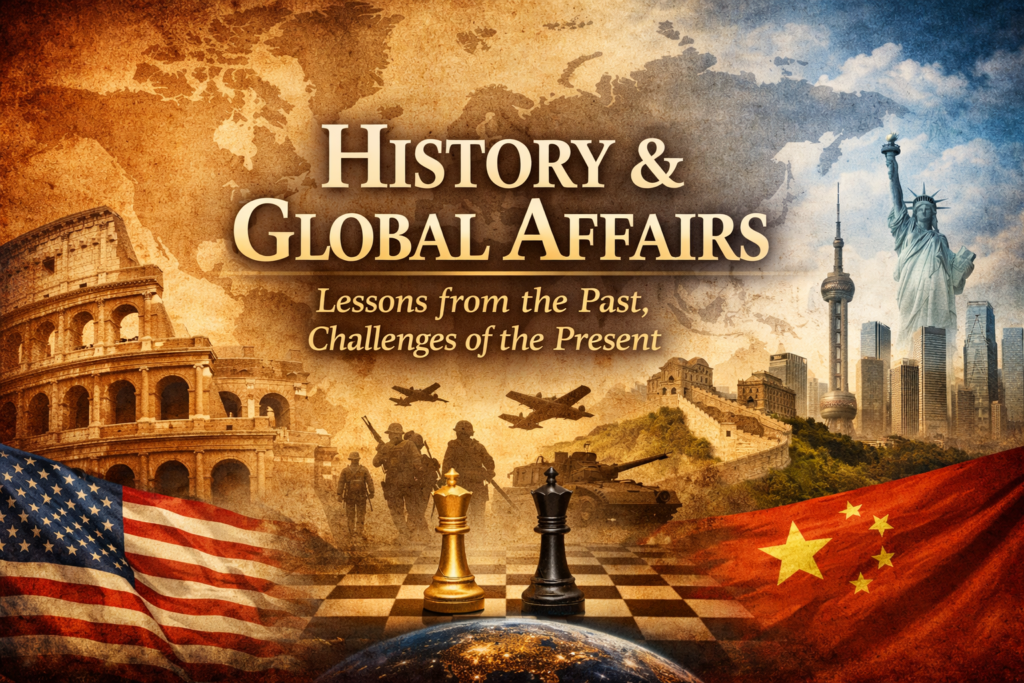
In a world that is constantly evolving, it is easy to believe that we are living in unprecedented times. Yet, history quietly reminds us that many of today’s global challenges—conflicts, power struggles, alliances, and economic rivalries—are echoes of the past. The study of history is not merely an academic exercise; it is a powerful lens through which we can better understand global affairs and perhaps navigate them more wisely.
Explore the Series
In this section, History & World Affairs, we will be covering the following themes that connect present-day global developments with their historical roots:
- USA–China Rivalry: A New Cold War?
- Russia–Ukraine War and the Legacy of the Soviet Collapse
- Middle East Conflict and the Sykes-Picot Legacy
- India’s Rise: From Non-Alignment to Global Influence
- Taiwan Issue and the Chinese Civil War Legacy
- Israel–Palestine Conflict and the Balfour Declaration
- NATO’s Evolution in Modern Geopolitics
- Energy Wars: From the Oil Crisis to Green Transition
- Global Pandemics: From Spanish Flu to COVID-19
- Technology Race: From Space Race to AI Dominance
These topics will continue to evolve, with new additions as global developments unfold, ensuring that this series remains relevant, insightful, and aligned with the changing dynamics of world affairs.
The Cyclical Nature of Power
History has repeatedly demonstrated that global power is rarely permanent. From the rise and fall of the Roman Empire to the decline of colonial powers like Britain and France, the balance of power has always been in flux. In the 20th century, the world witnessed the emergence of two superpowers—the United States and the Soviet Union—whose rivalry defined the Cold War era.
Today, we are witnessing another shift. The rise of China as a global economic and strategic power signals a move toward a more multipolar world. Much like past transitions, this shift brings both opportunities and tensions. Trade wars, technological competition, and geopolitical maneuvering are all part of this evolving landscape.
Lessons from the World Wars
The two World Wars were among the most defining events in modern history. They reshaped borders, economies, and international institutions. More importantly, they taught humanity the devastating cost of unchecked nationalism, militarism, and diplomatic failures.
Institutions such as the United Nations were born out of a desire to prevent such catastrophes. While imperfect, they represent an ongoing effort to resolve conflicts through dialogue rather than destruction. However, recent global tensions remind us that these lessons must be continually reinforced.
The Role of Diplomacy and Alliances
Diplomacy has always played a crucial role in shaping global affairs. Strategic alliances—whether NATO in the West or emerging partnerships in Asia—serve as both stabilizing forces and sources of tension.
History shows that alliances can deter conflict, but they can also escalate it. The intricate web of alliances before World War I, for instance, turned a regional dispute into a global war. Today, similar complexities exist, making diplomacy more critical than ever.
Economic Power: The New Battlefield
In earlier centuries, wars were fought primarily on battlefields. Today, economic strength often determines global influence. Trade agreements, sanctions, and supply chain control have become powerful tools in international relations.
The globalization of economies has interconnected nations in ways unimaginable a century ago. While this has led to unprecedented growth, it has also created vulnerabilities. A crisis in one part of the world can quickly ripple across continents, as seen during the global financial crisis and the COVID-19 pandemic.
The Human Element
Amid discussions of power and policy, it is important not to lose sight of the human dimension. Wars, political decisions, and economic policies ultimately affect ordinary people. History is filled with stories of resilience, sacrifice, and hope.
Leaders come and go, borders change, and ideologies evolve—but the human aspiration for peace, stability, and prosperity remains constant. This is perhaps the most enduring lesson history offers.
The Road Ahead
As we look to the future, the interplay between history and global affairs becomes even more significant. Climate change, technological disruption, and shifting demographics present challenges that require collective action.
If history teaches us anything, it is that cooperation often yields better outcomes than conflict. The world stands at a crossroads where the choices made today will shape the decades to come.
Conclusion
History is not just about the past—it is a guide for the present and a compass for the future. By understanding the patterns, successes, and failures of those who came before us, we can approach global affairs with greater wisdom and responsibility.
In an increasingly interconnected world, the lessons of history are more relevant than ever. The question is not whether we will face challenges—it is whether we will learn from the past to meet them effectively.
FAQs
History provides context to current events. Many modern conflicts, alliances, and policies are rooted in past decisions, making historical understanding essential for meaningful analysis.
Yes, many present-day tensions resemble earlier geopolitical rivalries, such as the Cold War. While the actors and tools may differ, the underlying dynamics often remain similar.
A multipolar world refers to a global system where power is distributed among several countries rather than dominated by one or two superpowers.
Economic strength, trade relationships, and control over resources now play a major role in shaping international relations, often replacing traditional military dominance.
While history cannot prevent conflicts entirely, it offers valuable lessons that can guide better decision-making and encourage diplomacy over confrontation.
Technology has become a key factor in global power, influencing areas such as cybersecurity, artificial intelligence, and communication, much like nuclear power did in the past.