Table of Contents
ToggleIntroduction
The story of energy is the story of civilization. From the flicker of firelight to the hum of electric cities, energy has shaped humanity’s progress — and its problems. Today, the planet stands at a crossroads: our dependence on fossil fuels has powered prosperity but at the cost of climate balance.
Renewable energy isn’t just a scientific breakthrough — it’s a moral and economic imperative. It represents humanity’s effort to harmonize progress with preservation, innovation with responsibility. As the world races toward carbon neutrality, new technologies in solar, wind, hydrogen, and smart grids are lighting the path to a cleaner, sustainable tomorrow.
🔙Previously in the Future of Technology Series:
Quantum Computing: Cracking the Code of Complexity
Explore how quantum computers are redefining intelligence, problem-solving, and the limits of computation.
Solar, Wind, and Hydrogen Breakthroughs
☀️ Solar Power: The Dawn of Abundance
Sunlight, the most abundant energy source on Earth, is now being harnessed with unprecedented efficiency.
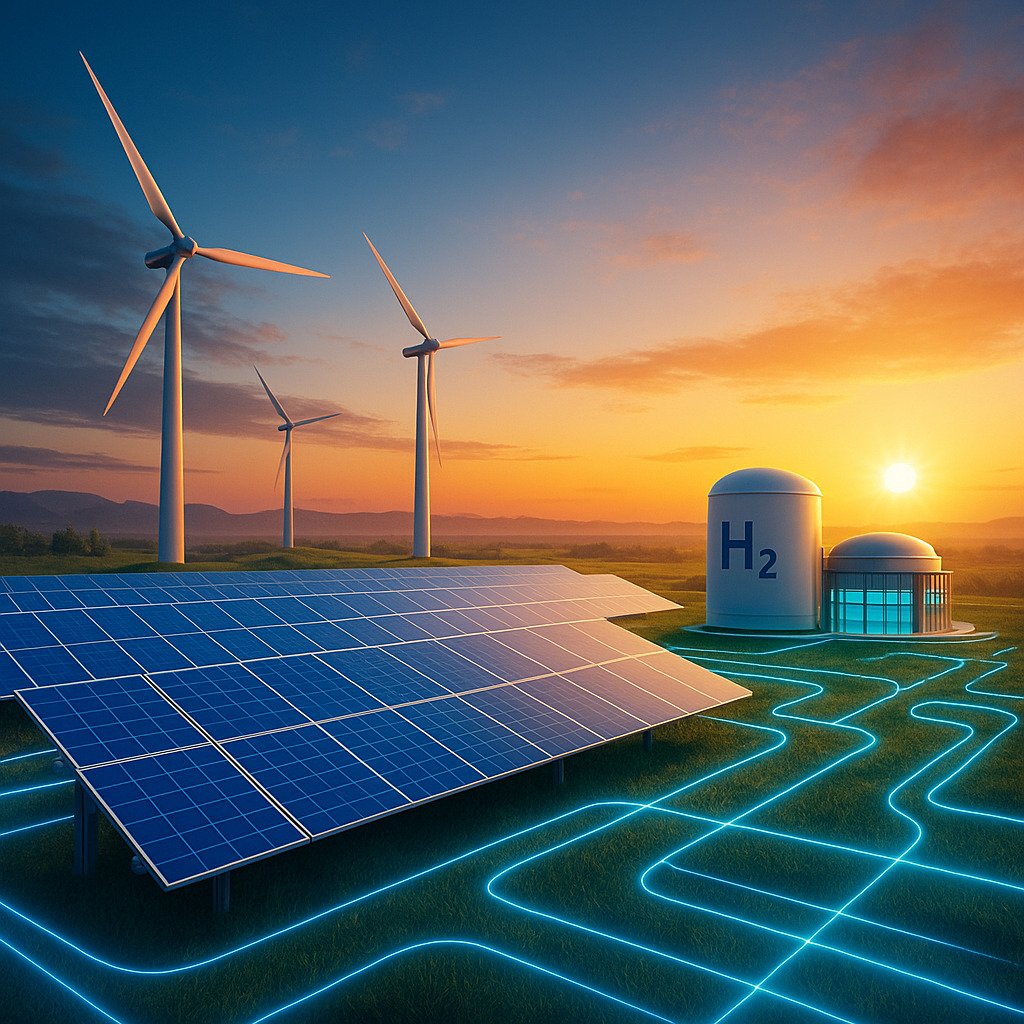
Modern photovoltaic panels convert sunlight into electricity at rates unimaginable just a decade ago, while perovskite solar cells promise cheaper and more flexible energy solutions. Floating solar farms, desert-based solar cities, and solar roofs are turning once passive landscapes into powerhouses of clean energy.
🌬️ Wind Energy: The Power in Motion
Wind technology has matured from rustic windmills to massive offshore turbines taller than skyscrapers.
Today’s wind farms generate more energy with fewer blades, thanks to advanced aerodynamic design and predictive AI maintenance. Offshore farms in the North Sea and Gujarat’s coastal belt are examples of how wind can meet large-scale industrial demand while minimizing land use.
⚗️ Hydrogen: The Invisible Giant
If solar and wind are the face of clean energy, hydrogen is its backbone. Green hydrogen, produced through electrolysis powered by renewables, holds the key to decarbonizing industries that cannot be electrified — such as steel, shipping, and aviation.
It stores energy when the sun doesn’t shine and the wind doesn’t blow — offering a bridge to 24/7 clean power. As costs fall and production scales, hydrogen could become the fuel of the future — invisible, efficient, and limitless.
Smart Grids and Energy Storage Innovation
Producing renewable power is only half the equation; managing it efficiently is the other.
Smart grids — powered by artificial intelligence and real-time analytics — are transforming how electricity is distributed and consumed. They adjust supply automatically, balance fluctuations, and even predict outages before they occur.
Meanwhile, energy storage innovations are solving renewables’ biggest limitation: intermittency.
Next-generation solid-state batteries, gravity-based storage, and even molten-salt reservoirs are enabling energy retention for days, not hours. These technologies are the unsung heroes ensuring that renewable energy doesn’t just flow — it endures.
The Economics of Renewable Energy
Once dismissed as expensive and impractical, renewables are now the most cost-effective energy sources in history.
The cost of solar power has fallen by nearly 90% since 2010, while onshore wind prices have halved.
Investments are shifting rapidly — not out of charity, but out of sound economics. Clean energy creates more jobs per dollar invested than fossil fuels, driving new industries in battery manufacturing, electric vehicles, and green infrastructure.
Major corporations are now competing to achieve net-zero commitments, not just for image but for profitability. The energy transition is no longer an environmental argument — it’s a business case.
The Role of Policy and Global Cooperation
Technology alone cannot save the planet — policy and cooperation must pave the way.
Nations are finally realizing that clean energy is not just about environment, but about energy security, economic stability, and global equity.
Agreements like the Paris Accord and initiatives like Mission Innovation have united countries to share research, investments, and technologies. However, disparities remain: the Global South still needs equitable access to green financing and affordable tech transfers.
True sustainability will emerge not when the rich decarbonize, but when all nations can thrive without harming the Earth.
Conclusion
Renewable energy is more than a technological revolution — it’s a renaissance of conscience.
It challenges us to think not only about what powers our machines, but what powers our future.
Solar, wind, hydrogen, and smart systems are rewriting the narrative of progress — one where growth and sustainability are no longer opposites, but partners.
The dawn of clean energy isn’t just about saving the planet. It’s about restoring balance — between humanity, innovation, and nature itself.
👉Next in the Future of Technology Series: The Internet of Things: A Connected World: Discover how interconnected devices are reshaping industries, homes, and human behavior in the digital age.