Technology has always been humanity’s most tireless partner — a silent force extending our reach, precision, and imagination. In recent decades, robotics has evolved from performing repetitive industrial chores to taking on roles once thought uniquely human. Today, robots are not only assembling machines but assisting surgeons, teaching children, and even comforting the elderly. The rise of robotics represents more than automation; it signals a profound shift in how humans and machines coexist in the modern world — a partnership that is redefining the very nature of work.
🔙Previously in the Future of Technology Series:”https://wolverinespeaks.com/artificial-intelligence-the-thinking-machine/
Artificial Intelligence: The Thinking Machine
Explore how machines are learning to think, create, and redefine human intelligence.
Table of Contents
ToggleThe evolution from industrial robots to humanoids
The journey of robotics began quietly — in factories filled with sparks, steel, and rhythm. Early industrial robots were heavy, single-purpose machines, tirelessly performing repetitive tasks that humans found dull or dangerous.
They welded cars, assembled electronics, and lifted tons of material without fatigue or complaint. Efficiency was their only language.
But as technology matured, robotics evolved from mechanical muscle to mechanical mind. The rise of artificial intelligence gave robots the ability to see, learn, and decide. They began to move beyond cages and conveyor belts, stepping into offices, hospitals, and homes.
Today’s humanoid robots, designed with sensors, emotions, and speech, are not just performing tasks — they are interacting. Some can read facial expressions, assist children in classrooms, or comfort the elderly with gentle gestures.
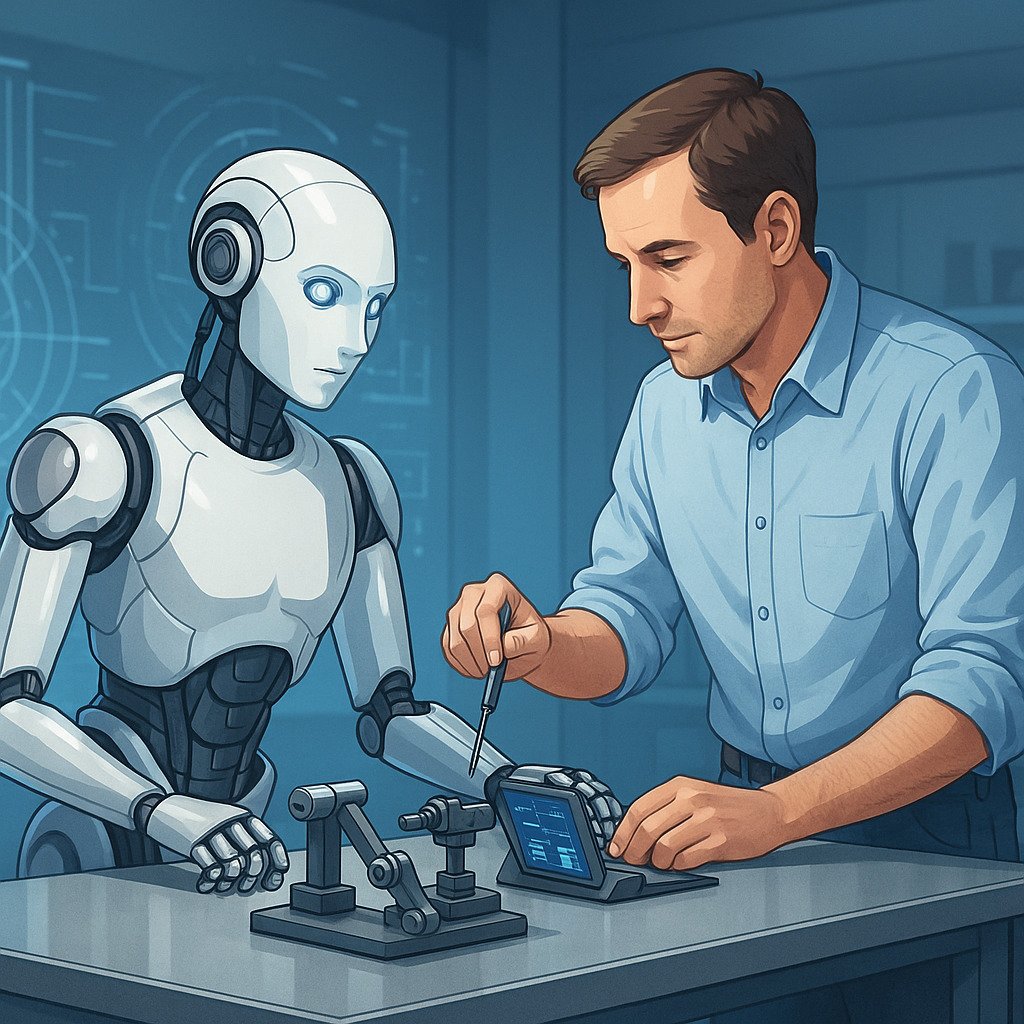
This transformation — from industrial automation to intelligent companionship — marks a shift from robots as tools to robots as partners.
We are entering an era where machines don’t just work for us; they may one day work with us.
Robotics in medicine, defense, and caregiving
Few inventions have touched as many aspects of human life as robotics.
In medicine, robotic precision has changed what it means to heal. Surgeons now rely on robotic arms for delicate operations — steady, accurate, and fatigue-free. The Da Vinci surgical system, for example, can perform complex procedures through incisions smaller than a coin, with the surgeon controlling every movement from a console.
In rehabilitation, robotic exoskeletons help patients walk again after paralysis — giving steel and software a strangely human warmth.
In defense, robots act as silent guardians. Drones scout dangerous terrains where humans can’t go, and bomb-disposal robots save countless lives by taking calculated risks instead of soldiers.
Autonomous surveillance systems now analyze threats in real time, blurring the line between warfare and data science.
In caregiving, robots are becoming companions — particularly in countries with aging populations. They remind elders to take medicines, monitor vital signs, and even chat to reduce loneliness.
While they can’t replace human empathy, their tireless presence offers comfort and consistency that few humans can sustain.
Across these fields, robotics has transcended utility. It has become a bridge between compassion and computation, serving humanity in ways once left to imagination.
Impact on employment and skill requirements
Whenever automation rises, so does anxiety — especially about jobs.
The fear that robots will replace humans is not new. Yet, history tells us something interesting: every technological revolution creates new kinds of work even as it replaces old ones.
In factories, robotic arms may have reduced manual assembly jobs, but they’ve also created demand for robot programmers, maintenance specialists, AI trainers, and data engineers.
The new workforce is not disappearing — it’s transforming.
The challenge lies in reskilling. Workers must evolve from operating tools to collaborating with intelligent systems. The jobs of tomorrow will demand human creativity, empathy, and problem-solving — skills that machines still struggle to emulate.
In the coming decade, education and industry must walk hand in hand.
Students trained in robotics, AI, and ethics will not just find jobs — they will shape the next generation of machines.
In short, the future of work isn’t man versus machine — it’s man alongside machine, guided by learning, adaptation, and vision.
Future vision: Human–robot collaboration
The true promise of robotics isn’t about replacement; it’s about collaboration.
Imagine a hospital where robots handle routine tasks — fetching supplies, monitoring patients — while doctors spend more time understanding and healing.
Or a construction site where robots lift heavy materials while humans plan, design, and ensure safety.
Such a world isn’t distant — it’s emerging in laboratories and workplaces right now.
Collaborative robots, or cobots, are designed to work shoulder to shoulder with humans, responding to voice commands and gestures, even anticipating needs.
They don’t just extend physical strength — they amplify human purpose.
But collaboration goes beyond mechanics. It requires trust.
Humans must learn to rely on machines not as rivals but as teammates — and robots must learn to read human cues with sensitivity and respect.
The future workforce will be neither wholly human nor entirely robotic — it will be symbiotic, driven by shared intelligence.
And perhaps that’s the most exciting part: in teaching robots to work with us, we might rediscover what it truly means to be human.
Conclusion: The Workforce of Tomorrow
Robotics began as an idea to make life easier. It has now evolved into a force that is reshaping what it means to work, to care, and to create.
The new workforce will not be defined by machines taking over, but by humans and robots learning from each other — combining precision with purpose, logic with empathy.
In this grand collaboration, efficiency meets humanity — and the result could be a future more capable, compassionate, and connected than ever before.
“Next in the Future of Technology Series:”
Biotechnology: Engineering Life Itself
From decoding DNA to designing new life — discover how technology is reshaping biology and ethics.