Table of Contents
ToggleIntroduction
The world is searching for energy solutions that are reliable, affordable, low-carbon, and capable of supporting growing electricity demand. While renewable energy sources such as solar and wind are expanding rapidly, concerns regarding intermittency, grid stability, and energy security have renewed interest in nuclear power.
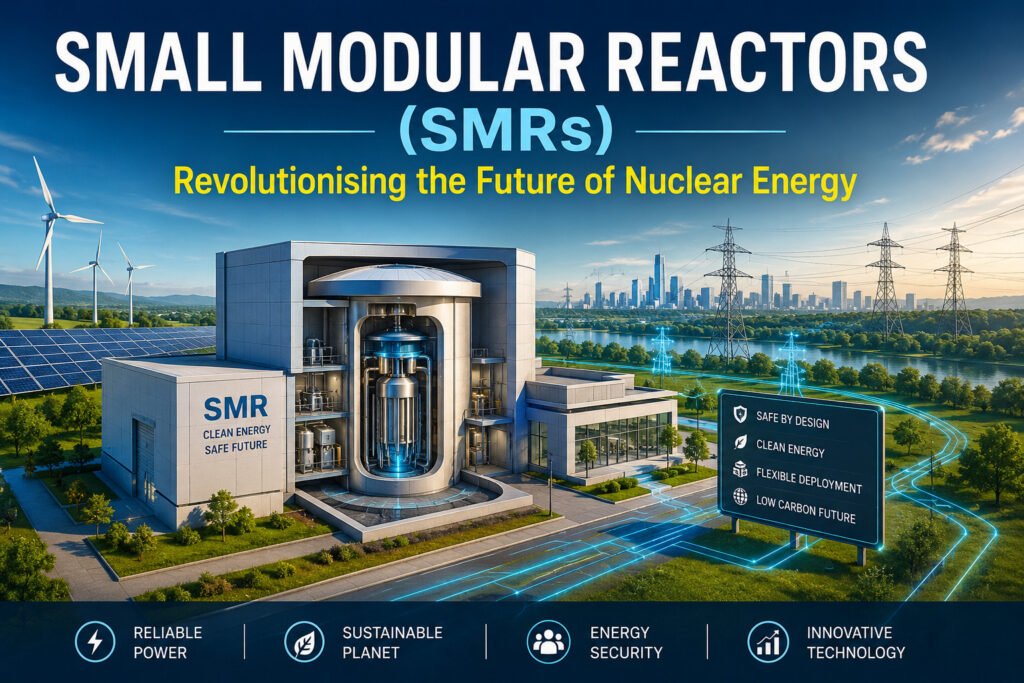
One of the most promising developments in the nuclear industry is the emergence of Small Modular Reactors (SMRs). These next-generation reactors are designed to be smaller, safer, more flexible, and potentially less expensive than traditional large nuclear power plants.
To understand how SMRs fit into the broader evolution of atomic energy, readers may also explore our pillar article, “Nuclear Energy: Powering the Future with the Atom.”
Supporters view SMRs as a transformative technology capable of helping nations achieve energy security, decarbonisation, and sustainable economic growth. Critics question whether they can be deployed at scale and compete economically with other energy technologies.
Whatever the outcome, SMRs are rapidly becoming one of the most closely watched developments in the global energy landscape.
What Are Small Modular Reactors?
Small Modular Reactors are advanced nuclear reactors that typically produce up to 300 MW of electricity per unit, although some designs may generate more.
Unlike conventional nuclear plants that are constructed almost entirely on-site, SMRs are designed for modular manufacturing. Major components can be fabricated in factories and transported to their final location for assembly.
This approach offers several potential advantages:
- Reduced construction time
- Improved quality control
- Lower initial capital investment
- Enhanced safety
- Greater flexibility in deployment
Multiple SMR units can also be combined to create larger power stations as electricity demand grows.
Readers interested in understanding how SMRs compare with other reactor designs may also find value in our article, “Nuclear Reactor Technologies Explained.”
Why Are Governments Around the World Interested in SMRs?
Several global trends have driven renewed interest in SMRs.
Climate Change
Many countries have committed to achieving net-zero carbon emissions. SMRs offer low-carbon electricity generation that can complement renewable energy sources.
The growing interest in SMRs is closely linked to global decarbonisation efforts discussed in “Nuclear Power and Climate Change.”
Energy Security
Geopolitical events have highlighted the risks associated with dependence on imported fossil fuels. SMRs can strengthen domestic energy security.
Growing Electricity Demand
Artificial intelligence, data centres, electric vehicles, and industrial electrification are expected to increase electricity consumption significantly over the coming decades.
Grid Flexibility
SMRs can be deployed in remote locations, industrial clusters, mining operations, islands, and regions where large nuclear plants may not be practical.
What Are the Major Powers Saying About SMRs?
United States
The United States views SMRs as a strategic technology capable of strengthening energy security, supporting climate goals, and maintaining leadership in nuclear innovation.
Several federal programmes provide financial support for SMR development.
United Kingdom
The UK government sees SMRs as an important component of its long-term clean energy strategy. The objective is to reduce carbon emissions while creating high-skilled jobs and strengthening domestic manufacturing.
Canada
Canada is among the most active supporters of SMR deployment. The country’s vast geography and remote communities make SMRs particularly attractive for replacing diesel generation.
Russia
Russia is already operating small modular reactor technology through its floating nuclear power plant programme and continues to invest heavily in advanced reactor technologies.
China
China is aggressively pursuing advanced nuclear technologies, including SMRs, as part of its efforts to enhance energy security and reduce carbon emissions.
India
India is closely monitoring global SMR developments. Given the country’s growing energy demand, remote industrial requirements, and long-term nuclear ambitions, SMRs may eventually complement India’s existing nuclear programme.
Readers interested in India’s current and future nuclear ambitions may also explore “Nuclear Power in India.”
Which Companies Are Leading SMR Development?
Several organisations are competing to commercialise SMR technology.
NuScale Power (USA)
One of the most prominent SMR developers. Its design focuses on passive safety systems and modular deployment.
GE Hitachi Nuclear Energy (USA/Japan)
Developer of the BWRX-300, one of the most widely discussed SMR designs.
Rolls-Royce SMR (United Kingdom)
Developing factory-built SMRs aimed at supporting the UK’s future energy strategy.
TerraPower (USA)
Founded with support from technology entrepreneur Bill Gates, TerraPower is developing advanced reactor concepts including Natrium technology.
Rosatom (Russia)
A global leader in nuclear technology with significant SMR-related initiatives.
China National Nuclear Corporation (CNNC)
Actively developing indigenous SMR technologies for domestic and international deployment.
What Fuel Do SMRs Use?
Most SMRs utilise low-enriched uranium (LEU), similar to conventional nuclear reactors.
However, future designs may use:
- High-Assay Low-Enriched Uranium (HALEU)
- Mixed oxide fuels
- Thorium-based fuels –
India’s long-term interest in thorium-based technologies is examined in “Thorium: The Fuel of the Future?”
- Advanced fuel cycles
Fuel requirements vary depending on reactor technology and design objectives.
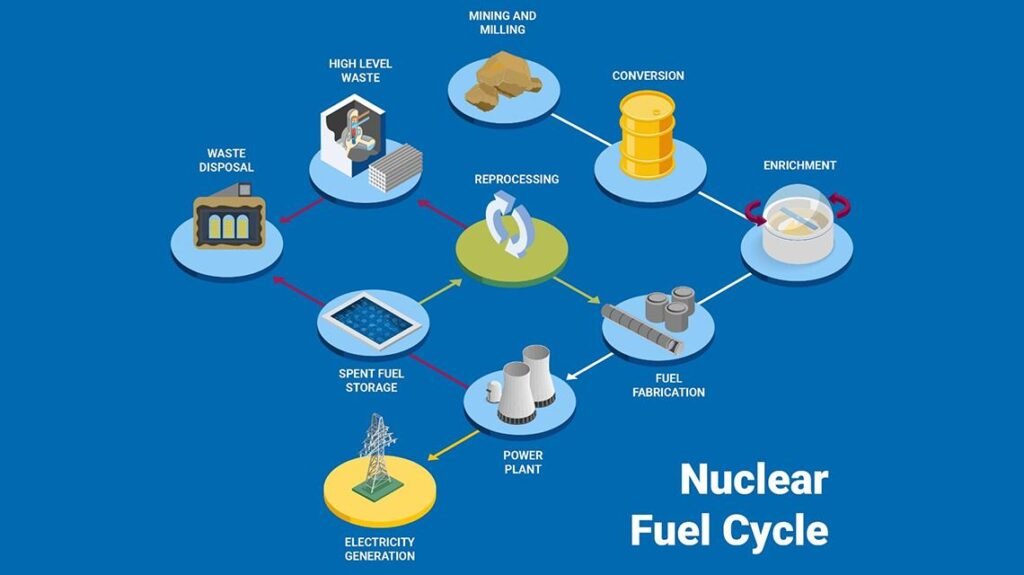
For a deeper understanding of uranium mining, enrichment, fuel fabrication, reactor use, and waste management, readers are encouraged to explore “Uranium and Nuclear Fuel Cycle.”
Safety Features of Small Modular Reactors
Safety is one of the principal selling points of SMRs.
Many designs incorporate passive safety systems that rely on natural forces such as gravity, natural circulation, and convection rather than active mechanical systems.
Key safety advantages include:
- Simplified reactor designs
- Reduced fuel inventory
- Underground installation options
- Passive cooling systems
- Lower accident probabilities
Many SMR developers claim that severe accidents requiring large-scale evacuations are extremely unlikely.
Concerns regarding reactor safety, spent fuel, and radioactive waste are discussed in detail in “Nuclear Safety and Waste Management.”
Potential Applications of SMRs
SMRs may be used for far more than electricity generation.
Potential applications include:
Power Generation
Reliable low-carbon electricity for national grids.
Industrial Heat
Supplying heat to refineries, petrochemical complexes, steel plants, and manufacturing facilities.
Hydrogen Production
Supporting the emerging hydrogen economy.
Desalination
Producing fresh water in water-scarce regions.
Remote Communities
Replacing diesel-powered generation systems.
Data Centres
Meeting the rapidly growing power demands of artificial intelligence and digital infrastructure.
Challenges Facing SMRs
Despite their promise, SMRs face several challenges.
- Regulatory approvals
- Financing requirements
- Fuel supply chains
- Public acceptance
- Waste management
- Demonstrating economic competitiveness
The commercial success of SMRs remains dependent on successful large-scale deployment.
The Future of SMRs
Many experts believe SMRs could play a significant role in the global energy transition.
If developers achieve their goals regarding safety, cost reduction, and scalability, SMRs may become one of the most important energy technologies of the twenty-first century.
However, widespread adoption will depend on technological performance, regulatory support, public confidence, and economic viability.
The future growth of SMRs will also influence uranium demand, a topic explored in “Global Uranium Market and Investment Outlook.”
Conclusion
Small Modular Reactors represent one of the most ambitious attempts to reinvent nuclear power for the modern era. By combining advanced safety features, modular construction, operational flexibility, and low-carbon electricity generation, SMRs offer the possibility of addressing some of the most pressing energy challenges facing the world today.
Whether they ultimately become a niche technology or a major component of future energy systems remains to be seen. What is clear, however, is that governments, utilities, investors, and technology companies around the world are paying close attention to the SMR revolution.
The evolution from Chernobyl-era reactors to modern SMR designs demonstrates how the nuclear industry continues to learn from past experiences, as explored in “Chernobyl Disaster (1986): Causes, Consequences and Lessons for the Future.”
Frequently Asked Questions(FAQs)
A Small Modular Reactor is an advanced nuclear reactor designed to generate up to 300 MW of electricity per unit. SMRs are smaller, more flexible, and easier to deploy than traditional nuclear power plants.
Governments see SMRs as a potential solution for clean energy generation, energy security, decarbonisation, and reliable electricity supply.
The United States, United Kingdom, Canada, Russia, China, and several European countries are actively investing in SMR technologies.
Major developers include NuScale Power, Rolls-Royce SMR, GE Hitachi, TerraPower, Rosatom, and China National Nuclear Corporation (CNNC).
Most current SMR designs use low-enriched uranium (LEU), although some future designs may utilise HALEU, thorium, or other advanced fuels.
Many SMR designs incorporate passive safety systems that rely on natural forces such as gravity and convection, reducing the need for active intervention during emergencies.
Yes. SMRs generate electricity with very low greenhouse gas emissions and can complement renewable energy sources in achieving net-zero targets.
Many experts believe SMRs could replace ageing coal-fired power plants by utilising existing grid infrastructure and providing reliable low-carbon electricity.
Yes. SMRs can provide electricity, industrial heat, hydrogen production, desalination, and power for mining operations, data centres, and remote communities.
Challenges include regulatory approvals, financing, fuel supply chains, public acceptance, and demonstrating commercial viability at scale.
India is closely monitoring SMR developments worldwide and is expected to explore their potential as part of its long-term nuclear energy strategy.
SMRs are expected to complement rather than completely replace large nuclear power plants. Both technologies are likely to coexist in future energy systems.
Related Reading
- Nuclear Energy: Powering the Future with the Atom
• Nuclear Reactor Technologies Explained
• Nuclear Power in India
• Thorium: The Fuel of the Future?
• Nuclear Safety and Waste Management
• Uranium and Nuclear Fuel Cycle
• Global Uranium Market and Investment Outlook
• Chernobyl Disaster (1986): Causes, Consequences and Lessons for the Future