Table of Contents
ToggleIntroduction
Football, known as soccer in some parts of the world, is the most popular sport on the planet. Played and followed by billions of people across continents, football transcends language, culture, geography, and social boundaries.
From dusty village grounds to magnificent stadiums packed with passionate supporters, football has the unique ability to unite people through a shared love of the game. Its simplicity, excitement, and unpredictability have made it the undisputed global sport.
Whether it is the FIFA World Cup, the UEFA Champions League, the English Premier League, La Liga, or local grassroots competitions, football continues to inspire generations of players and fans.
Football occupies a special place within “The Sporting World: Stories, Spirit and Sporting Excellence”, inspiring billions of players and supporters across the globe.
This Football Hub on WolverineSpeaks explores the game’s history, greatest tournaments, legendary players, evolving tactics, and future developments.
Why Is Football So Popular?
Football’s appeal lies in its simplicity.
A ball, an open space, and a group of players are often all that is needed to play the game. At the highest level, however, football becomes a fascinating blend of skill, strategy, athleticism, teamwork, and emotion.
Key reasons for its popularity include:
- Global accessibility
- Rich history and traditions
- Passionate fan culture
- International rivalries
- Dramatic and unpredictable outcomes
- Opportunities for social mobility and community engagement
A Brief History of Football
Modern football traces its origins to England during the nineteenth century. The establishment of standardised rules led to the formation of organised competitions and eventually international tournaments.
Over the decades, football evolved from a regional pastime into a global phenomenon.
Major milestones include:
- Formation of FIFA in 1904
- First FIFA World Cup in 1930
- Emergence of European club competitions
- Global television broadcasting
- Professionalisation and commercial growth
- Introduction of VAR technology
- Expansion of the FIFA World Cup
Major Football Competitions
Football’s popularity is fuelled by iconic tournaments and leagues.
International Competitions
- FIFA World Cup
- UEFA European Championship
- Copa América
- AFC Asian Cup
- Africa Cup of Nations
Club Competitions
- UEFA Champions League
- English Premier League
- La Liga
- Bundesliga
- Serie A
- Ligue 1
Legendary Footballers
Football has produced some of the most celebrated athletes in sporting history.
Among the legends of the game are:
- Pelé
- Diego Maradona
- Johan Cruyff
- Franz Beckenbauer
- Lionel Messi
- Cristiano Ronaldo
- Zinedine Zidane
- Ronaldinho
Each generation has produced players who have redefined excellence and inspired millions.
The Evolution of Football Tactics
Football is not merely about physical skill.
Tactical innovations have transformed the game over the decades.
Examples include:
- Total Football
- Catenaccio
- Tiki-Taka
- Gegenpressing
- Modern positional play
The strategic battle between coaches often determines success at the highest levels.
Football and Technology
Technology is playing an increasingly important role in football.
Key developments include:
- Video Assistant Referee (VAR)
- Goal-line technology
- Performance analytics
- Wearable monitoring systems
- Artificial intelligence in scouting and player development
Football in India
Although cricket remains India’s most popular sport, football enjoys a rich history and growing support.
The Indian Super League (ISL), grassroots development programmes, and increasing international exposure are helping to strengthen football’s presence in the country.
For a deeper look at India’s football journey — from its golden era and missed World Cup opportunity to the challenges of grassroots development, professional leagues and the road ahead — read:
Football in India: Why a Nation of 1.4 Billion Is Still Waiting for Its World Cup Breakthrough
Featured Football Content
Readers may also enjoy:
FIFA World Cup 2026: The Biggest Tournament in Football
Explore the teams, venues, format, favourites, key players, and storylines surrounding the expanded FIFA World Cup 2026.
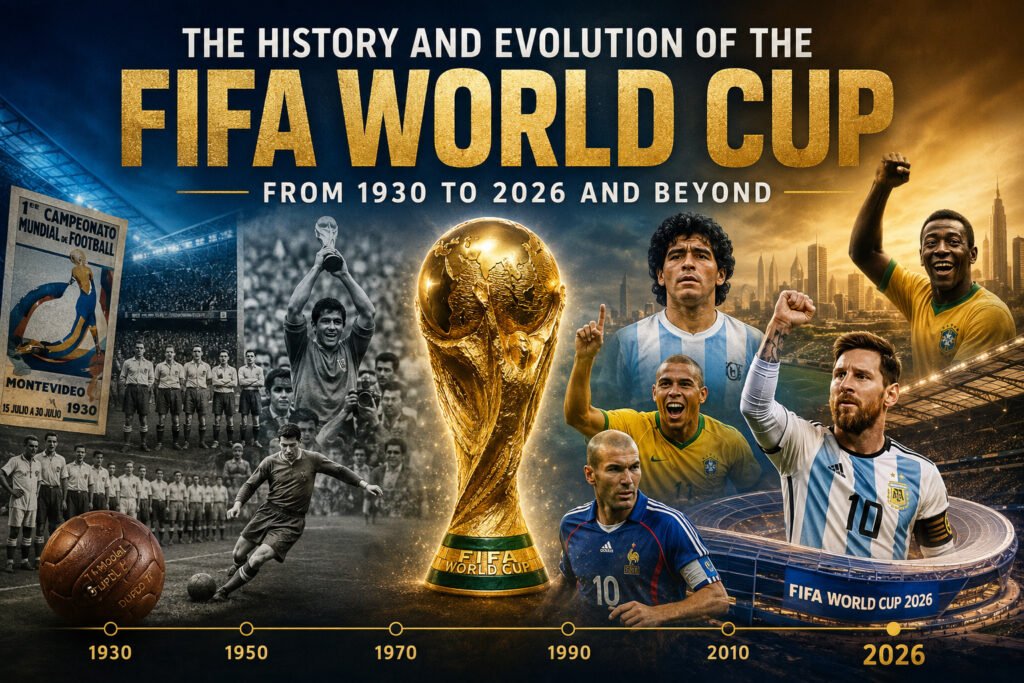
The History and Evolution of the FIFA World Cup
Football Legends Who Changed the Game (Coming Soon)
UEFA Champions League: Europe’s Ultimate Club Competition (Coming Soon)
The Greatest Football Rivalries in History (Coming Soon)
Football Tactics Explained: From Total Football to Gegenpressing (Coming Soon)
Football in India: Challenges and Opportunities (Coming Soon)
Conclusion
Football is far more than a sport. It is a cultural phenomenon, a source of national pride, a vehicle for social change, and a global language understood by billions.
As the game continues to evolve through innovation, technology, and expanding international participation, its ability to inspire passion and bring people together remains unchanged.
Whether you are a lifelong supporter or a newcomer to the sport, football offers stories, emotions, and moments that few other activities can match.
Frequently Asked Questions(FAQs)
Football is called the beautiful game because of its simplicity, creativity, skill, teamwork, and universal appeal. The phrase became widely associated with football legend Pelé.
Football is followed by more than four billion people, making it the most popular sport on the planet.
FIFA (Fédération Internationale de Football Association) is the governing body responsible for world football and the FIFA World Cup.
Brazil holds the record with five FIFA World Cup titles.
Major competitions include the FIFA World Cup, UEFA Champions League, Premier League, La Liga, Bundesliga, Serie A, Copa América, and UEFA European Championship.
Pelé, Diego Maradona, Johan Cruyff, Franz Beckenbauer, Lionel Messi, Cristiano Ronaldo, and Zinedine Zidane are among the greatest footballers in history.
Video Assistant Referee (VAR) is a technology system used to assist referees in reviewing important decisions during matches.
Yes. The growth of the Indian Super League, grassroots programmes, and international broadcasts has increased football’s popularity across India.
Its simplicity, accessibility, low equipment requirements, global competitions, passionate fan culture, and rich history make football the most widely followed sport.
There is no single standard size for a football stadium. FIFA recommends that an international football pitch should measure between 100–110 metres in length and 64–75 metres in width. Stadium capacities vary widely, from around 20,000 spectators to more than 100,000 in some of the world’s largest venues.
An official FIFA-approved football (Size 5) has a circumference of 68–70 centimetres and weighs between 410 and 450 grams at the start of a match. Size 5 balls are used in all major international competitions, including the FIFA World Cup.
Football is considered the de facto national sport in several countries, including Brazil, Argentina, England, Spain, Germany, and Italy, due to its immense popularity. However, many countries do not officially designate a national sport by law.
The official match balls for FIFA World Cups have traditionally been supplied by Adidas since 1970. Other leading football manufacturers include Nike, Puma, Mitre, Select, and Umbro, which supply balls for various domestic and international competitions.
The penalty spot is located 11 metres (12 yards) from the goal line. During a penalty kick, only the goalkeeper and the designated penalty taker are permitted inside the penalty area until the ball is kicked.
An international football goal measures 7.32 metres (24 feet) wide and 2.44 metres (8 feet) high.
A standard football match consists of two halves of 45 minutes each, with a 15-minute interval at half-time. Additional stoppage time may be added by the referee.