Table of Contents
Toggle1. Introduction
The FIFA World Cup is the dream destination for every football-playing nation. While fans usually remember the goals, trophies, finals and superstar players, the journey to the tournament begins much earlier through a long and competitive qualification process.
Unlike many club tournaments, teams do not simply enter the FIFA World Cup by invitation. Each national team must usually earn its place through continental qualification matches organised across different regions of the world. The process tests consistency, depth, travel endurance, tactical quality and the strength of football systems within each country.
For India, the FIFA World Cup remains an unfulfilled dream. Despite having a passionate football culture in several regions and a long football history, India has never played in the World Cup finals. Understanding why requires looking not only at footballing performance, but also at history, administration, infrastructure, rankings, player development and the changing competitiveness of Asian footbal
2. How Teams Qualify Through Different Continental Routes
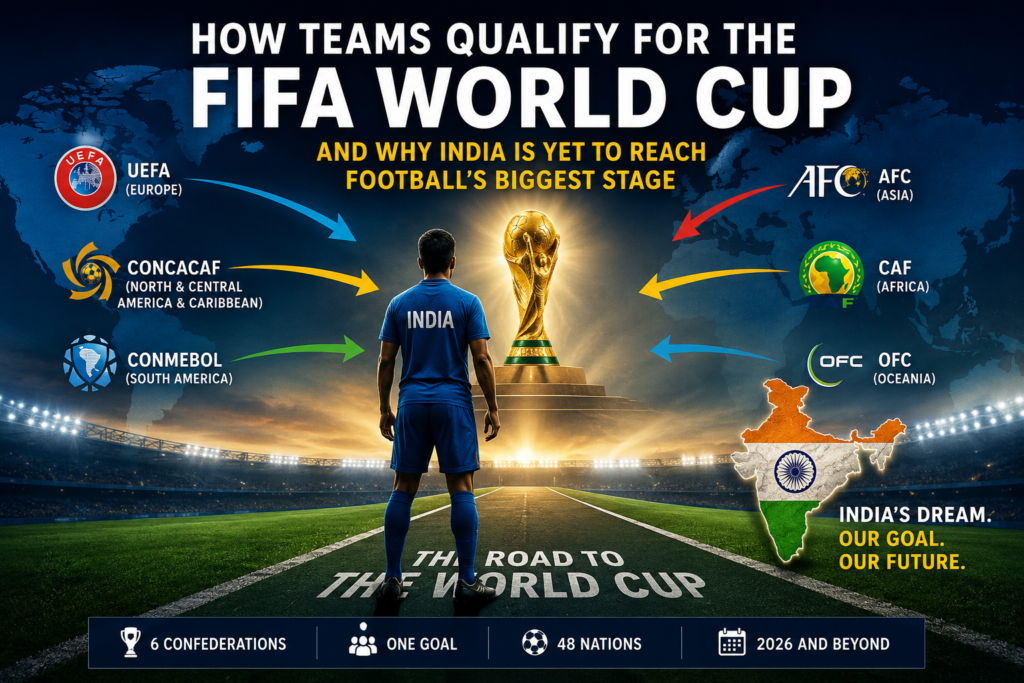
FIFA World Cup qualification is organised through six continental confederations:
AFC – Asia
CAF – Africa
CONCACAF – North America, Central America and the Caribbean
CONMEBOL – South America
OFC – Oceania
UEFA – Europe
Each confederation conducts its own qualification tournament. The format differs from continent to continent depending on the number of member nations, competitive balance and FIFA-approved slot allocation.
For the expanded 48-team FIFA World Cup, the qualification places are distributed broadly as follows:
Asia: 8 direct places plus possible play-off route
Africa: 9 direct places plus possible play-off route
Europe: 16 places
South America: 6 direct places plus possible play-off route
CONCACAF: 6 direct places including host nations, plus possible play-off route
Oceania: 1 direct place plus possible play-off route
Intercontinental play-offs: final additional places
This means qualification has become slightly more accessible compared with the old 32-team format, but it remains extremely demanding. Even with more places available, countries still need strong domestic leagues, organised youth development, fitness standards, tactical maturity and consistent international results.
3. Which Organisation Oversees the Qualifying Tournaments?
The overall authority for the FIFA World Cup is FIFA, the global governing body of football. However, the actual qualification tournaments are conducted by the continental confederations under FIFA’s broad framework.
For example, India competes in the Asian qualification route, which is organised by the Asian Football Confederation, commonly known as the AFC. Similarly, European nations qualify through UEFA, African nations through CAF, and South American nations through CONMEBOL.
FIFA decides the final tournament structure, overall rules, slot allocation and approval of qualification pathways, while each confederation manages fixtures, groups, qualifying rounds and regional competition formats.
4. Is There Any Restriction on the Number of Nations from a Continent?
Yes. Every continent has a fixed number of FIFA World Cup slots. This is known as continental slot allocation.
The number of teams from each continent is not unlimited. For example, even if many strong teams exist in Europe or South America, only a fixed number can qualify. Similarly, Asia has a fixed number of places, which means India must compete against stronger and more established Asian football nations such as Japan, South Korea, Iran, Saudi Arabia, Australia and Qatar.
This system ensures global representation while maintaining competitive balance. It also means that a country’s route to the World Cup depends heavily on the strength of its own continent.
5. Does the Host Country Qualify Automatically? Yes. The host
country usually qualifies automatically for the FIFA World Cup. This is a long-standing tradition because the host nation is responsible for staging the tournament and is expected to participate in it.
For the 2026 FIFA World Cup, the tournament is being jointly hosted by the United States, Canada and Mexico. All three host countries received automatic qualification.
Automatic qualification gives the host nation a major advantage because it avoids the uncertainty and pressure of the qualifying rounds. However, it also places high expectations on the host team to perform well in front of its home supporters.
6. Why India Has Not Qualified for the FIFA World Cup So Far
India’s failure to qualify for the FIFA World Cup is not due to one single reason. It is the result of several long-term challenges.
First, India has historically struggled to maintain a high FIFA ranking. Since qualification draws and seedings often depend on rankings, lower-ranked teams usually face tougher routes.
Second, Indian football has lacked consistent grassroots development compared with leading football nations. Countries that regularly qualify for the World Cup invest heavily in youth academies, scouting systems, coaching education and competitive domestic structures from an early age.
Third, India’s domestic football ecosystem has often lacked the depth, intensity and commercial scale required to produce a large pool of international-level players.
Fourth, Asian football has become much stronger. Nations such as Japan, South Korea, Iran, Saudi Arabia, Australia and Qatar have professionalised their systems and regularly compete at a higher level.
Fifth, cricket’s dominance in India has affected football’s media attention, funding, sponsorship and mass sporting aspiration, although football remains deeply popular in states such as West Bengal, Kerala, Goa, Manipur, Mizoram, Meghalaya and parts of the North-East.
IIndia’s challenge is therefore structural, not merely tactical. Qualification will require long-term planning, better youth development, stronger domestic competition, improved coaching and a larger pool of technically skilled players.
For updates on Indian football, national team fixtures and development programmes, readers may visit the official All India Football Federation (AIFF) website.
7. The Closest India Came to Playing in the FIFA World Cup
India’s closest opportunity came in 1950.
India qualified for the 1950 FIFA World Cup in Brazil after other teams in its Asian qualifying group withdrew. India was placed in a group with Sweden, Italy and Paraguay. However, India withdrew before the tournament began.
For many years, a popular story claimed that India withdrew because FIFA did not allow the players to play barefoot. However, this explanation is now widely regarded as a myth. The more accepted reasons include financial difficulty, travel challenges, lack of preparation time, team selection issues and the fact that the Olympics were considered more prestigious by Indian football administrators at that time.
This remains one of the greatest missed opportunities in Indian sporting history. Had India participated in 1950, the story of Indian football might have taken a very different direction.
8. India’s Chances of Qualifying in the Near Future
India’s chances of qualifying for the FIFA World Cup have improved slightly because the tournament has expanded from 32 teams to 48 teams. Asia now has more qualification slots than before, which gives countries like India a better mathematical chance.
However, a better chance does not mean an easy path. India still needs to improve significantly to compete with Asia’s top football nations. The gap in physical intensity, tactical discipline, technical quality and international exposure remains large.
For India to realistically qualify in the future, the following improvements are essential:
- stronger grassroots football;
- better coaching standards;
- more competitive domestic leagues;
- improved youth academies;
- greater investment in sports science and fitness;
- regular international exposure;
- better scouting from schools, colleges and regional leagues;
- stronger integration between clubs and the national team pathway.
India can qualify in the future, but it will require sustained work over many years rather than short-term optimism.
India’s future qualification prospects are closely linked to performance, consistency and improvement in the FIFA Men’s World Rankings.
9. Remuneration and Financial Reward for Participating Nations
Qualifying for the FIFA World Cup is not only a sporting achievement; it is also financially rewarding. Participating nations receive money from FIFA, including preparation funds and prize money depending on their performance in the tournament.
For the 2026 FIFA World Cup, FIFA approved a major increase in prize money. The total prize money pool for participating teams is substantial, with higher rewards for teams progressing deeper into the tournament.
Even teams that qualify but exit early receive financial support. This money is usually paid to the national football federation, which may then distribute bonuses to players and staff according to its own policies.
For a country like India, qualification would therefore have enormous benefits. It would bring international visibility, commercial sponsorship, media attention, stronger fan engagement and significant financial support for football development.
10. Why Qualification Matters Beyond Football
A FIFA World Cup appearance can transform a country’s football culture. It inspires young players, attracts sponsors, improves federation credibility, strengthens domestic leagues and increases public interest in the sport.
For India, qualification would be more than just participation in a tournament. It would be a symbolic breakthrough, showing that Indian football has finally reached the global stage.
It could also encourage parents, schools, clubs and sponsors to treat football as a serious career pathway. Just as cricket changed after India’s 1983 World Cup victory, football could experience a major cultural shift if India reaches the FIFA World Cup.
Conclusion
The road to the FIFA World Cup is long, competitive and unforgiving. Every participating country must pass through a demanding qualification system shaped by continental routes, fixed slots, rankings, performance and football infrastructure.
India’s absence from the World Cup is the result of historical missed opportunities and long-term structural weaknesses. The 1950 withdrawal remains the closest India has come, while the expanded 48-team format offers new hope for the future.
However, hope alone will not be enough. India must build a stronger football ecosystem from the grassroots to the professional level. If that happens, the dream of seeing India at the FIFA World Cup may one day become a reality.
Until then, India’s World Cup journey remains one of sport’s most compelling unfinished stories.
Continue Exploring Football on WolverineSpeaks
This article is part of the WolverineSpeaks Football Knowledge Series, designed to help readers explore the world’s most popular sport from every perspective. To broaden your understanding of football and the FIFA World Cup, you may also enjoy the following articles:
Football: The Beautiful Game That Unites the World – Discover the history, evolution, rules, culture and global appeal of the world’s most popular sport.
The History and Evolution of the FIFA World Cup: From 1930 to 2026 and Beyond – Explore how the FIFA World Cup grew from a 13-team tournament into the biggest sporting event on the planet.
FIFA World Cup Records and Statistics: The Greatest Players, Teams and Moments Ever – Discover the greatest players, teams, records, milestones and unforgettable moments in World Cup history.
The Future of the FIFA World Cup (2030, 2034 and Beyond) – Explore how football’s greatest tournament is expected to evolve over the coming decades, including future host nations, expanded formats, technological innovations, sustainability initiatives, commercial growth and the emergence of new footballing powers shaping the next era of the FIFA World Cup.
Frequently Asked Questions(FAQs)
National teams qualify through continental qualification tournaments organised by their respective football confederations. The best-performing teams from each continent earn places in the FIFA World Cup finals based on the allocation decided by FIFA.
The qualification process is overseen by FIFA, while the tournaments themselves are organised by the six continental confederations: AFC, CAF, CONCACAF, CONMEBOL, OFC and UEFA.
The FIFA World Cup 2026 will feature 48 teams, an increase from the previous 32-team format, making it the largest tournament in FIFA World Cup history.
The expansion aims to provide greater global representation, give more nations an opportunity to qualify, increase football’s popularity worldwide and generate additional commercial and broadcasting revenue.
Europe (UEFA) receives the largest allocation due to the strength and depth of its national teams, followed by Asia (AFC), Africa (CAF), South America (CONMEBOL), North, Central America and the Caribbean (CONCACAF), and Oceania (OFC).
Yes. The host nation, or host nations in the case of a jointly hosted tournament, automatically qualify without playing in the qualification rounds.
The United States, Canada and Mexico qualified automatically as co-hosts of the 2026 FIFA World Cup.
No. FIFA allocates a fixed number of qualification places to each continental confederation, ensuring balanced global representation.
An intercontinental play-off is a qualification tournament involving teams from different confederations competing for the remaining FIFA World Cup places after the continental qualifiers have concluded.
India qualified for the 1950 FIFA World Cup after several Asian teams withdrew. However, India withdrew before the tournament and has never appeared in the FIFA World Cup finals.
The widely repeated claim that India withdrew because players were not allowed to play barefoot is now considered a myth by many historians. The more widely accepted reasons include financial constraints, travel costs, inadequate preparation, administrative decisions and a greater focus on the Olympic Games.
India has faced long-term challenges, including limited grassroots development, inconsistent domestic football structures, lower FIFA rankings, intense competition within Asia and comparatively lower investment in football.
Yes. FIFA rankings influence seeding in qualification draws, and a higher ranking can result in a more favourable qualification pathway.
The All India Football Federation (AIFF) is the governing body responsible for managing football in India, including the national teams and domestic competitions.
India is a member of the Asian Football Confederation (AFC), which organises the FIFA World Cup qualification process for Asian nations.
Yes. The expansion provides Asia with additional qualification places, slightly improving India’s chances. However, India must still compete successfully against stronger Asian football nations.
In recent decades, Japan, South Korea, Iran, Saudi Arabia and Australia have been among Asia’s most regular FIFA World Cup qualifiers. These countries have stronger domestic football systems, better international exposure, established youth development structures and greater experience in high-pressure qualification matches.
Other Asian nations such as Qatar, the United Arab Emirates, Iraq, China and North Korea have also appeared in the FIFA World Cup, but they are not considered regular qualifiers in the same way.
The biggest challenge is building a sustainable football ecosystem that includes grassroots development, quality coaching, youth academies, competitive domestic leagues and regular international exposure.
Yes. Participating nations receive preparation funding and prize money from FIFA. Qualification also attracts sponsorship, broadcasting revenue, tourism and greater commercial interest.
Youth development is one of the most important factors. Successful football nations invest heavily in academies, coaching and player development from an early age.
Qualification tournaments are organised before every FIFA World Cup, which is held every four years.
Yes. Qualification is usually based on league standings, points or knockout results. Teams can qualify even after drawing or losing some matches, provided they finish high enough in their qualification group or progress through the required rounds.
Brazil holds the record, having qualified for every FIFA World Cup since the tournament began in 1930.
Qualification would transform Indian football by inspiring millions of young players, attracting greater investment, improving infrastructure, strengthening domestic leagues and significantly enhancing India’s global football reputation.
While predicting future qualification is impossible, India’s prospects are improving gradually. Continued investment in youth development, coaching, infrastructure and competitive football will be essential if India is to realise its long-held World Cup dream.