Table of Contents
Toggle1. Introduction
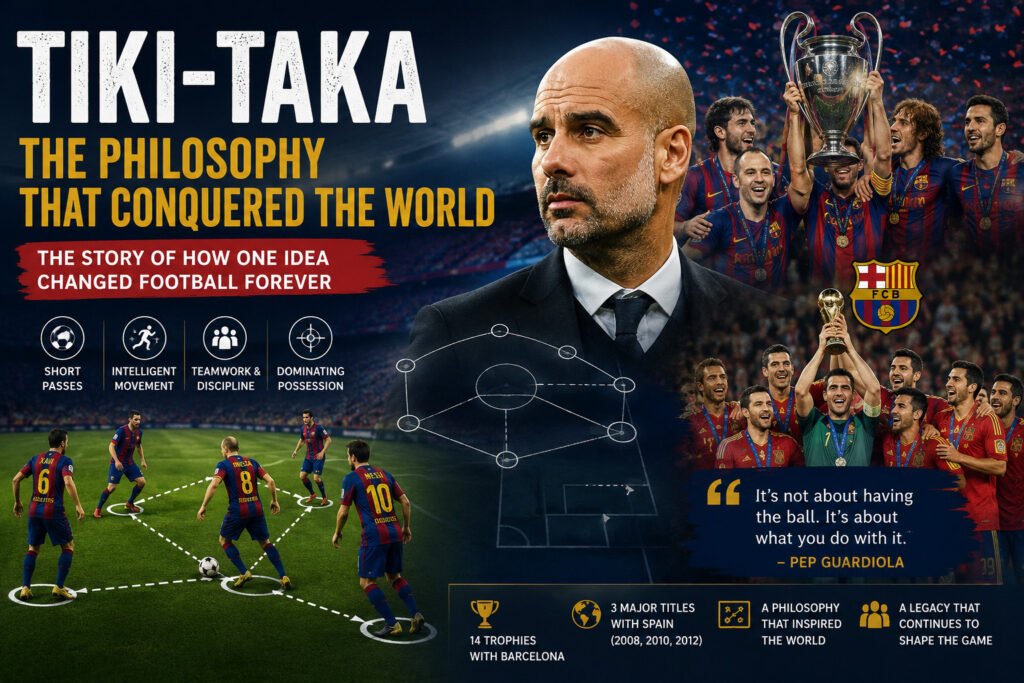
Few football philosophies have transformed the modern game as profoundly as Tiki-Taka. More than just a style of play, it is a tactical philosophy built on intelligent passing, constant movement, positional awareness and collective teamwork.
For over a decade, Tiki-Taka captivated football fans around the world with its elegant simplicity and remarkable effectiveness. Teams employing this philosophy demonstrated that controlling possession was not merely about keeping the ball—it was about controlling the rhythm of the game, creating space and patiently waiting for the perfect opportunity to attack.
Although the philosophy is most closely associated with Barcelona and Spain’s golden era, its influence extends far beyond one club or one generation. Coaches across the world have adopted and adapted many of its principles, making Tiki-Taka one of the most influential tactical systems in football history.
Yet, like every successful football philosophy, Tiki-Taka has evolved over time. While it brought unprecedented success to some of the greatest teams ever assembled, opponents eventually developed strategies to counter its strengths, leading to new tactical innovations in the modern game.
In this article, we explore the meaning, origins, evolution, principles, greatest exponents, successes and continuing legacy of Tiki-Taka, and examine why it remains one of the most admired football philosophies ever developed.
2. What is Tiki-Taka? Its Meaning, Origin and Evolution Football lovers across
the world today recognise Tiki-Taka as a style of play based on quick passing, intelligent movement and dominating possession. More than just a tactical system, it is a football philosophy that values teamwork, technical excellence and intelligent use of space over individual brilliance or physical power.
Interestingly, the name “Tiki-Taka” was never coined by a coach or a football club. It was popularised by Spanish television commentator Andrés Montes, who used the rhythmic expression while describing Spain’s rapid passing game during a live broadcast. The phrase echoed the sound of the ball moving swiftly from one player to another—“tiki… taka… tiki… taka…”—and quickly captured the imagination of football fans.
Although the name Tiki-Taka is relatively recent, the philosophy behind it is not. Long before the term came into existence, teams had recognised the importance of short passing, intelligent movement and maintaining possession. However, no club embraced and perfected these principles quite like FC Barcelona.
Barcelona demonstrated to the footballing world that patient passing, intelligent movement and collective teamwork could overcome even the strongest opponents. As the club began winning major domestic and international honours, the term Tiki-Taka spread rapidly across the footballing world. What had started as a commentator’s colourful expression soon became the name of one of the most admired football philosophies in history.
The next chapter in this remarkable story began when a young Barcelona coach named Pep Guardiola took charge of the team. Building upon the club’s footballing philosophy, he refined Tiki-Taka into one of the most successful tactical systems the game has ever witnessed, inspiring coaches, players and football lovers across the globe.
3. Pep Guardiola: The Coach Who Perfected Tiki-Taka and Changed Modern Football When Pep
Guardiola became Barcelona’s first-team coach in 2008, he inherited a club that already believed in attractive, possession-based football. Having graduated through Barcelona’s own youth system and later captained the club, Guardiola understood its footballing philosophy better than anyone else. His challenge was not to invent a new style of play, but to refine an existing philosophy into a system capable of dominating world football.
Guardiola believed that possession was not an end in itself but a means of controlling every aspect of the game. His players were encouraged to move constantly, create passing options, recover possession immediately after losing the ball and patiently wait for the right moment to attack. Every pass had a purpose, every movement created space, and every player contributed both in attack and defence.
The results were extraordinary.
Barcelona became one of the most successful club teams in football history, winning domestic league titles, the UEFA Champions League and several international trophies while producing a style of football admired across the globe. More importantly, Barcelona’s success demonstrated that intelligence, technical ability and teamwork could consistently overcome physically stronger opponents.
The influence of Barcelona soon extended beyond club football. Many players who formed the backbone of Guardiola’s Barcelona also represented Spain. Applying the same philosophy at international level, Spain enjoyed one of the greatest periods in football history by winning UEFA Euro 2008, the 2010 FIFA World Cup and UEFA Euro 2012—an unprecedented sequence of three major international titles.
At the heart of this remarkable success lay a set of guiding principles that came to define Tiki-Taka. While these ideas had existed in different forms earlier, Guardiola combined them into a highly disciplined and remarkably effective system that changed the way football was played and coached across the world.
The Seven Principles of Tiki-Taka
1. Short and Accurate Passing
Quick, precise passing keeps the ball moving faster than the opposition and reduces the chances of losing possession.
2. Possession with Purpose
The objective is not merely to keep the ball but to control the tempo of the match, tire the opposition and create openings at the right moment.
3. Constant Movement
Players rarely remain stationary. Continuous movement creates passing options and disrupts the opponent’s defensive shape.
4. Positional Discipline
Every player understands where to position himself so that the team always maintains balance in attack and defence.
5. Creating Passing Triangles
Players constantly position themselves to provide at least two safe passing options, making it extremely difficult for opponents to intercept the ball.
6. Immediate Pressing After Losing Possession
When possession is lost, players immediately press the opponent to win the ball back before a counter-attack can develop.
7. Patience Before Penetration
Rather than forcing risky attacks, Tiki-Taka encourages teams to circulate the ball until the opposition makes a mistake or leaves space to exploit.
These principles transformed Tiki-Taka from an attractive style of football into a complete tactical philosophy. Coaches around the world began studying Barcelona’s methods, while clubs at every level attempted to replicate aspects of Guardiola’s approach. Few tactical systems in football history have influenced the game so profoundly.
4. Tiki-Taka: From Dominance to Lasting Legacy For nearly a decade,
Tiki-Taka appeared almost unstoppable. Barcelona mesmerised football fans with breathtaking passing sequences, while Spain conquered Europe and the world with a style of football that seemed both beautiful and unbeatable. Many believed that possession football had reached its ultimate form and that Tiki-Taka represented the future of the game.
However, football has always been a game of constant evolution. Every successful philosophy eventually inspires opponents to develop new ways of overcoming it, and Tiki-Taka was no exception.
Coaches across Europe began studying Barcelona’s methods in great detail. Instead of sitting back and allowing Barcelona to dictate possession, many teams adopted aggressive high pressing, denied passing lanes and attacked quickly the moment possession was regained. Others defended in compact formations, patiently waiting for opportunities to launch rapid counter-attacks. These tactical adjustments gradually reduced the dominance that Tiki-Taka had once enjoyed.
Another criticism was that some teams misunderstood the philosophy. They copied the endless passing but forgot its real objective. Tiki-Taka was never about completing the highest number of passes. Its purpose was to create space, draw defenders out of position and patiently build the right opportunity to score. When possession became slow, predictable or lacked penetration, opponents found it easier to defend.
Did this mean that Tiki-Taka had disappeared?
Not at all.
Rather than vanishing, it evolved.
Modern football has become a blend of several tactical philosophies. Today’s leading teams still value possession, intelligent movement and technical excellence, but they combine these qualities with quicker transitions, greater physical intensity and more direct attacking play. Even Pep Guardiola himself adapted his methods during his later managerial career, proving that successful coaches evolve with the game rather than remain prisoners of one system.
Although football continues to evolve, the influence of Tiki-Taka remains unmistakable. Clubs across Europe and beyond have adopted many of its principles, youth academies continue to emphasise technical ability and positional awareness, and coaches at every level encourage players to value intelligent passing and teamwork over individual brilliance.
Perhaps the greatest legacy of Tiki-Taka is that it changed the way football is understood. It demonstrated that controlling possession could also mean controlling the rhythm, psychology and destiny of a match. It showed that intelligence, patience and collective effort could consistently triumph over sheer physical strength.
Today, few teams play pure Tiki-Taka in the way Barcelona once did. Yet almost every successful team incorporates some of its principles. In that sense, Tiki-Taka never truly disappeared—it became part of football’s DNA.
That is the mark of every great philosophy. It may evolve, it may be refined and it may even be challenged, but its influence continues to shape future generations. Tiki-Taka is no longer merely Barcelona’s style of play; it has become one of football’s greatest and most enduring gifts to the modern game.
5. Conclusion
Football has witnessed countless tactical systems over the years, but very few have influenced the sport as profoundly as Tiki-Taka. More than a style of play, it became a philosophy that demonstrated how intelligence, teamwork, technical excellence and patience could dominate the world’s biggest stages.
Under Pep Guardiola, Barcelona transformed Tiki-Taka into one of the most successful footballing systems ever seen. It not only brought an unprecedented collection of domestic and international trophies but also inspired Spain’s golden era and influenced coaches, clubs and players across the globe.
Although football has continued to evolve and new tactical approaches have emerged, the principles of Tiki-Taka remain deeply embedded in the modern game. Today’s leading teams may play faster, press higher and attack more directly, yet many of them still rely on the same foundations of intelligent passing, positional discipline and collective movement that made Tiki-Taka famous.
History remembers successful teams for the trophies they win. It remembers great philosophies for the way they change the game itself. Tiki-Taka achieved both. It conquered football’s biggest competitions, inspired a generation of coaches and forever altered the way the beautiful game is played, understood and admired around the world.
If you enjoyed learning about Connected Ball Technology, you may also like these in-depth football articles on WolverineSpeaks:
Football: The Beautiful Game That Unites the World – Discover the history, rules, culture and universal appeal of the world’s most popular sport.
The History and Evolution of the FIFA World Cup: From 1930 to 2026 and Beyond – Explore how the FIFA World Cup evolved from a 13-team tournament in Uruguay to a global sporting spectacle featuring 48 nations.
FIFA World Cup Records and Statistics: The Greatest Players, Teams and Moments Ever – Discover the legendary players, iconic teams, remarkable records and unforgettable moments that have shaped FIFA World Cup history.
How Teams Qualify for the FIFA World Cup – And Why India Is Yet to Reach Football’s Biggest Stage – Understand the qualification process across FIFA’s six continental confederations, learn why qualifying is so competitive, and explore India’s journey and future prospects of reaching.
- The Future of the FIFA World Cup (2030, 2034 and Beyond) – Learn how technology, sustainability and global expansion are shaping the future of football’s greatest tournament.
- Connected Ball Technology: How Smart Footballs Are Revolutionising the Beautiful Game – Discover how intelligent footballs equipped with embedded sensors assist VAR and Semi-Automated Offside Technology, making modern football faster, fairer and more accurate while preserving the spirit of the game.
Frequently Asked Questions(FAQs)
Tiki-Taka is a football philosophy based on short, accurate passing, intelligent movement, maintaining possession and creating space. It emphasises teamwork and technical excellence rather than individual brilliance.
“Tiki-Taka” is an expression that imitates the rhythmic sound of the ball being passed quickly between players. It became associated with Spain’s and Barcelona’s possession-based style of football.
The term was popularised by Spanish television commentator Andrés Montes, who used it while describing Spain’s rapid passing game during a live broadcast.
No. Pep Guardiola did not invent Tiki-Taka. He refined Barcelona’s existing football philosophy and transformed it into one of the most successful tactical systems in football history.
FC Barcelona is the club most closely associated with Tiki-Taka because it perfected and popularised the philosophy under Pep Guardiola.
Spain became famous for playing Tiki-Taka during its golden era, winning UEFA Euro 2008, the FIFA World Cup 2010 and UEFA Euro 2012.
The seven principles are:
- Short and accurate passing
- Possession with purpose
- Constant movement
- Positional discipline
- Creating passing triangles
- Immediate pressing after losing possession
- Patience before penetration
It enabled teams to control possession, dictate the tempo of the match, create space, minimise mistakes and wear down opponents through intelligent teamwork.
No. Possession was a means to an end. The objective was to create scoring opportunities by controlling space and forcing opponents out of position.
Many teams copied the passing but overlooked the movement, positioning, pressing and tactical discipline that made the philosophy effective.
Opponents developed high-pressing systems, compact defensive structures and rapid counter-attacking strategies that reduced its effectiveness.
Yes. Pure Tiki-Taka is less common, but many leading clubs continue to use its principles alongside faster transitions and more direct attacking football.
Pep Guardiola continues to use many principles of Tiki-Taka while adapting them to the demands of modern football.
Players such as Lionel Messi, Xavi, Andrés Iniesta, Sergio Busquets, Carles Puyol and Gerard Piqué became synonymous with the philosophy because of their technical ability and understanding of the system.
Not necessarily. It requires technically gifted players, excellent teamwork, tactical discipline and considerable patience. Without these qualities, the system is difficult to implement successfully.
Total Football focused on positional interchange and tactical flexibility, whereas Tiki-Taka places greater emphasis on short passing, possession and controlling the rhythm of the game.
Yes. It influenced coaching methods, youth development, tactical thinking and playing styles across the world, making it one of the most influential football philosophies ever developed.
Its greatest legacy is demonstrating that intelligence, teamwork and technical excellence can consistently compete with and often overcome physical strength and direct football.
19.Can Tiki-Taka succeed in modern football?
Yes, but usually in an evolved form. Modern teams combine possession-based football with high pressing, quicker transitions and greater physical intensity.
Why is Tiki-Taka regarded as one of football’s greatest philosophies?
Because it not only won numerous domestic and international trophies but also revolutionised the way football is played, coached and understood across the world.