Table of Contents
Toggle1. Introduction
Football has always been a game of skill, passion and human judgement. For more than a century, referees relied entirely on their eyesight and experience to make crucial decisions, often under immense pressure from players, coaches and millions of spectators. While football has produced countless unforgettable moments, it has also witnessed numerous controversies arising from disputed goals, offside decisions and handball incidents.
In recent decades, technology has steadily transformed the sport. Goal-line technology eliminated uncertainty over whether the ball had crossed the line, while the Video Assistant Referee (VAR) introduced a new level of accuracy in reviewing important match incidents. Yet one challenge remained: determining the exact moment when a player made contact with the ball.
To address this issue, FIFA, together with technology partners, introduced Connected Ball Technology—one of the most significant innovations in modern football. By embedding an intelligent electronic sensor inside the football, officials can now receive precise real-time data that supports faster and more accurate decision-making during matches.
Far from replacing referees, Connected Ball Technology acts as an intelligent assistant. It provides objective information that complements human judgement, helping to reduce errors while preserving the spirit and flow of the game.
Today, smart footballs represent the next chapter in football’s technological evolution. As the game continues to embrace innovation, Connected Ball Technology is expected to play an increasingly important role in future FIFA World Cups and other elite competitions.
2. The Evolution of the Football
The football itself has undergone a remarkable transformation over the centuries. Early forms of the game were played using simple balls made from natural materials such as animal bladders wrapped in leather. These balls were often irregular in shape, absorbed water during wet conditions and became considerably heavier as matches progressed.
During the nineteenth century, the invention of vulcanised rubber by Charles Goodyear revolutionised football manufacturing. Rubber bladders replaced animal bladders, producing balls that were more durable, more spherical and better suited to organised competition. As football grew in popularity, manufacturers refined the design by improving the leather panels, stitching techniques and internal construction.
A major milestone came when FIFA introduced standard specifications for match balls, ensuring consistency in size, weight, circumference, air pressure and performance. This standardisation enabled players around the world to compete under identical conditions.
The FIFA World Cup has often served as a showcase for innovation in football design. Each tournament has introduced new match balls featuring advances in aerodynamics, materials and manufacturing techniques. Famous designs such as the Adidas Telstar, Tango, Teamgeist, Jabulani and Al Rihla reflected the continuous pursuit of improved accuracy, flight stability and player control.
The latest stage in this evolution is Connected Ball Technology. Modern match balls not only meet FIFA’s strict physical standards but also contain sophisticated electronic sensors capable of transmitting live data during a match. In effect, the football has evolved from a simple leather sphere into a smart sporting device, combining traditional craftsmanship with cutting-edge digital technology.
This remarkable journey demonstrates that even the most familiar object in football continues to evolve, helping the game become fairer, more accurate and better suited to the demands of modern competition.
3. Why FIFA Introduced Connected Ball Technology
Modern football is played at an extraordinary pace, with players capable of making split-second movements that are often impossible for the human eye to judge accurately. Even with the introduction of the Video Assistant Referee (VAR), one major challenge remained—determining the precise instant when a player last touched the ball.
This moment is particularly important in offside decisions, where a difference of a few centimetres can decide the outcome of a match. Traditional video replay alone could not always identify the exact point of contact with complete precision.
To improve accuracy, FIFA introduced Connected Ball Technology in collaboration with Adidas and technology partners. The objective was not to replace referees but to provide them with precise, real-time data that supports faster and more consistent decision-making.
The technology was first used extensively during the FIFA World Cup Qatar 2022 and has since become an important component of modern officiating in elite football competitions.
4. How the Chip Works
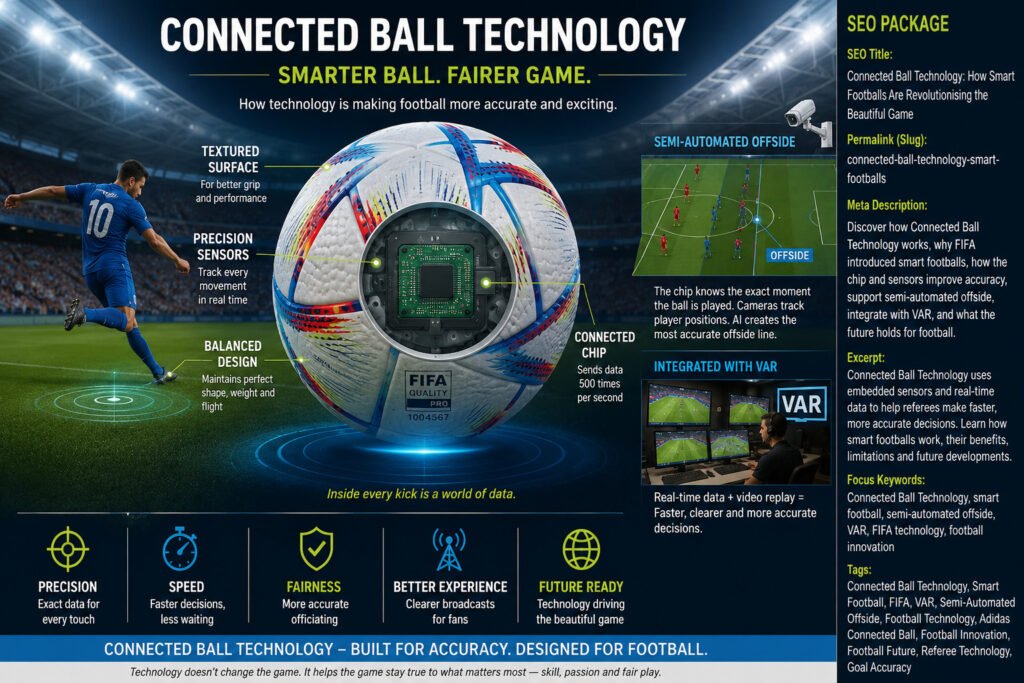
At the heart of Connected Ball Technology is a tiny electronic sensor embedded at the centre of the football. The sensor is securely suspended within the ball so that it does not affect its balance, weight or flight characteristics.
The sensor continuously measures the movement of the ball and transmits data to the stadium’s receiving system hundreds of times every second. This enables match officials to determine the exact instant when a player makes contact with the ball.
The data is synchronised with high-speed cameras positioned around the stadium. By combining information from the ball sensor and multiple cameras tracking players, the system creates an accurate digital picture of every significant event during play.
Importantly, players do not notice any difference while kicking, heading or controlling the ball because the sensor is extremely lightweight and has been designed to comply fully with FIFA’s performance standards.
5. Sensors Inside the Ball
The electronic sensor is often referred to as an Inertial Measurement Unit (IMU). It contains highly sensitive accelerometers and gyroscopes that measure acceleration, direction and movement in three dimensions.
The sensor records:
- the precise moment the ball is kicked;
- changes in speed and direction;
- rotation and spin;
- movement through the air;
- impact with players.
This information is transmitted wirelessly to the match operations centre almost instantly.
The sensor is powered by a small rechargeable battery designed to last throughout the match and is securely positioned so that it remains stable regardless of the force of the kick.
6. Semi-Automated Offside Technology
One of the most important uses of Connected Ball Technology is supporting Semi-Automated Offside Technology (SAOT).
Offside decisions require officials to determine two events simultaneously:
- the exact moment the attacking player receives the pass; and
- the precise position of every relevant player at that instant.
The ball sensor provides the exact kick point, while multiple tracking cameras monitor the positions of players across the pitch.
Artificial intelligence combines these two sets of information within seconds to generate an accurate offside recommendation for the VAR team.
The final decision, however, still rests with the on-field referee, preserving the human element of the game while significantly improving accuracy.
7. Integration with VAR
Connected Ball Technology is fully integrated with the Video Assistant Referee (VAR) system.
Rather than operating independently, the two technologies complement each other.
VAR reviews major match incidents such as:
- goals;
- penalties;
- direct red cards;
- mistaken identity; and
- offside decisions leading to goals.
When an offside review is required, Connected Ball Technology supplies the precise moment the ball was played, while the camera system identifies player positions.
This combination reduces delays, increases confidence in decisions and provides broadcasters with clear visual explanations for spectators.
8. Advantages of Connected Ball Technology
Connected Ball Technology offers several important benefits.
Improved Accuracy
The exact moment of contact with the ball can now be measured far more accurately than through video replay alone.
Faster Decisions
Officials receive instant data, reducing lengthy VAR reviews.
Greater Fairness
Objective data helps ensure that crucial decisions are based on measurable evidence rather than estimation.
Better Fan Understanding
The graphical animations shown during broadcasts help supporters understand why a decision has been made.
Support for Referees
Rather than replacing referees, the technology provides additional information, allowing officials to make more informed decisions.
9. Limitations and Challenges
Despite its advantages, Connected Ball Technology is not without limitations.
High Cost
The technology requires specially designed footballs, sophisticated sensors, tracking cameras and advanced computing systems, making it expensive for lower-level competitions.
Limited Availability
At present, Connected Ball Technology is mainly used in elite international and professional tournaments. Most domestic leagues around the world do not yet have access to it.
Human Judgement Still Required
The technology identifies data but cannot interpret every situation. Decisions involving deliberate handball, fouls, advantage or player intent still require human judgement.
Technical Reliability
Although extremely reliable, any electronic system depends on proper calibration, communication and maintenance.
10. Future Developments
Connected Ball Technology represents only the beginning of football’s technological evolution.
Future developments may include:
- even more precise player tracking;
- AI-assisted tactical analysis;
- improved injury prevention through movement data;
- enhanced coaching analytics;
- smarter broadcast graphics;
- interactive viewing experiences for fans;
- integration with wearable player technology;
- real-time performance statistics during live matches.
As artificial intelligence continues to evolve, Connected Ball Technology may become an even more powerful tool for referees, coaches, broadcasters and supporters.
However, football’s governing bodies have repeatedly emphasised that technology should enhance the game rather than dominate it. The spirit of football will continue to depend on the skill, creativity and judgement of players and officials.
Conclusion
Connected Ball Technology represents an important step in the continuing evolution of football. By combining sensors, high-speed cameras, artificial intelligence and VAR, the technology allows match officials to identify crucial moments with a level of precision that was previously impossible.
Its greatest value lies not in replacing referees, but in supporting them with reliable and objective information. This is particularly important in decisions involving offsides, where even a fraction of a second can influence the outcome of a match.
As the technology develops further, smart footballs may become increasingly useful not only for officiating, but also for coaching, performance analysis, broadcasting and fan engagement. However, the challenge will always be to ensure that technology enhances the game without diminishing its spontaneity, emotion and human character.
Football will continue to be decided by the skill, judgement and creativity of those on the pitch. Connected Ball Technology simply provides a more accurate framework within which the beautiful game can be played.
Continue Exploring Football on WolverineSpeaks
If you enjoyed learning about Connected Ball Technology, you may also like these in-depth football articles on WolverineSpeaks:
Football: The Beautiful Game That Unites the World – Discover the history, rules, culture and universal appeal of the world’s most popular sport.
The History and Evolution of the FIFA World Cup: From 1930 to 2026 and Beyond – Explore how the FIFA World Cup evolved from a 13-team tournament in Uruguay to a global sporting spectacle featuring 48 nations.
FIFA World Cup Records and Statistics: The Greatest Players, Teams and Moments Ever – Discover the legendary players, iconic teams, remarkable records and unforgettable moments that have shaped FIFA World Cup history.
How Teams Qualify for the FIFA World Cup – And Why India Is Yet to Reach Football’s Biggest Stage – Understand the qualification process across FIFA’s six continental confederations, learn why qualifying is so competitive, and explore India’s journey and future prospects of reaching.
- The Future of the FIFA World Cup (2030, 2034 and Beyond) – Learn how technology, sustainability and global expansion are shaping the future of football’s greatest tournament.
Frequently Asked Questions(FAQs)
Connected Ball Technology uses a small electronic sensor positioned inside the football to capture and transmit real-time movement data. This information assists VAR officials, particularly in identifying the precise moment the ball is played.
Yes. A modern connected match ball contains a lightweight Inertial Measurement Unit, commonly called an IMU sensor. It is securely positioned at the centre of the ball so that its balance and performance are not affected.
The sensor measures the ball’s acceleration and movement in three dimensions. It can help identify changes in speed, direction, rotation and the precise moment of contact with a player.
FIFA’s connected ball system can transmit movement data approximately 500 times per second, allowing officials to identify the kick point far more precisely than by relying on ordinary video footage alone.
The kick point is the exact moment when a player makes contact with and plays the ball. Identifying this moment accurately is essential when judging whether an attacking player was in an offside position.
The ball sensor identifies the precise moment the pass is made, while stadium cameras track the positions of the players. These two sets of data are combined to help the VAR team make faster and more accurate offside decisions.
Semi-Automated Offside Technology, or SAOT, is a support system that combines ball data, player-tracking cameras and artificial intelligence to generate an offside recommendation for video match officials. The final decision is still confirmed by the officials.
No. The system provides data and an automated recommendation, but the VAR team reviews the incident before the referee confirms the final decision. This is why the system is described as “semi-automated”.
The sensor sends real-time ball data to the video operation room. VAR officials combine this information with video footage and player-position data when reviewing incidents such as offsides, possible handballs and touches of the ball.
It can detect a movement or impact associated with contact and help officials identify an individual touch. Video evidence is still used to confirm which player made the contact and how it affects the decision.
No. It may help identify whether and when contact occurred, but it cannot independently decide whether a handball offence has been committed. Questions of arm position, intent and the applicable Laws of the Game still require human interpretation.
It is designed not to do so. The lightweight sensor is held at the centre of the ball using a specialised suspension system. Match balls must also satisfy FIFA’s testing requirements for weight, circumference, pressure, shape and performance.
The technology gained worldwide attention at the 2022 FIFA World Cup in Qatar, where the official match ball, Al Rihla, contained an IMU sensor that supported Semi-Automated Offside Technology.
No. Goal-line technology determines whether the whole ball has crossed the goal line. Connected Ball Technology records the ball’s movement and precise contact timing. The two systems perform different functions.
No. It is an officiating support tool. Referees and video match officials remain responsible for interpreting incidents and making the final decision.
The principal advantages are greater accuracy, faster offside reviews, clearer identification of ball contact, reduced dependence on visual estimation and improved explanations for spectators.
The system is costly, requires specialised balls, stadium receivers, tracking cameras and trained officials, and is therefore mainly available in elite competitions. It also cannot interpret every football incident without human judgement.
Competition organisers maintain backup procedures, replacement match balls and technical monitoring. If connected-ball data is unavailable, officials can continue using authorised video systems and conventional refereeing procedures.
Yes. Ball data can be used to calculate information such as speed, movement, spin and the timing of contact. This may benefit broadcasters, analysts and coaches, subject to competition rules and data policies.
Their use is likely to increase as the technology becomes more affordable and easier to install. However, widespread adoption will depend on cost, infrastructure and approval by football authorities.
At present, its full application is generally too expensive and technically demanding for grassroots football. Simpler smart balls may be used for training, but they do not necessarily provide the certified officiating systems used in elite competitions.
Possibly. Future developments may include improved touch detection, enhanced ball tracking, richer performance data, better integration with artificial intelligence and faster communication with match officials.
No. It can reduce factual errors, but many decisions involve interpretation, including fouls, handballs, player intent and disciplinary action. Debate will therefore remain part of football.
When properly tested and applied consistently, the same technology and decision-making procedures are used for both teams. Its purpose is to provide objective evidence and improve fairness.
It demonstrates how technology can improve factual accuracy without replacing human officials. By combining sensor data, cameras, artificial intelligence and referee judgement, it can make elite football faster, fairer and more transparent.
Connected Ball Technology was developed through a collaboration between Adidas, FIFA’s official match ball supplier, and KINEXON, a German technology company specialising in real-time tracking and sensor systems. While Adidas designed and manufactured the official match ball, KINEXON developed the embedded Inertial Measurement Unit (IMU) sensor that transmits real-time movement data to assist match officials.
Since 1970, Adidas has been the official supplier of match balls for the FIFA World Cup. Every tournament has featured a specially designed ball, including iconic models such as the Telstar, Tango, Teamgeist, Jabulani, Brazuca, Telstar 18, Al Rihla and Fussballliebe.
Modern footballs are no longer made of leather. They are manufactured using multiple layers of high-performance synthetic materials, primarily polyurethane (PU) or thermoplastic polyurethane (TPU), supported by foam layers and a synthetic rubber bladder. These materials provide better water resistance, durability, shape retention and more consistent flight characteristics